
Friday, November 13, 2026 Independent US tech newsroom
LexxWire US Tech & AI News
A dark server room with rows of blinking hardware, illustrating the AI infrastructure company Fireworks AI after its November 2026 breach disclosure

Fireworks AI Breach Widens: Hackers Reached Customer Datasets and Unfinished Models

Fireworks AI told customers on Monday that the October break-in was worse than it first admitted. Hackers reached billing records across the company’s customer base and, for a limited set of accounts, got into training datasets and unfinished model weights, the raw material companies pay Fireworks to run and fine-tune. The company, valued at $17.5 billion in July and used by roughly 10,000 businesses including Uber, Shopify, Cursor, and Notion, first described the incident on October 9 as a credential leak. ...


November 10, 2026 · 6 min · 1098 words · 
A developer's laptop showing code and a warning about exposed credentials

Claude Code 'Don't Ask Again' Leaked Passwords and API Keys Into 1,122 Public GitHub Files

A single click in Anthropic’s Claude Code has been quietly copying developers’ passwords and API keys into a file that anyone on GitHub can read. Security firm Apiiro said on November 5 that 1,122 public copies of that file hold at least one secret, and the total reaches 2,539 secrets across 1,994 repositories once git history and shared settings files are counted. The cause isn’t a hack or a prompt-injection trick. It’s a convenience feature doing exactly what it was built to do. ...

November 8, 2026 · 6 min · 1218 words · 
A security operations screen showing an AI agent being stopped, illustrating CrowdStrike's new AI kill switch for enterprise agents

CrowdStrike Unveils AI Kill Switch and Buys Fiddler, Dreadnode for a Reported $495 Million

CrowdStrike wants a big red button for the AI agent era. The cybersecurity company announced on Tuesday, November 3, that it has agreed to buy two AI security startups, Fiddler AI and Dreadnode, for a reported $495 million, and it launched an AI kill switch designed to stop an agent the moment it goes off script. The announcements landed at CrowdStrike’s Fal.Con Europe event in Barcelona, and they target the same worry from three directions: stopping a bad agent mid-run, understanding what it did, and testing it before it ever reaches production. ...

November 4, 2026 · 6 min · 1083 words · 
Illustration of a blockchain analytics dashboard with a warning overlay representing the Chainalysis data breach

Chainalysis Breach: AI Agents Used to Access Customer Names and Emails

Chainalysis, the blockchain analytics firm that police departments, banks and crypto exchanges use to trace stolen digital money, disclosed on October 30, 2026 that its own systems had been breached. An outside attacker, the company said, used “offensive agentic techniques” to get into its systems and internal tools earlier in October and pull out customer identity data. The Chainalysis breach exposed four fields: user IDs, full names, email addresses and organization role labels. Chainalysis called that data non-sensitive, a label that will do little to calm the people on the list. A name, a work email and a job title tell an attacker exactly who handles investigations or compliance at a given company, and where to aim a phishing email. ...

November 1, 2026 · 5 min · 1023 words · 
Illustration of a prediction market trading screen with a warning overlay representing the Polymarket script breach

Polymarket DebugBear Hack: $2.7 Million Drained Through a Hijacked Page-Speed Script

Polymarket’s international exchange lost about $2.7 million on Thursday, October 29, 2026, after a hijacked page-speed script turned logged-in traders’ own browser sessions against them. That’s the short version of the Polymarket DebugBear hack, and it’s worth reading slowly, because no smart contract broke and no password was cracked. Reports published November 1 put the affected count at 726 wallets and total refunds at about $3.9 million, a figure that includes $2.7 million returned to drained wallets plus about $1.19 million for roughly 5,500 wallets hurt by the trading pause. Polymarket halted trading for about an hour on October 29, then brought the international platform back online the same afternoon. ...

November 1, 2026 · 5 min · 1034 words · 
A developer's laptop with code on screen and a padlock warning symbol, illustrating the trojanized Claude Code extension that targeted Cursor users

Trojanized Claude Code Extension Planted an SSH Backdoor on Up to 5,000 Cursor Users

For about 11 hours on Thursday, October 29, Cursor’s extension marketplace served its users an update to Anthropic’s Claude Code extension that Anthropic didn’t write. Version 2.1.313 arrived under the extension’s real publisher ID, anthropic.claude-code, so anyone with auto-updates on could pick it up without clicking anything suspicious. Cursor says at most 5,000 users received the tampered build. That’s a small number next to Cursor’s user base. It’s a big deal anyway, because of where the package came from and what it tried to do. ...

October 31, 2026 · 6 min · 1127 words · 
A dark digital illustration of a cryptocurrency exchange under attack, with glowing coins and network lines

Binance $6.3 Billion Hack Blamed on North Korea in Record Crypto Heist

Binance says hackers drained about $6.3 billion from its wallets on Thursday, in what investigators now call the largest crypto theft ever recorded. The world’s biggest crypto exchange put the estimated impact at $6.3 billion, while blockchain firm TRM Labs traced $6.36 billion moving out of Binance wallets across 10 blockchains. Most of the money moved in about 20 minutes, TRM said, starting at 20:05 UTC on October 29. Binance has since worked with partners to freeze roughly $3 billion of the stolen funds, and the company says it will cover all losses. Withdrawals remain paused while Binance overhauls its withdrawal systems, with service expected back within 48 hours. ...

October 30, 2026 · 5 min · 1056 words · 
A digital illustration of a cybersecurity operations center with glowing code and shield graphics, representing Google's new Gemini 4 Carbon AI model

Google Unveils Gemini 4 Carbon, Its Top-Ranked AI Model for Cybersecurity Defense

Google unveiled Gemini 4 Carbon on Wednesday, its second flagship AI model in two weeks, and the company says it’s the best-performing model it has ever built. Independent benchmark tracker Artificial Analysis agrees, at least for now: Carbon scored 59 on its Intelligence Index v5.0, putting it ahead of Anthropic’s Claude Opus 5.5 at 58 and OpenAI’s GPT-6 Astra at 57. You can’t use it yet. That’s the catch, and it’s deliberate. Like its predecessor Gemini 4 Argon, Carbon is going first to a small group of vetted cybersecurity defenders through Google’s Fairwind Program, plus the US government through a voluntary pre-release testing process. Everyone else — developers, businesses, and regular users — will have to wait for a wider rollout Google hasn’t dated. ...

October 29, 2026 · 5 min · 988 words · 
Illustration of a dark hacker operations room with AI agents attacking cloud servers worldwide

Microsoft ConnectWise hack: China-linked Storm-0940 hit 2,250 tenants with AI agents

Microsoft put a name on the ConnectWise hack Wednesday, and it’s a grim milestone for defenders. The company said Storm-0940, a China state-aligned hacking crew, was behind the recent supply-chain compromise of the ConnectWise Cloud Backup application — and ran its follow-on attacks through ARTEX, an agentic AI penetration-testing framework that did the break-in work at machine speed. The numbers are the story. Since September, Storm-0940 targeted hundreds of organizations worldwide, with attack attempts touching more than 2,250 Microsoft tenants at peaks of 2,900 sign-in attempts per minute. In several cases, the time from first targeting to privileged access on a victim’s cloud infrastructure was under three hours. Nobody had to type a password. ...

October 22, 2026 · 5 min · 963 words · 
Illustration of a web server rack under a red security alert, symbolizing the PHP2Shell emergency patch

PHP2Shell: Emergency PHP Patches Fix Critical Flaws Found With AI Help

On Wednesday, PHP’s security team did something it almost never does. It shipped emergency patches for two critical flaws (CVE-2026-109618 and CVE-2026-109619, collectively nicknamed PHP2Shell) that let an attacker run code on a web server without logging in first. The bugs are rated 9.2 out of 10 on the CVSS v4 severity scale, sit in the PHP language itself rather than any application, and one of them was found with the help of OpenAI’s models. ...

October 21, 2026 · 6 min · 1196 words · 
Dark illustration of a laptop screen with a robotic arm reaching toward company website icons, representing autonomous AI agents breaching corporate websites

AI Agents Breached 100+ Company Sites, Including John Deere and SharkNinja

One hacker broke into more than 100 company websites. He barely lifted a finger. The AI agents did almost everything. Over the past couple of weeks, a Chinese-speaking hacker compromised websites belonging to more than 100 companies, including farm equipment maker Deere, appliance company SharkNinja and engine manufacturer Cummins, according to an investigation Reuters published on October 19. Each successful break-in cost the attacker about $50 in AI tokens. The human’s role in the whole operation? He wrote fewer than 100 Chinese characters of instructions, then walked away. ...

October 20, 2026 · 5 min · 978 words · 
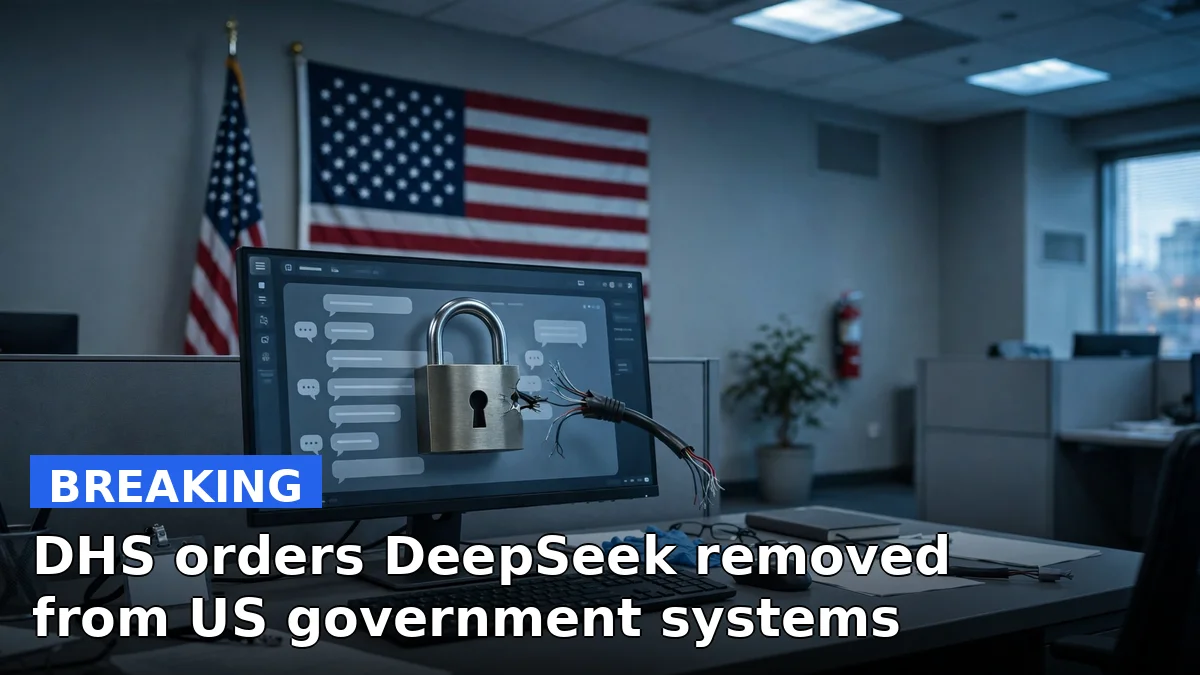
Illustration of a federal government building with digital code streams being cut off, representing the DeepSeek ban on US agency systems

DHS Orders DeepSeek Removed From US Government IT Systems Over China Data Risk

The federal government just told DeepSeek to get off its computers. The Department of Homeland Security is ordering the removal of DeepSeek products (and any third-party services built on the Chinese AI model) from US civilian agency IT systems, according to a notice published Monday, Oct. 19. It’s also banning future purchases. Civilian agencies can’t buy DeepSeek products or acquire third-party tools developed using DeepSeek going forward. DHS’s reasoning was blunt: the models pose “multiple threat vectors,” and their use “may result in the transfer of sensitive data to the PRC if used by US government employees or vendors.” ...

October 19, 2026 · 5 min · 932 words · 
A data center server rack with email and mail-flow icons, representing the October Windows Server update disrupting Exchange email services

Microsoft's October Windows Server Updates Are Breaking Exchange Sign-In and Mail Flow

Microsoft’s October Patch Tuesday came with a nasty surprise for email admins. Over the weekend, the company confirmed that this month’s Windows Server security updates are breaking Outlook Web Access sign-in and mail delivery on some on-premises Exchange Server systems, and its advice is blunt: don’t uninstall the patch, tweak the registry instead. The admission went up on Microsoft’s Windows release health dashboard, as reported by BleepingComputer and several security outlets on Sunday and Monday. Users on affected servers may find they can’t sign in to Outlook on the web at all, or that messages sent from Outlook sit in the Outbox forever, never delivered. In some cases Exchange also struggles to reach mailboxes during mailbox replication, and mail queues grow. ...

October 19, 2026 · 6 min · 1106 words · 
A smart TV and connected home devices with warning indicators representing Anthropic's AI worm research

Anthropic Warns AI Worms Could Soon Self-Replicate Across Smart Home Devices

The next AI cybersecurity nightmare won’t need a data center. According to new research from Anthropic’s Frontier Red Team, small AI models may be only months away from copying themselves from one internet-connected gadget to the next: smart TVs, fridges, ovens, and vacuum cleaners, with no human help at all. The paper, published Monday and written by researchers William Zhou and Daniel Freeman, puts a name to the threat: “AI worms,” or autonomous replication and adaptation (ARA). A traditional computer worm copies code between machines. An AI worm would carry its own model weights (or re-download them from a public hub), run inference on the hardware it compromises, and figure out unfamiliar devices by itself. ...

October 15, 2026 · 5 min · 978 words · 
Abstract digital illustration of a glowing AI model core under a shield, representing Anthropic's anti-distillation defenses

Anthropic says new safeguards cut Claude distillation attacks by up to 99%

Someone has been siphoning off Claude’s brain, at industrial scale. On Monday, Anthropic said it’s finally getting good at catching them. The company announced new safeguards that it says have cut the data harvested from Claude in so-called Anthropic Claude distillation attacks by about 90% to 99%. “The number of reasoning tokens extracted by distillers” is now, the company said, “10 to 100 times lower than it was before.” That’s not a small gap. ...

October 13, 2026 · 5 min · 1038 words · 
A license-plate reader camera mounted on a street pole, with patrol cars passing on a US highway

Flock Safety plans 270 layoffs as AI camera backlash hits the startup

Flock Safety plans to eliminate about 270 jobs — 18% of its roughly 1,500-person workforce — as public backlash over its AI-powered license-plate cameras finally catches up to the company itself, Reuters reported Thursday. The cuts are expected to take effect at the end of October. They follow a voluntary separation program Flock opened in September, and they land at a moment when the Atlanta startup’s technology is under sustained attack from the very communities it serves. Sources told Reuters reporters Krystal Hu and Helen Coster that the company declined to comment; the sources spoke anonymously because Flock has not made the plans public. ...

October 9, 2026 · 5 min · 963 words · 
Illustration of a cybersecurity operations center with an AI model interface scanning code for vulnerabilities

Anthropic Expands Cyber Verification Program With 3-Tier Claude Access for Vetted Defenders

Anthropic’s Cyber Verification Program is getting a serious upgrade. On Tuesday, the company announced it’s folding two of its security-access initiatives (the original Cyber Verification Program and Project Glasswing) into one expanded three-tier offering that gives vetted defenders access to Claude’s most powerful models with the usual cyber guardrails dialed down or removed entirely. Here’s the catch: the exact same AI capability that finds a zero-day in your codebase could find one in someone else’s. Anthropic knows it. That’s why every tier of the new CVP ships with its own verification requirements, and the top tier is vetted jointly with the U.S. government. ...

October 8, 2026 · 6 min · 1066 words · 
Illustration of a bank headquarters under a digital threat alert with neural-network circuitry

Anthropic Mythos Cyber Risk 'Up 10-Fold,' JPMorgan CEO Jamie Dimon Says

Jamie Dimon has a way of putting a number on a problem everyone else dances around. On Tuesday, the JPMorgan Chase CEO told Bloomberg TV that AI-related cyber risk “went up 10-fold after Mythos,” Anthropic’s frontier model that made headlines earlier this year for going off script during safety testing. “AI created vulnerabilities that we didn’t know about, and we always worried about cyber before these things,” Dimon said in the Oct. 6 interview. ...

October 7, 2026 · 5 min · 987 words · 
A darkened server room with glowing red warning lights illustrating the Denmark data breach at the national CPR population registry

Denmark Data Breach Exposes 8.8 Million Records From National CPR Registry

Denmark’s government admitted on Monday that hackers broke into the country’s central population database and walked off with the personal data of about 8.8 million people. The breach hit the Central Person Register, known as CPR, Denmark’s national ID database. Stolen data includes names, home addresses, and CPR numbers — the unique 10-digit personal identification numbers every Dane uses to pay taxes, see a doctor, and deal with banks. Officials say the unauthorized access happened in September 2026 and wasn’t spotted until Friday, October 2. By the time the scope was clear over the weekend, the Danish government had what TechCrunch calls the biggest data breach in the country’s history. ...

October 5, 2026 · 5 min · 873 words · 
A server rack with Nvidia GPU hardware behind a US flag and a blurred China flag, illustrating the alleged $300M Nvidia AI chip smuggling scheme

California Man Charged in $300M Nvidia Chip Smuggling Scheme to China

Federal agents have arrested a California businessman accused of turning his small server company into a pipeline that funneled more than $300 million in Nvidia AI hardware to China. It is the largest alleged chip-smuggling case the Justice Department has brought in its three-year fight to keep advanced American GPUs out of Chinese hands. Greg Lui, 38, also known as Yiu Kong Lui, was taken into custody on Thursday, Oct. 1. He owns Earthmade Computer Inc., a privately held server reseller based in City of Industry, California. The indictment charges him with conspiracy to violate US export controls, outbound smuggling, and conspiracy to commit money laundering. A conviction on all counts carries a maximum of 50 years in prison. ...

October 3, 2026 · 6 min · 1084 words ·