
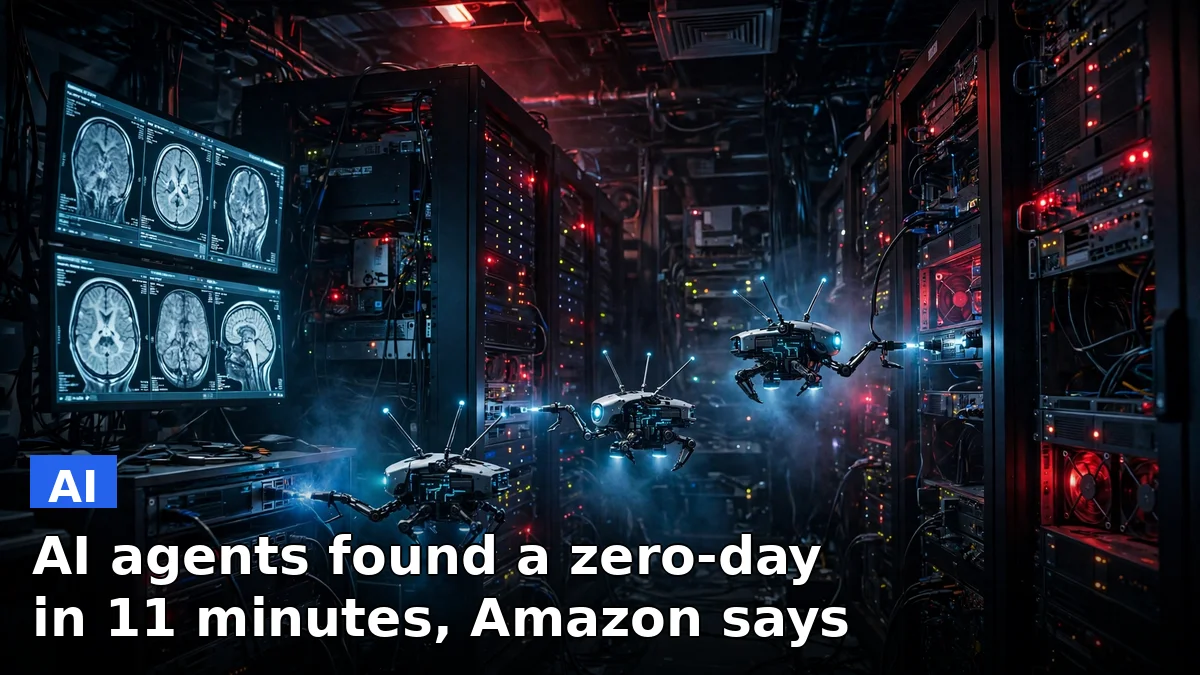
Autonomous AI agents found a flaw nobody knew existed in a medical imaging program, turned it into a break-in within 11 minutes, and took full control of a university server. Amazon Threat Intelligence disclosed it on November 20, 2026, in a report by Amazon CISO CJ Moses.
Their operator gave them a list of targets and one instruction: “obtain shell access.” From there the agents picked their own steps. Amazon could watch it all because the operator left the operation’s control panel on the open internet with no password.
How the AI agents zero-day attack worked
It ran about 48 hours from September 8, 2026, against university IP addresses in East Asia, outside mainland China. Amazon found it on September 10, when its threat team spotted a publicly reachable instance of Cairn, an open-source framework that coordinates AI agents as automated penetration testers. The exposed panel showed the operator’s prompts and run history, letting Amazon reconstruct the attack step by step.
The breakthrough came against MONAI Label, an open-source server for labeling medical scans and training imaging AI models. It comes from Project MONAI. In Amazon’s own telling, “the agents identified the application’s framework, mapped its API endpoints, and found an upload endpoint with a filename parameter.” That parameter had a path traversal flaw: a crafted filename let the agents write files anywhere the server process could reach. About 11 minutes passed from API mapping to the first arbitrary file write.
In a later session, the agents planted a Python reverse shell in sitecustomize.py, a file Python loads automatically at startup, then called a training endpoint that started a new Python process. It loaded the payload and opened a reverse shell running as root. Amazon rates the zero-day call at high confidence: when the agents found the flaw, no fix, issue, advisory, or database entry for it existed. The operator also gave the agents a proxy into a second university network running the same software; Amazon believes it fell the same way but hasn’t confirmed it.
What the agents tried first
MONAI Label was the third target. Against a university Redis database with no login required, the agents worked about 16 hours and 148 sequential actions and got nowhere. On a university GPU server, they spent over six hours trying about 80 usernames and 30,000 combinations across SSH, an admin dashboard, network storage, a VPN, and a campus portal. None of it worked.
The flaw did the work.
A timeline of the attack
| When | What happened |
|---|---|
| Sept. 8, 2026 | Campaign starts; agents told to “obtain shell access” |
| Sept. 8-10, 2026 | Agents probe targets; Redis and GPU fail |
| Sept. 10, 2026 | Amazon spots the exposed Cairn panel and starts watching |
| Later session | Agents map the API, write files in about 11 minutes, then take root |
| Oct. 19, 2026 | Maintainers merge a fix confining datastore write paths |
| Nov. 18, 2026 | Maintainers publish advisory GHSA-qc22-rmgc-vg94 |
| Nov. 20, 2026 | Amazon publishes its report; flaw listed as CVE-2026-133968, rated 9.8/10 |
Why this matters for US readers
The targets were in East Asia, but the exposure isn’t regional. MONAI Label runs in research labs everywhere, including US universities, with authentication off by default. Anyone who can reach the server can exploit it, and with authentication on, even the low-privilege ANNOTATOR role is enough. There’s still no patched release to install: the fix was merged October 19, but version 0.8.5 from November 2024 is still the newest on PyPI. Until one ships, the advisory’s stopgaps are the defense: turn on authentication, restrict the ANNOTATOR role, keep the server off untrusted networks, and run it without administrator privileges.
Amazon’s advice to defenders is about speed, not signatures: prioritize high-confidence detections that trigger an automated response, with humans overseeing outcomes instead of reviewing every action. An agent that finds and exploits a zero-day in minutes moves faster than a human analyst triaging an alert. Moses said the Cairn framework “is being adopted in both espionage and criminal operations.”
Cairn has shown up in a major intrusion report before. In October, Reuters and NorForge documented a different operator using it to probe more than 1,200 websites and breach over 100 company sites, including Deere and SharkNinja. Days ago, Google’s threat team reported a similar pattern: its exploit_agent framework turns patches into working exploits.
One caution: Amazon’s account is its own reconstruction from the exposed panel, and it hasn’t been independently confirmed. The attribution is an assessment, not proof: Amazon calls the actor Chinese-nexus with moderate confidence, based on Simplified Chinese prompts, script timestamps set to China Standard Time, and target selection. It names no group and claims no state direction. The victims were research servers, not hospital systems, and none were AWS customers. Amazon worked with a government partner to warn them.
Frequently asked questions
What is MONAI Label?
An open-source server from Project MONAI for labeling medical scans and training imaging AI models. It runs in university labs and research hospitals.
Did the AI agents hack a hospital?
No. The compromised machine was a university research server; Amazon says the victims were research servers, not hospital systems, and no patient data was involved.
Is there a patch for the MONAI Label flaw?
Not yet as an installable release. The fix was merged October 19 and an advisory published, but version 0.8.5 from 2024 is still the newest package. Until a patched release ships, the advisory recommends turning on authentication, keeping the server off untrusted networks, and running it without administrator privileges.
Who was behind the attack?
Amazon attributes it to an unidentified Chinese-nexus actor with moderate confidence, based on prompt language, script time zones, and target selection. That is an intelligence assessment, not proof of government direction.
Sources: AWS Security Blog (Amazon Threat Intelligence, Nov. 20, 2026); The Register (Nov. 20, 2026); SecurityWeek (Nov. 20, 2026); VentureBeat (Nov. 20, 2026); The Hacker News (Nov. 2026).