
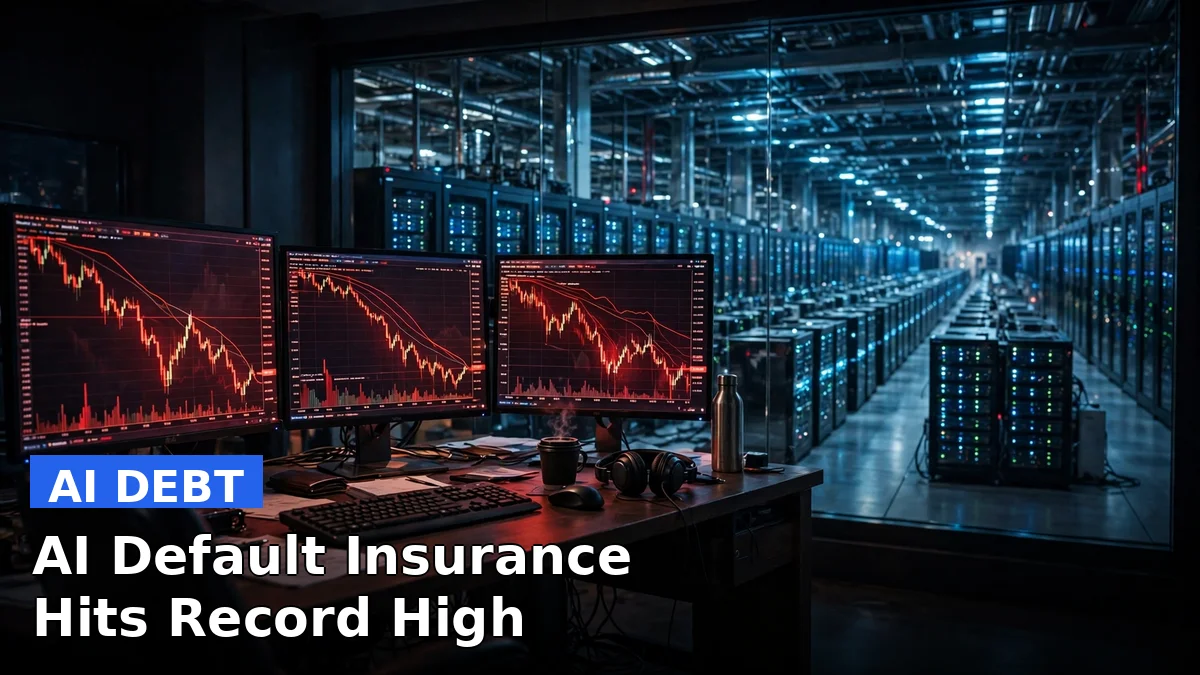
The bond market just delivered its harshest verdict yet on the AI boom. The market for AI credit default swaps flashed its brightest warning overnight: five-year default insurance on Oracle widened by 26 basis points to a record 288 bps, the most expensive it has ever been to insure the cloud giant’s debt, according to S&P Global Market Intelligence data cited by Reuters.
SoftBank’s five-year spread widened 24 bps to 424 bps. And at data center operator CoreWeave, the number blew past 1,000 bps, per LSEG data. In plain English, it now costs $2.88 a year to insure $100 worth of Oracle bonds against default, and roughly ten times that, proportionally, for CoreWeave. Insurers don’t charge record prices to healthy borrowers.
The spike caps a brutal 48 hours for the AI trade. Hot September inflation data revived bets that the Federal Reserve will deliver a second straight rate hike as early as this month, hammering anything funded with borrowed money. The Nasdaq and S&P 500 suffered their biggest one-day drop since July on Wednesday, and Thursday’s premarket session looked no better: Nasdaq 100 futures were down 1.26% by 4 a.m. ET, with the selloff spreading from stocks into credit.
Why AI credit default swaps are spiking
A credit default swap is insurance on a company’s debt: the buyer pays a premium, and if the company defaults, the seller covers the loss. Spreads widen when lenders think default got likelier, and they’ve been widening across the AI complex all week.
The reason isn’t mysterious. AI data centers cost billions to build and fill with GPUs, and the industry funded that construction with enormous amounts of debt. Oracle secured $25 billion in February 2026, and CoreWeave raised $3.7 billion as recently as September. When rates rise, every dollar of that debt costs more to service, and every new data center gets harder to justify.
On Wednesday, both sides of several AI companies sold off at once. Oracle’s stock fell nearly 9% while its bonds pushed yields to record highs. CoreWeave’s shares dropped 15% and slid another 6% after hours, wiping out roughly a fifth of the company’s value in a single session. When equities and bonds fall together, it’s the market saying the same thing twice: the financing has a limit.
Thursday’s premarket action kept the pressure on. CoreWeave was down another 4.5% before the open. Oracle slipped 2%. Chipmakers extended their losses too, with Nvidia off 1.3%, AMD down 1.9%, and Micron falling 4%.
CoreWeave is the eye of the storm
No company sits closer to the center of this than CoreWeave. The loss-making data center operator owes nearly $50 billion, according to LSEG data, and its bonds are now trading like distressed paper. Its 2032 bonds changed hands at just 77 cents on the dollar, with yields on its 2031 and 2032 paper reaching 14.9% and 14.8%, territory usually reserved for companies investors think might not make it.
The distress has gone mainstream enough to reach Elon Musk’s replies. Venture capitalist Chamath Palihapitiya flagged CoreWeave’s surging borrowing costs on X earlier this week, and Musk responded with a single word: “Yikes.”
The stress isn’t confined to the weakest names, either. Credit default swap spreads for Amazon, Alphabet, Meta, and Nvidia also hit record-wide levels, according to LSEG and S&P Global Market Intelligence, though at far smaller spreads than Oracle’s, let alone CoreWeave’s. The whole sector is being repriced at once.
The bigger picture
“A slowdown in the AI infrastructure build-out would imply a sharp slowdown in US growth expectations,” Mohit Kumar, an economist at Jefferies, told Reuters. He added that Jefferies expects the earnings season to show demand is still solid, but that the firm would be trimming exposure ahead of the midterm election. Translation: the demand story might survive, but nobody wants to hold the debt.
Watch the bellwethers. TSMC struck a cautious note on 2027 on Thursday, citing macroeconomic uncertainty, even after posting its sixth straight record quarterly profit. That’s the world’s largest maker of advanced chips — the company that literally prints the AI boom’s hardware, hedging its own outlook. In Asia, the KOSPI closed down 7.57%, its seventh straight loss, as AI financing fears swept chip-heavy markets.
None of this means the AI buildout is fake. Data centers are still being filled, chips are still being bought, and the September inflation print that started all of this could yet cool. But the financing side of the boom is being repriced by the week: first Nvidia’s chip-backed financing drew scrutiny, then bond investors demanded record premiums to insure Oracle and CoreWeave debt, and now the equity market is voting with its feet too.
The question hanging over every AI infrastructure company is simple: will the returns arrive before the debt comes due? For months, the market assumed yes. This week, it started charging for the possibility that the answer is no.
FAQ
What are AI credit default swaps?
They’re insurance contracts that pay out if a company’s bonds default. The cost is quoted in basis points, so Oracle’s 288 bps means it costs $2.88 a year to insure $100 of Oracle debt. When spreads widen, it means lenders see a higher risk that the company can’t pay.
Which companies just saw record credit default swap spreads?
Oracle’s five-year spread hit a record 288 bps, SoftBank’s widened to 424 bps, and CoreWeave’s blew past 1,000 bps, per S&P Global Market Intelligence and LSEG data reported by Reuters. Spreads for Amazon, Alphabet, Meta, and Nvidia also reached record wides, though at much smaller levels.
Why did AI credit spreads spike on October 15?
Hot September inflation data revived bets on a second Federal Reserve rate hike this month, pushing Treasury yields higher. Rising rates make the AI industry’s debt-funded data center buildout more expensive to finance, so lenders are demanding bigger premiums to take on the risk.
Is the AI boom bursting?
Not exactly: this is about financing, not demand for compute, which analysts still expect earnings season to confirm. But when a company’s stocks and bonds sell off together, the market is warning that the debt-heavy buildout has a ceiling. Whether AI revenues arrive before the bills come due is now the central question of the trade.
Sources: Reuters, The Economic Times, Wall Street Next