
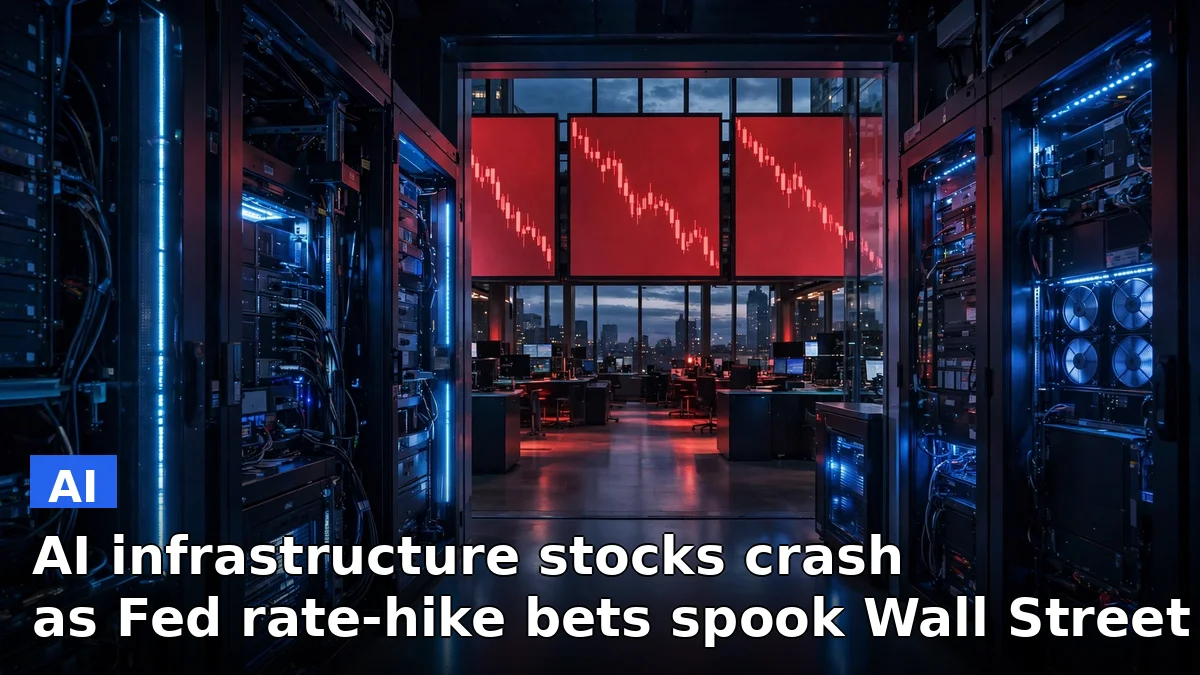
Wednesday was a bruising day for AI infrastructure stocks — the companies building the physical backbone of the AI era. Reuters reports that shares of neocloud firms Nebius and CoreWeave fell 15.1% and 9.5%, respectively, on October 14, as investors priced in a growing chance that interest rates climb higher and make the industry’s debt-fueled expansion far more expensive.
The damage spread fast. Data center operators Applied Digital and IREN dropped 8.8% and 9.9%. Oracle, the debt-heavy hyperscaler betting big on AI, slid 7.2%, with most of its dollar bonds declining too. Server makers Dell and HPE fell 10.3% and 6.4% after Barclays downgraded both to “equal-weight” from “overweight.”
The trigger was inflation data. Hot September consumer price figures pushed up bets that the Federal Reserve could deliver a second rate hike as early as this month, sending the 10-year Treasury yield up 3.6 basis points and the two-year yield up 7.2 basis points. The Economic Times’ live market blog noted the broader indexes sagged as the September inflation print fed those same Fed bets.
This is what the AI trade looks like when money stops being cheap.
Why AI infrastructure stocks got spooked
The AI buildout runs on borrowed money. Data centers cost billions to construct and fill with GPUs, and companies like CoreWeave, Nebius, and Oracle have funded that construction by piling on debt. When rates rise, the math on every new facility gets worse — and on Wednesday, the market decided the math had gotten worse a lot.
“Investors are questioning whether the AI buildout will generate the returns that were expected,” Kim Forrest, chief investment officer at Bokeh Capital Partners, told Reuters. That sentence captures the whole day. The companies riding the 2026 AI rally were some of the worst performers on the main benchmarks — not because demand for compute vanished, but because the financing behind it suddenly looked shakier.
CoreWeave’s stock is now on track to wipe out about a quarter of its value this month, and Nebius is set to erase almost 20%, per Reuters. These are not obscure names anymore: both went public amid enormous enthusiasm for AI cloud computing, and both now trade like proxies for investor anxiety about the whole cycle.
The credit market is flashing red too
The pain wasn’t confined to stocks. The cost of insuring debt against defaults for some AI companies, including Oracle and CoreWeave, surged to record highs, according to S&P Global Market Intelligence data. In plain terms: lenders are charging more than ever to take on the risk that these companies can’t pay their bills.
That matters because the AI boom’s most aggressive expansion plans were drawn up in a cheaper-money environment. Oracle’s cloud and AI push rests on enormous capital spending, and its bonds slid alongside its stock on Wednesday. When both the equity and the debt of a company sell off together, it’s the market saying the same thing twice: borrowing has a ceiling.
Barclays throws cold water on AI servers
Dell and HPE had their own problem on top of the rate scare. Barclays downgraded both server makers, and the note was blunt: “Valuations have run, commodity costs have helped revenues, and we don’t see a meaningful AI inflection yet.” Dell fell 10.3%, HPE 6.4%.
The comment about “meaningful AI inflection” cuts at the bull case. The story behind the 2026 hardware boom was that enterprises would pour money into AI-ready servers in a transformative wave. Barclays is saying the wave hasn’t really shown up — what’s shown up is inflated component prices padding revenue numbers.
Why this matters
One rough day doesn’t kill a buildout. But the pattern forming in October is worth watching: lenders demanding bigger guarantees for Nvidia’s chip-backed financing, bond investors charging record premiums to insure Oracle and CoreWeave debt, and now a broad equity selloff tied directly to rates. The financing side of the AI boom is getting more scrutiny by the week.
Higher rates don’t just raise the cost of the next data center. They force every AI infrastructure company to answer a harder question about the one it already built: will the returns arrive before the debt comes due? If the answer is yes, Wednesday was a buying opportunity. If the answer is no, it was the start of a repricing. Either way, the era of building first and financing later appears to be ending.
FAQ
Why are AI infrastructure stocks falling?
Hot September consumer price data raised bets on a second Fed rate hike as early as this month, pushing up Treasury yields. Higher rates raise borrowing costs for AI firms funding data centers with debt, so the most debt-heavy names sold off hardest.
Which AI infrastructure stocks were hit hardest on October 14?
Nebius dropped 15.1% and CoreWeave 9.5%, according to Reuters. Data center operators Applied Digital and IREN fell 8.8% and 9.9%. Oracle slid 7.2%, while Dell and HPE fell 10.3% and 6.4% after Barclays downgraded both to “equal-weight.”
What did Barclays say about Dell and HPE?
Barclays cut both server makers to “equal-weight” from “overweight,” arguing valuations had run ahead of reality. “Valuations have run, commodity costs have helped revenues, and we don’t see a meaningful AI inflection yet,” the bank said.
Is the AI boom over?
Not necessarily — the selloff is about financing, not demand. But rising rates make debt-funded data centers harder to justify, and record credit-insurance costs for Oracle and CoreWeave show lenders are charging the AI buildout more for risk.
Sources: Reuters, The Economic Times