
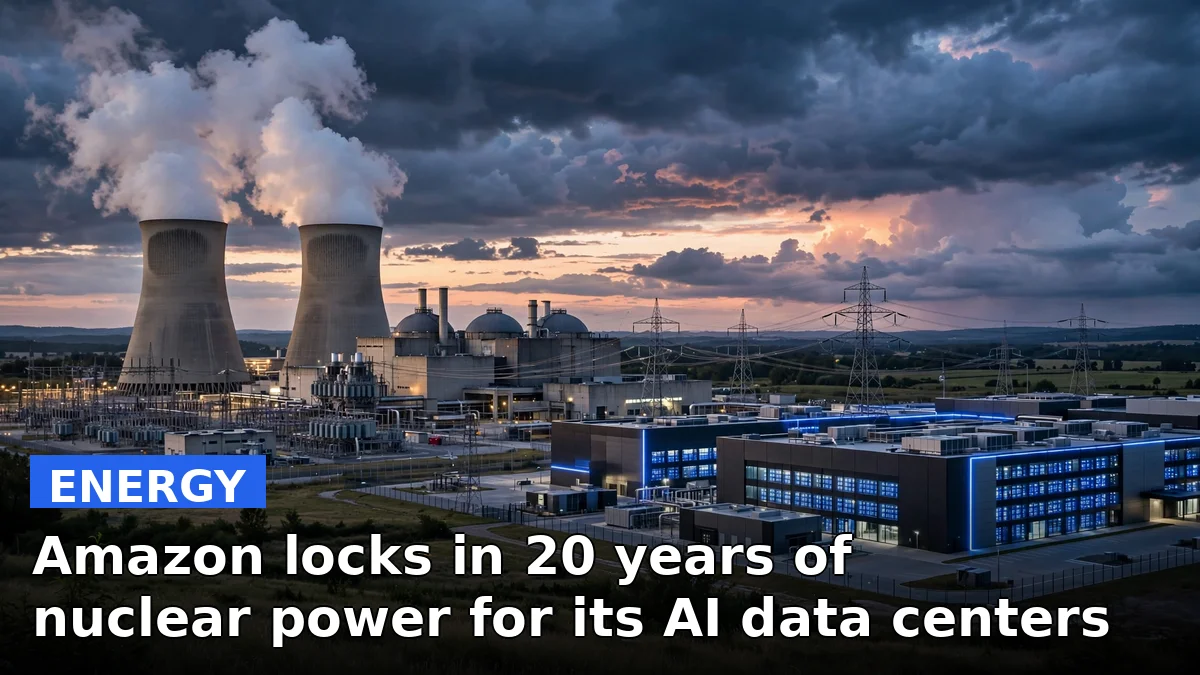
Amazon just bought itself two decades of nuclear power. The company and Constellation Energy announced Wednesday a 20-year power purchase agreement covering 690 megawatts from the Calvert Cliffs nuclear plant in Maryland, a deal that also unlocks more than $3 billion in upgrades to the plant.
Goldman Sachs analyst Carly Davenport called the arrangement “positive for industry broadly,” and investors agreed: Constellation’s stock climbed 3.3% in after-hours trading after the announcement, Barron’s reported.
The deal is Amazon’s first “uprate” project. Instead of building a new plant, Constellation will squeeze more output from Calvert Cliffs through equipment upgrades that add roughly 190 megawatts of new emissions-free capacity, enough for around 200,000 homes. That extra power comes online between 2030 and 2032.
The power, notably, won’t go straight to Amazon’s servers.
What Amazon’s nuclear deal with Constellation actually buys
Calvert Cliffs, in Lusby, Maryland, is the state’s only nuclear plant and its largest carbon-free energy source, producing about 80% of Maryland’s clean electricity and enough power for the equivalent of 1.3 million homes. Amazon’s agreement covers 690 MW out of the plant’s roughly 1,790 MW total generating capacity.
Under the terms, electricity from Calvert Cliffs keeps flowing into the regional grid rather than being physically dedicated to any single Amazon data center. The companies signed a separate but related retail supply agreement to manage Amazon’s power costs across the 13-state PJM power market, where its data centers and facilities operate.
For Constellation, the revenue certainty funds a big bet on old hardware. The company plans to invest more than $3 billion across the 1,790 MW facility and will seek another 20 years of operating authority for the plant’s two reactors. Unit 1’s license expires in 2034; Unit 2’s follows in 2036. According to Constellation, the planned 190 MW increase roughly equals the combined capacity of all of Maryland’s operating utility-scale wind and solar facilities.
Deliveries under the power agreement begin in 2027. Constellation, the country’s largest electricity provider, is also reportedly exploring whether entirely new reactors could be added at the site, according to The Wall Street Journal.
From a scrapped campus to a bigger plant
The deal lands just weeks after Amazon walked away from a different plan: building a data-center campus right next to the plant. The company pulled those plans earlier this year after strong pushback from local residents over environmental, resource, and health concerns.
That backlash has become a national pattern. Communities across the country have turned against data centers amid fears the facilities could push up local electricity prices, and power providers have faced regulatory delays as a result. Barron’s noted that Constellation’s other data-center power deals have slowed this year for exactly those reasons.
So instead of building next door, Amazon is effectively financing the plant’s expansion from across the meter. The electricity still feeds the shared grid. The plant gets its upgrades, and its roughly 800 employees get two more decades of job security. Amazon gets cost certainty across its mid-Atlantic operations without a construction fight.
It’s a cleverer political arrangement than co-location, and it probably wasn’t available a year ago. Utilities used to wait for someone else to sign before committing billions to upgrades. Now the tech companies are signing first.
Why Big Tech keeps going nuclear
“Big Tech, including Amazon, is competing to secure energy for data centers that power artificial intelligence,” the Wall Street Journal noted of the deal. “Nuclear power is seen as an attractive option because it provides stable electricity 24 hours a day with no carbon emissions.”
That’s the whole thesis in two sentences. AI data centers need enormous amounts of power around the clock, and solar and wind can’t promise around-the-clock output. Nuclear can, and it arrives without the carbon accounting headaches that follow gas plants.
Amazon is hardly alone. Tech giants have been signing nuclear deals for several years, but this one stands out for its structure: a long-duration purchase agreement paired with a physical plant expansion, rather than a simple co-location deal or a contract for power that doesn’t exist yet. The uprate approach adds real megawatts to the grid instead of just reshuffling who claims them.
For Maryland, the transaction preserves a long-term source of carbon-free electricity and turns one of the state’s oldest industrial assets into a growth story. For the AI industry, it’s another signal that the power race is becoming the main race.
The bigger picture
Follow the money and the story here isn’t really about Amazon, or even about AI. It’s about who pays for America’s power grid upgrade. For decades, utilities asked regulators and ratepayers to fund capacity expansions. Now trillion-dollar tech companies are stepping in as the anchor tenants, signing 20-year commitments that make multi-billion-dollar upgrades financeable.
That shifts the politics as well as the economics. A 20-year deal with Amazon gives Constellation cover to pursue license renewals and upgrades that might otherwise stall in permitting fights. It also insulates Constellation from the boom-bust cycle of data-center demand, since the retail agreement spreads Amazon’s costs across a 13-state market.
The risk is concentration. If AI demand stalls, these contracts look expensive. If it keeps growing, today’s deals will look cheap. Constellation’s stock is still down this year as investors grew impatient with the pace of profit growth, which tells you the market hasn’t fully bought the story yet.
Amazon just bet $3 billion-plus and twenty years that it has. In the AI power race, that’s no longer an unusual bet. It’s the entry fee.
Frequently asked questions
What is the Amazon Constellation nuclear deal? Amazon and Constellation Energy signed a 20-year power purchase agreement on Sept. 30, 2026, covering 690 megawatts from the Calvert Cliffs nuclear plant in Maryland. The deal also funds a $3 billion-plus expansion that will add about 190 MW of new capacity.
Will Amazon’s nuclear deal power its data centers directly? No. The electricity from Calvert Cliffs keeps flowing into the regional PJM grid rather than being wired to any single Amazon data center. A separate retail supply agreement covers Amazon’s power costs across the 13-state PJM market.
When does Amazon’s nuclear power deal take effect? Power deliveries begin in 2027, while the new 190 MW of uprated capacity from plant upgrades is expected online between 2030 and 2032.
Why is Amazon buying nuclear power instead of renewables? Nuclear plants run around the clock, which matters for AI data centers that need steady, enormous power. Amazon’s agreement also backs a 20-year license renewal effort for Calvert Cliffs’ two reactors, whose permits expire in 2034 and 2036.
Sources: Reuters, Bloomberg, Wall Street Journal, Barron’s