
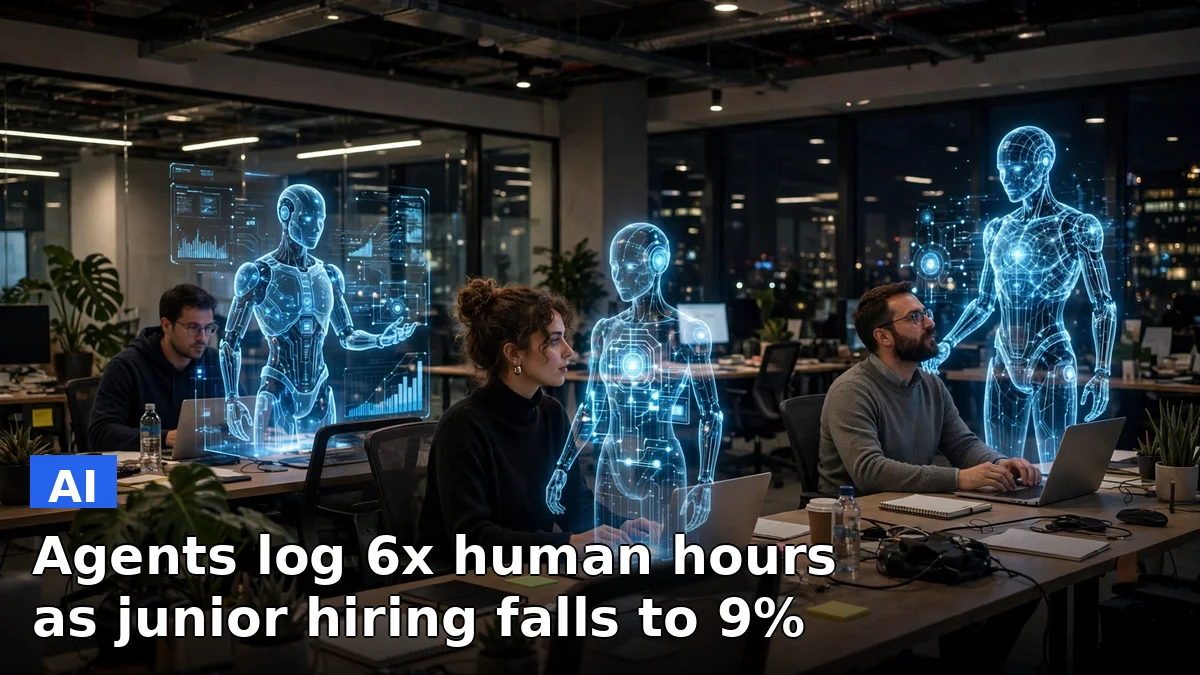
Anthropic just published the most detailed self-portrait yet of what happens when an AI company lets AI agents do real work. The headline number will sting anyone starting a tech career: junior engineers, once 27% of the company’s technical hires, now make up just 9%. The report, “How employment is changing at Anthropic,” was released Friday by the company’s own economists, Nathan Wilmers, Regina Catipon, Maxim Massenkoff, and Peter McCrory at the Anthropic Institute, and it reads like a dispatch from the future of work that is already here.
It is not a think tank’s projection. The team worked from internal employment, AI-use, output, survey, calendar, and hiring records, plus 17 employee interviews. Anthropic is offering itself as a leading indicator of how AI shifts work across the economy. One employee interviewed for the study put the shift bluntly: “I think we’ve already moved past the point of Claude augmenting away the really entry-level admin type role.”
The junior pipeline is thinning fast
The hiring numbers are the report’s lead finding for a reason. Since early 2025, the share of junior-level employees in Anthropic’s technical departments slipped from 21% to 14%. The decline among new hires was steeper: junior technical hires fell from 27% to 9%.
The drop has a clear timeline. Talk of weaker demand for junior technical staff surfaced in core teams in January 2026. In an April 2026 survey, around a third of machine learning managers and a fifth of software engineering managers said they were hiring less because of AI. Postings for junior roles have fallen especially sharply since December 2025.
Here’s the wrinkle. Anthropic did not shrink. The company tripled in size over the past year, and technical hiring grew in absolute terms. Sales, finance, and recruiting just grew faster — technical departments now make up 56% of the workforce instead of 61%. One hiring manager told the researchers about the moment things tipped: “the thing that raised eyebrows was the uplift for performance engineers in particular and it basically overnight changed what we were looking for.”
Agents now outwork the humans who direct them
The hiring shift tracks directly to how the work is getting done. In March 2026, the combined hours of Anthropic’s autonomous and interactive AI agents passed human work hours for the first time. By August, interactive agents, the ones individual employees direct, were logging roughly six hours for every one worked by their human handlers, measured against an assumed 40-hour week.
Output moved with it. Code commits per engineer are running at about five times their level of six months earlier. To separate AI’s effect from the company’s growth spurt, the researchers compared 192 engineers who adopted coding agents with 74 who had not. The adopters’ output rose sharply after adoption, and the finding that gives the rest credibility: agent-written code was removed or reverted at the same rate as code the same person wrote by hand.
The gains were not limited to engineering. Lawyers processed more contracts, accounts payable cleared more invoices, salespeople closed more deals. And non-technical employees got in on the act: coding agent sessions by staff with no coding background went from 2 per month in August 2025 to 90 in May 2026. One sales rep built a custom dashboard in three to four hours, a project that had been, in their words, “out of my wheelhouse.”
The job is becoming the job of managing agents
The most interesting section of the report isn’t the hiring figures. It’s the description of how daily work has deformed around the agents.
The researchers call it “meta-work”: building visibility tools, monitoring agent pipelines, checking outputs. Between fall 2025 and spring 2026, meta-work grew from 10% to 22% of the average employee’s interactive Claude sessions. Supervision became the job.
Meanwhile the median employee spent 20% more time in meetings than a year earlier. The report says staff called face-to-face coordination indispensable: when everything else can be delegated, deciding what matters is what remains. Another unnamed employee framed the new default this way: “that 20% that was strategic becomes 90% of the job.”
Hiring itself is changing shape. Managers now emphasize “autonomy and judgment” and effective AI use at interviews, while giving less weight to narrow domain expertise and execution skills. Mentions of AI tool proficiency climbed from around 5% to 15% of technical role assessments, and from 7% to 28% for non-technical ones. The scarce resource, the report argues, is human attention: reading all the output of an employee’s interactive agents would take half the work week even for non-technical staff.
Why the Anthropic AI jobs report matters
Anthropic is grading its own homework, and that caveat runs through everything. The figures describe one company, measured with its own internal data, over a year in which it tripled in size. Adoption was not random, so the productivity comparisons are not a controlled experiment. The report gives percentages without absolute headcounts, and Anthropic concedes that protections for current employees “do not help people who were never hired.”
Still, the report matters precisely because no one else has published anything this granular. Most debate about AI and jobs runs on anecdotes and layoffs trackers. Here is a frontier lab showing its own telemetry: junior hiring down two-thirds in share terms, agents outworking humans six to one, 5x commit velocity, and the hiring bar shifting from “can you do the task” to “can you direct the thing that does the task.”
That last shift is the part worth watching. If Anthropic is a leading indicator, the entry-level rung isn’t being removed by mass layoffs; it’s being narrowed by hiring bar. Fewer juniors get in, but the ones who do spend their days managing agents rather than writing boilerplate. Anthropic says it has built an early warning system for jobs at risk and prioritized internal redeployments. Whether other companies will do the same is an open question the report doesn’t answer.
One number to keep in your back pocket: Anthropic’s staff told the researchers they expect AI to handle 75% of their work by 2030, against 28% for other Americans. The gap between those two figures is where the next labor fight will be.
FAQ
What did Anthropic’s AI jobs report find?
The report found the junior share of Anthropic’s technical hires fell from 27% to 9% since early 2025, while interactive AI agent hours grew to six times employee hours by August 2026. Code commits per engineer hit five times their level of six months earlier.
Did AI agents replace Anthropic employees?
Not in the layoff sense. Anthropic’s technical hiring still grew in absolute terms, and the company tripled in size. What changed is the mix: fewer junior hires, more output per person, and employees spending more time managing agents.
What is “meta-work” at Anthropic?
The report defines meta-work as building visibility tools and monitoring agent pipelines: basically the work of supervising AI instead of doing the task directly. It grew from 10% to 22% of employees’ interactive Claude sessions between fall 2025 and spring 2026.
Does this prove AI is killing junior tech jobs everywhere?
No. It is a single-company study, based on Anthropic’s own internal data, over a year when the company tripled in size. Adoption was not random, and Anthropic itself cautions that its employment practices cannot be replicated across the economy.
Sources: TechCrunch, AI Weekly, Blockchain.News