
The AI compute gold rush just took another strange and very expensive turn.
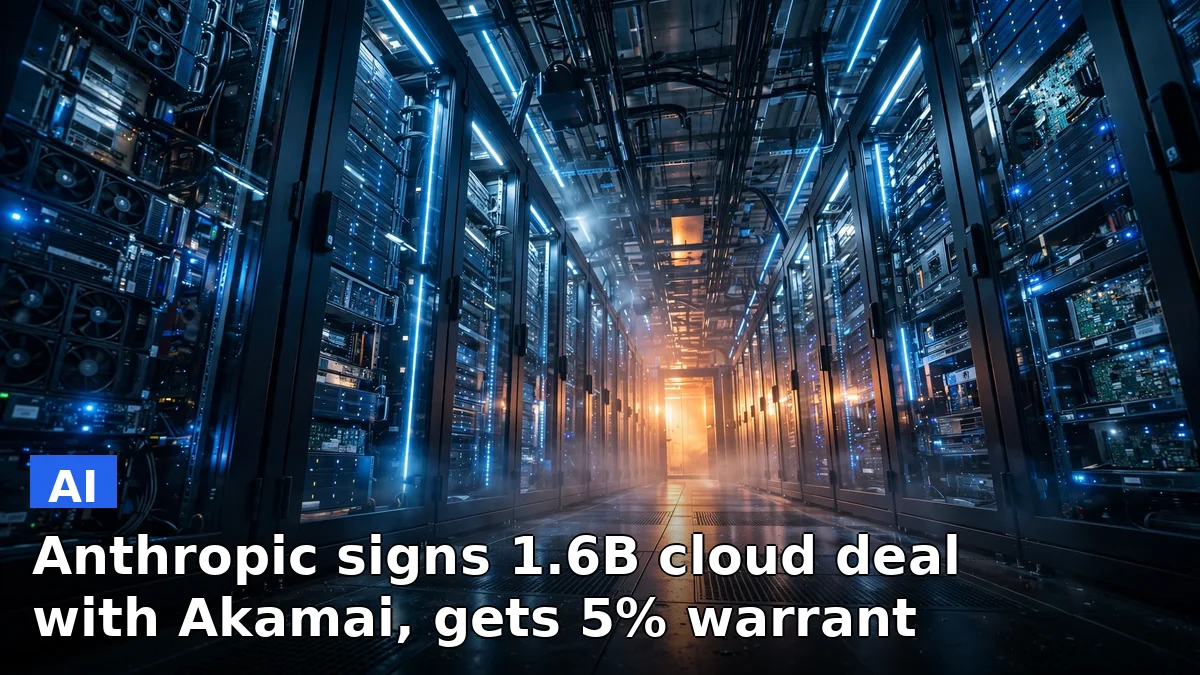
Akamai Technologies said Thursday, September 24, 2026, that it signed an $11.6 billion cloud services agreement with Anthropic — the largest AI customer commitment in Akamai’s history. The seven-year contract can grow by another $9 billion, pushing the potential total to about $20 billion. Investors liked the math: Akamai shares surged 22% in extended trading after the announcement, Reuters reported.
Here’s the twist that got Wall Street talking. As part of the contract, Akamai handed Anthropic a warrant to buy roughly 7.7 million of its shares at $111.33 apiece. If Anthropic spends enough to vest the whole thing, the AI lab could own about 5% of the company selling it the servers.
That’s one way to hedge your cloud bill.
What the Anthropic Akamai cloud deal includes
The base commitment is $11.6 billion over seven years for Akamai’s cloud infrastructure. About 2% of Akamai’s outstanding stock is expected to vest against the initial commitment, according to the securities filing. The remaining 3% vests in steps of roughly 1% for every additional $3 billion Anthropic commits. Anthropic must pay cash to exercise the warrant, and vested portions can be exercised for seven years. The warrant covers non-voting convertible preferred stock and can only be transferred within Anthropic itself.
Anthropic isn’t buying a new data center, either. The lab is tapping Akamai’s existing distributed cloud platform rather than funding a fresh buildout, Investor’s Business Daily reported. And the capacity covers CPU workloads, not a dedicated GPU training operation.
Akamai estimates it will spend about $5.5 billion in total capital expenditure to deliver the $11.6 billion commitment. That includes roughly $1.7 billion added to its 2026 capex to pre-buy supply-chain components such as memory. The company said it expects no change to its 2026 revenue guidance.
Why CPUs, not GPUs
The most telling detail of the deal isn’t the dollar figure. It’s the chips.
Anthropic is buying CPU capacity for AI inferencing — the day-to-day work of actually running Claude for business customers — rather than the GPU clusters needed to train new models. That’s a signal the lab’s biggest near-term compute appetite isn’t training at all. It’s serving.
Raymond James analyst Frank Louthan put it bluntly in a note to clients: “We believe CPUs are more power-efficient and cost less to acquire and deploy than GPUs, which should drive higher margins.”
General-purpose CPUs had been fading from the AI conversation since Nvidia’s GPUs took over data centers. Demand for them appears to be back, since CPUs handle running code, browsing the web, and the always-on background work that AI agents need. As one industry observer put it, inference is where the meter runs — training is a one-time event, but answering billions of queries never stops.
Akamai’s biggest AI win
For Akamai, this is a transformation-sized deal. The company earns most of its sales from content delivery and cybersecurity, but it has been pushing into cloud computing in search of growth. The Anthropic contract is the largest in its history and adds to more than $2.8 billion in multi-year cloud infrastructure deals Akamai announced this year, Reuters reported.
“Anthropic is advancing the AI revolution and we are thrilled they chose Akamai’s capabilities for building and operating AI infrastructure at scale,” co-founder and CEO Tom Leighton said in the announcement. Speaking with Bloomberg, Leighton went further: the cloud business is “growing obviously extremely fast,” and cloud-contract revenue could eclipse Akamai’s other segments “fairly soon.”
The deal also builds on a smaller one. In May 2026, Bloomberg reported that Anthropic was the unnamed customer behind a $1.8 billion Akamai cloud agreement.
Why this matters
Anthropic has been on a compute-buying spree that now stretches across the map. Last month it agreed to spend $45 billion renting AI cloud capacity from Nscale’s West Virginia data center campus, Reuters reported. Weeks earlier it signed a $35 billion deal with Lambda, an Nvidia-backed cloud provider, for a Texas data center project developed by Hut 8. It has also cut compute deals with Google, SpaceX, and AMD.
The pattern is the same everywhere. AI labs are locking up years of capacity in advance because they can’t afford to run out — and when a lab signs the check, the cloud provider hands back equity. Procurement and investment, in one motion.
“Despite growing concerns about potential adverse consequences of agentic AI, infrastructure investment will continue to expand to support increasingly compute-intensive agentic workloads,” eMarketer analyst Jacob Bourne told Reuters. He called the warrant structure a vote of confidence in the durability of AI-driven cloud demand.
Whether that confidence holds depends on one thing: people and companies keep using AI agents at a pace that justifies the servers. So far, both sides of this deal are betting they will.
Frequently asked questions
How much is the Anthropic Akamai cloud deal worth?
Anthropic committed to $11.6 billion in cloud services over seven years. The contract can expand by another $9 billion, bringing the potential total to about $20 billion.
Why is Anthropic buying CPUs from Akamai instead of GPUs?
The deal covers CPU workloads for AI inferencing — running Claude for real business tasks — rather than GPU clusters for training new models. Analysts say CPUs are cheaper and more power-efficient for this work.
What does the warrant give Anthropic?
The right to buy about 7.7 million Akamai shares at $111.33 each, which could add up to a 5% stake. Roughly 2% vests with the initial $11.6 billion commitment; the rest vests in 1% steps for every extra $3 billion Anthropic spends.
Why did Akamai stock jump on the news?
Akamai shares rose 22% in extended trading on September 24. The deal is the largest AI customer commitment in the company’s history, and CEO Tom Leighton told Bloomberg the fast-growing cloud business could soon eclipse Akamai’s other segments.
Sources: Reuters, Bloomberg, Investor’s Business Daily.