
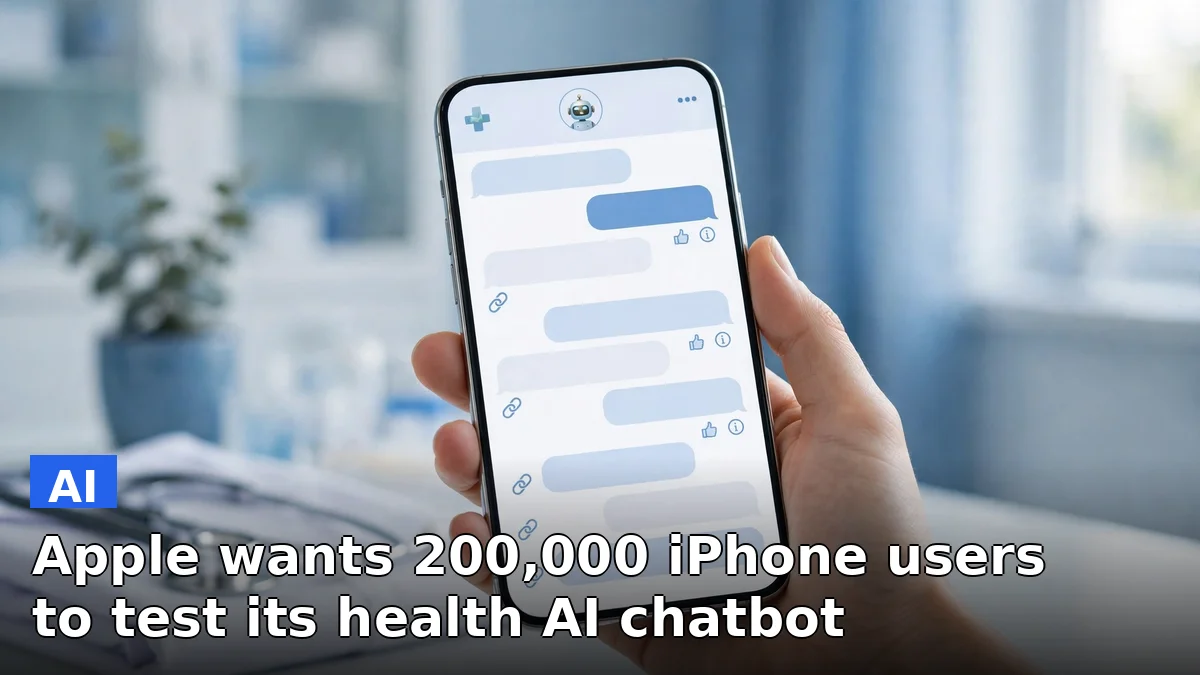
Apple wants 200,000 iPhone owners to ask a chatbot about their health. The company announced the Apple Health AI Usage Study on Sunday, November 15, at the HLTH conference in Las Vegas, and the study app is already available to download in the US.
The study runs with OpenEvidence, a clinical AI platform doctors already use, and it will last more than 12 months. Participants can ask everyday health questions and get answers drawn from peer-reviewed medical journals, including The New England Journal of Medicine, JAMA, and Nature.
Enrollment is open to US residents who are 21 or older. They need an iPhone 15 Pro or newer running iOS 26 or later. The study app itself runs separately from Siri and Apple Intelligence, The Verge reported, and participants can rate each answer for accuracy, detail, and relevance.
Apple isn’t selling a product here. It’s running an experiment.
How the Apple Health AI study app works
Inside the app, users type health questions the way they would ask ChatGPT or Claude. What comes back is different in one specific way: every answer carries links to the peer-reviewed clinical sources behind it, so a user can check the claim instead of taking the chatbot’s word for it.
Participants can also choose to connect their own health data through HealthKit. That covers resting heart rate, activity, sleep, and lab results, and sharing any of it is opt-in. The idea is that the chatbot can give more relevant answers when it knows something about the person asking, though Apple stresses that nobody has to share anything to take part.
Participants will also fill out monthly surveys about the experience, TechCrunch reported, which is how Apple plans to track whether the answers actually change what people do.
Safety checks sit on top of the whole thing. Apple says the app is built to spot certain concerning questions and steer the person toward a healthcare provider or other resources, rather than answering as if nothing were wrong.
What happens to your data
Apple drew a firm line on privacy for this one. Study data will not be used to train AI models, the company said, and data is anonymized before it is sent to a secure third-party cloud provider. OpenEvidence deletes query and response data after 24 hours.
That matters because health questions are about as personal as data gets. A chatbot that remembers what you asked about a symptom or a medication is a different proposition from one that forgets within a day, and Apple clearly wants participants to know which kind they’re dealing with before they sign up.
Dr. Sumbul Desai, Apple’s vice president of Health and Fitness, said the study will examine what drives consumer trust, the quality of health AI responses, and whether conversational AI can drive behavior change.
Why Apple is doing this now
People already ask general-purpose chatbots about symptoms, test results, and treatment options. Apple wants to find out whether they trust those answers, understand them, and actually do anything differently because of them. “The Apple Health AI Usage Study, conducted in collaboration with OpenEvidence, will evaluate trust, comprehension, and real-world health AI engagement,” the company said in its announcement.
OpenEvidence is a serious partner for that question. The platform is used by more than 703,000 clinicians a month as of mid-2026, according to Chief Healthcare Executive, which gives its answers a clinical grounding that a general chatbot doesn’t have. Daniel Nadler, OpenEvidence’s CEO, has built the company around citing the medical literature rather than summarizing it from memory.
Apple is also laying groundwork elsewhere in health. On November 3, the company made a redesigned Health app available to developers in the iOS 27.3 developer beta, and it plans to release it as a free software update by the end of the year. Apple hasn’t said whether anything from this study will end up in the Health app or Siri, but the timing is hard to ignore.
What the study won’t do
The limits here are explicit, and Apple repeated them in its announcement. The app is not designed to diagnose or treat any condition, and it does not replace advice from a medical professional. Anyone looking for a diagnosis should talk to a doctor, not a research app.
That framing also keeps Apple on the right side of a line the whole industry is watching. Regulators have started asking hard questions about AI tools that give health advice, and a study that measures trust and comprehension is a much safer place to learn than a consumer product that hands out answers with no oversight.
For now, the study is US-only, capped at 200,000 people, and open to anyone who meets the device and age requirements. Apple hasn’t said how long enrollment will stay open or when it will publish results. If the cap fills, the waitlist question answers itself.
FAQ
What is the Apple Health AI study?
The Apple Health AI Usage Study is a virtual research study, announced November 15, 2026, that lets participants ask a medical AI chatbot health questions through a dedicated iPhone app. Apple is running it with OpenEvidence to learn how people trust, understand, and act on AI-generated health information.
Who can join the Apple Health AI study?
Enrollment is open to up to 200,000 eligible US residents who are 21 or older. Participants need an iPhone 15 Pro or newer running iOS 26 or later, with Apple Intelligence enabled.
Does Apple use my health data to train AI models?
No. Apple says study data will not be used to train AI models. Data is anonymized before it goes to a secure third-party cloud provider, and OpenEvidence deletes query and response data after 24 hours. Sharing HealthKit data is optional.
Can the Apple Health AI study app diagnose me?
No. The app is a research tool, not a medical device. It is not designed to diagnose or treat any condition, and it does not replace advice from a doctor. It includes safeguards that flag concerning questions and point users toward a healthcare provider.
Sources: TechCrunch, The Verge, Engadget, MacRumors, Healthcare Dive, PYMNTS