
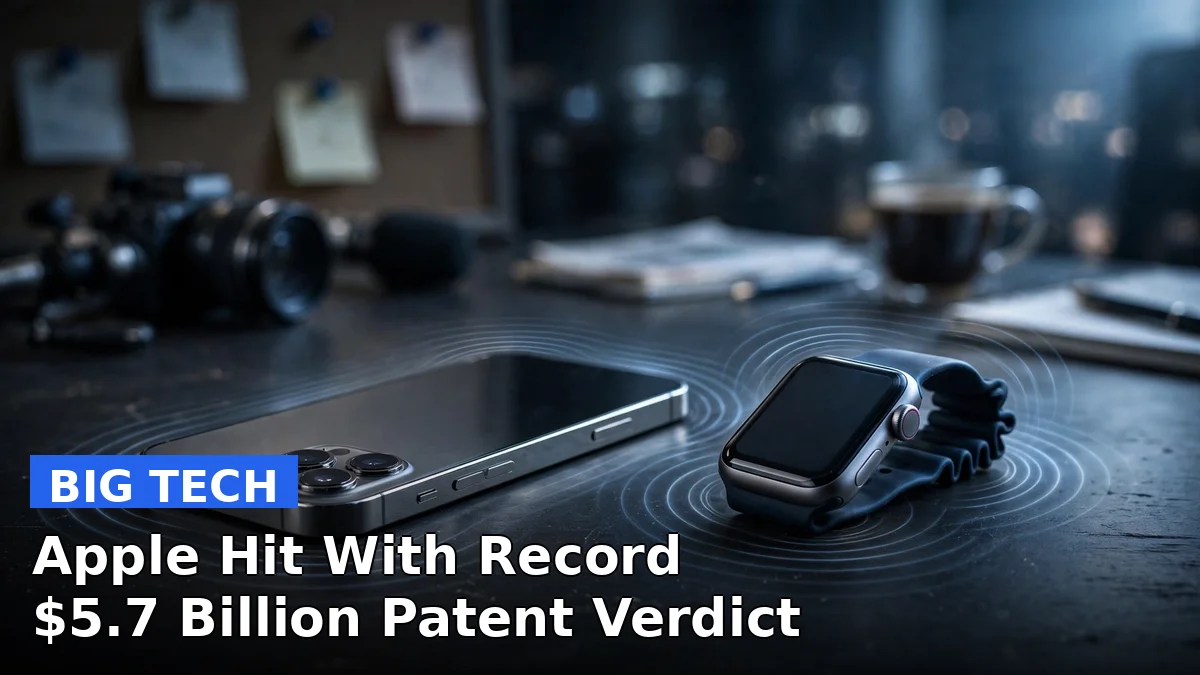
A federal jury in San Diego ordered Apple to pay $5,721,961,750 to Taction Technology on Friday, ruling that the Taptic Engine in iPhones and Apple Watches infringes two of the small company’s haptic patents. Reuters describes it as the country’s largest such verdict to date.
Seven jurors heard the case after a trial that opened September 14. They deliberated two days and returned the verdict Friday afternoon. The Apple $5.7 billion patent verdict lands as one of the biggest patent damage awards in American legal history, period.
Don’t expect Apple to write the check anytime soon.
What the jury found
The case turned on two patents, U.S. Patent Nos. 10,659,885 and 10,820,117, which cover damped tactile transducers — the hardware that lets a device buzz back at you when you tap it, rather than just click. The jury found Apple infringed claims 17 and 19 of the first patent and claim 16 of the second.
Taction had argued that Apple built its Taptic Engine, the linear-actuator hardware behind keyboard feedback, Apple Pay confirmations, and notification taps across iPhones and Apple Watches, on top of that technology without a license. According to reporting from The Verge and AppleInsider, Taction told the court Apple bought two of its Kannon gaming headsets and reverse-engineered the internals.
One detail will matter a lot going forward: the jury did not find Apple’s infringement willful. That distinction decides whether a judge can triple the damages. Without willfulness, the $5.72 billion stands as the ceiling, not the floor.
Apple’s response
Apple isn’t treating this as settled. The company denied using Taction’s technology and said it would appeal.
“Apple’s Taptic Engine is fundamentally different from Taction’s technology, which Taction’s own testing of Apple’s products confirmed during trial,” Apple said in a statement to Reuters. “Apple does not use Taction’s technology, and we will appeal.”
Taction’s lead attorney Lance Yang took the opposite view: “We’re happy the jury found for Taction and vindicated its patent rights.”
The road back from a 2023 dismissal
This verdict nearly never happened. In 2023, a San Diego federal judge granted Apple summary judgment of noninfringement, effectively killing the case before it reached a jury. The U.S. Court of Appeals for the Federal Circuit vacated that decision in August 2025 and sent the case back, which is what led to this month’s trial.
That back-and-forth is worth keeping in mind, because it previews what comes next. The appeal process for a verdict this size typically runs through post-trial motions, a Federal Circuit appeal, and possible rehearing requests. Cases of this scale have a way of settling for a fraction of the headline number before the final gavel falls.
Why this matters
The Taptic Engine is one of those parts of the iPhone nobody thinks about until it goes wrong. It was introduced with the original Apple Watch in 2014 and now lives in hundreds of millions of devices. That installed base is exactly why the damages number is so enormous — even a modest per-device royalty, multiplied across every iPhone and Apple Watch sold over the accused period, compounds into billions.
For Apple, the immediate financial risk is small. The company holds more cash than most countries. The strategic risk is the precedent: a tiny San Diego haptics firm just won a jury verdict against the world’s most valuable company, and every patent holder with a claim against a flagship smartphone feature is watching.
FAQ
Why was Apple ordered to pay $5.7 billion?
A San Diego jury found Apple’s Taptic Engine in iPhones and Apple Watches infringed two haptic-technology patents owned by Taction Technology, and awarded $5,721,961,750 in damages — the largest patent verdict against a tech company in U.S. history.
What patents did Apple infringe?
U.S. Patent Nos. 10,659,885 and 10,820,117, which cover vibration-based tactile transducers. The jury found infringement of claims 17 and 19 of the first patent and claim 16 of the second, but did not find the infringement willful.
Will Apple actually pay the $5.7 billion?
Not yet, and possibly never in full. Apple said it will appeal the verdict, and post-trial motions and appellate review could reduce or overturn the award before anything is paid.
Who is Taction Technology?
A San Diego-based haptics company that uses its tactile vibration technology in headphones and gaming headsets. It sued Apple in 2021, alleging Apple reverse-engineered its technology from two Kannon gaming headsets.
Sources: Reuters, The Verge, CNBC, AppleInsider