
Apple finally put a date on its smart home plans.
The company announced Thursday that it will hold a “Welcome Home” product launch on Tuesday, October 13, 2026. Greg Joswiak, Apple’s senior vice president of Worldwide Marketing, posted a 17-second teaser on X showing hands stitching the company’s retro rainbow logo into fabric before the tagline appears: “Welcome home. October 13.” Media invitations went out at the same time, pointing to an “Apple Experience” in Tribeca, New York, at 9:00 a.m. ET.
That’s an odd label for Apple. It called the March 4 gatherings this year “experiences” too, and those were small press sessions rather than full Apple Park keynotes. Apple hasn’t said whether October 13 will include a public livestream, so for now the only confirmed audience is reporters in a room in Manhattan.
But the tagline is doing a lot of work. “Welcome home” lines up neatly with years of reporting that Apple is about to push hard into the smart home, a category where Amazon’s Echo Show and Google’s Nest Hub have been running unopposed by Cupertino for nearly a decade.
Apple’s smart home hub is the headliner
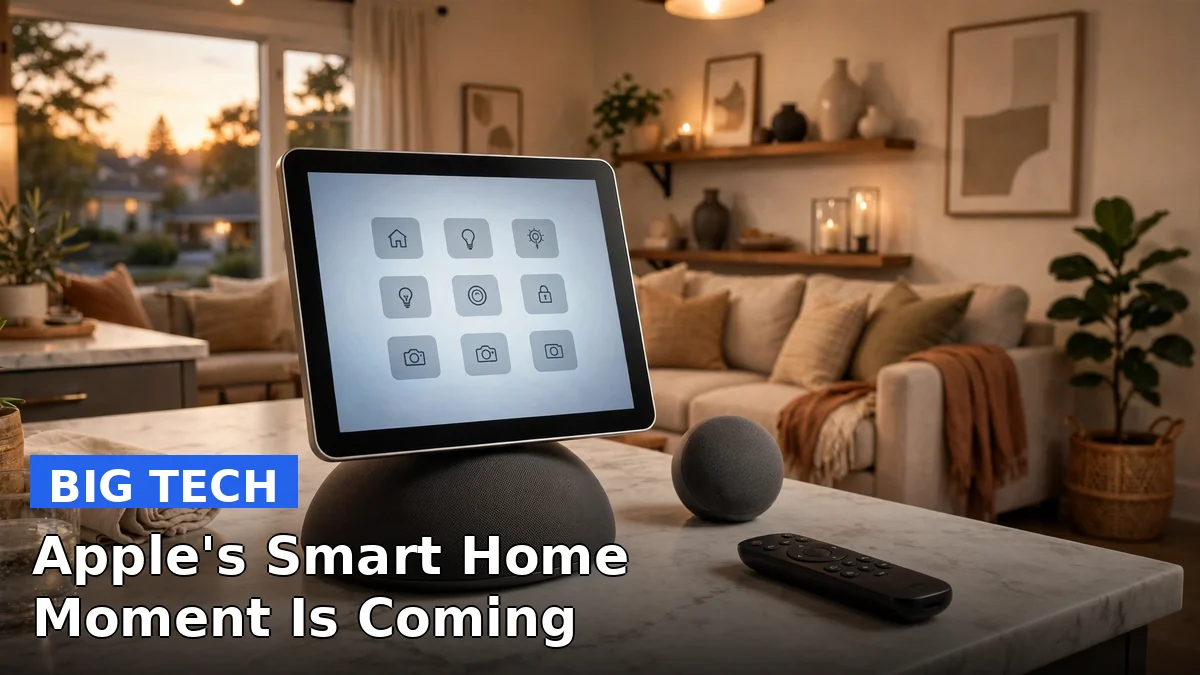
The centerpiece, per Bloomberg’s Mark Gurman, is Apple’s first-ever smart home hub, a product often referred to in coverage as HomePad. The device is described as a cross between an iPad and a HomePod: a roughly 6-inch square display built for shared household use, where voice is the main input and Siri AI handles lights, locks, FaceTime calls, video, news, weather, and calendar items.
Two form factors are expected. One, known internally as J490, puts the screen on a half-dome speaker base (picture a HomePod mini cut in half) on a tilting metal arm. The other, codenamed J491, is designed for the wall with a magnetic mounting system. Apple reportedly wants you to buy more than one, one per room.
The software is said to be a new operating system built on tvOS, with an interface that splits the difference between tvOS, watchOS, and iOS. Icons, widgets, apps, customizable clock faces. A camera and presence sensor would recognize who’s in the room and surface a personalized layout of messages, calendar, and contacts, with a guest mode that keeps your personal stuff hidden from visitors. One neat detail from reporting: interface elements grow larger as someone walks closer to the screen.
The hub has been delayed for years (it was originally planned for 2024), reportedly while Apple waited on a more capable Siri. Siri AI entered beta on existing Apple devices in September, and the hub’s demos are expected to revolve entirely around what it can now do.
HomePod mini and Apple TV finally get their turns
Alongside the hub, two products that have been sitting untouched for years are reportedly getting refreshes. The HomePod mini hasn’t been updated since 2020; the Apple TV set-top box hasn’t since 2022.
The new HomePod mini is expected to keep its current design while gaining faster processors to run Siri AI, an N1 networking chip for better Wi-Fi and Bluetooth, and new colors. Leaked artwork points to green, pink, blue, white, and black, with the current orange and yellow apparently on the way out. The Apple TV 4K is expected to get an A19 or A19 Pro chip, a RAM upgrade, the same N1 chip, and an upgraded Siri Remote. Both are positioning moves: making sure every screen and speaker in the house can actually run the assistant Apple keeps promising.
Gurman has also reported that Apple is working with LG on a line of co-developed smart home accessories: video doorbells, smart locks, thermostats, and indoor, outdoor, and floodlight cameras, with images of several leaking recently. Whether any of those make Tuesday’s stage is genuinely unclear. Reports have been cagey about whether they’d carry Apple’s branding or simply work with its ecosystem, so treat that as the least certain part of the day.
Siri AI is the whole bet
Strip away the hardware and the story is Siri. The assistant has been the punchline of the smart home for years, and Apple knows it. Everything about this event — the hub’s voice-first design, the processor bumps in the mini and Apple TV, the LG accessories feeding it more devices to control — amounts to infrastructure for a Siri that can finally compete with what’s on Echo and Nest.
There’s also a second date floating around. Bloomberg has reported Apple may hold another event on October 27 for new Macs: a touchscreen MacBook (possibly marketed as “MacBook Ultra”), M6 MacBook Pro and iMac models, and an OLED iPad mini. None of that is expected on the 13th, and Apple hasn’t confirmed it. But if the rumors hold, this is shaping up to be Apple’s busiest October in years.
Why this matters
Apple has the most locked-in user base in consumer tech and somehow the weakest smart home story. A hub that actually works with Siri AI would give the company a beachhead in millions of living rooms where the TV already says Apple TV on it. The risk, as always with Apple late entries, is that arriving years after Amazon and Google means competing on polish rather than price, and a rumored $350 price tag, if accurate, would position the hub far above the Echo Show and Nest Hub devices it competes with.
We’ll know Tuesday at 9 a.m. ET.
Frequently asked questions
When is Apple’s “Welcome Home” event?
Apple’s “Welcome Home” event is scheduled for Tuesday, October 13, 2026, at 9:00 a.m. ET. It’s billed as an “Apple Experience” press gathering in Tribeca, New York. Apple hasn’t yet confirmed whether there will be a public livestream.
What will Apple announce at the October 13 event?
Reporting points to three products: Apple’s first smart home hub (a roughly 6-inch smart display with a speaker base), the first HomePod mini refresh since 2020, and the first new Apple TV set-top box since 2022. All three are expected to be built around Siri AI.
What is Apple’s smart home hub?
Often called HomePad in coverage, it’s described as a cross between an iPad and a HomePod: a square touchscreen display meant for the whole household, with voice-first control, FaceTime, an intercom feature, and smart-home controls. Bloomberg’s Mark Gurman reports both a tabletop version with a speaker base and a separate wall-mounted model, with facial recognition to personalize the screen for whoever’s in the room.
How much will Apple’s smart home hub cost?
A price around $350 has been floated in reporting, but it is unconfirmed. If the hub is unveiled on October 13, expect real pricing and availability details then.
Sources: Bloomberg News (via MacRumors, MacDailyNews, iClarified, iPhone in Canada), MacRumors, Gadgets360, MacTrast.