
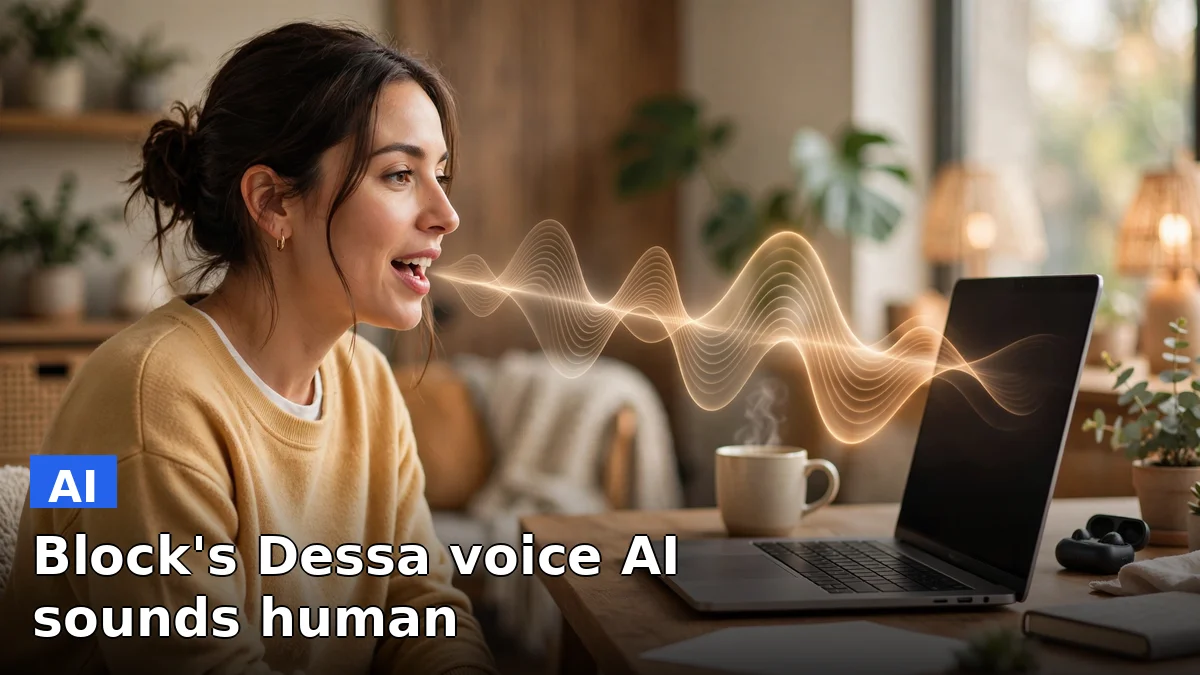
Jack Dorsey’s payments company Block has built a voice AI that never learned to read. On October 23, 2026, Block unveiled Dessa, a speech model it says was trained from scratch on nothing but recorded human conversation — no text, no pretrained models, no transcription step in between.
The result, in Block’s own demo recordings, is unsettling. Dessa laughs mid-sentence. It cuts in. It sounds tired when it says it’s tired from work. Dorsey called it “the most authentic full-duplex speech model ever built” in a post on X, adding that “talking with it feels like talking with a person… full of emotion, nuance, pauses, and a natural cadence.”
And unlike the giant models that need a data center, Dessa runs locally on a MacBook Pro with an M4 Max chip or better. Block says it trained the model on a single Nvidia GB200 NVL72 system — one rack, not a warehouse of them.
What Dessa actually does
Full-duplex is the key word. Most voice assistants are half-duplex in practice: you talk, they listen, they answer. Dessa talks and listens at the same time, the way people do in a real conversation. Audio goes in, audio comes out, and nothing gets flattened into text along the way.
That matters because text throws away most of what makes speech human. A transcript can’t carry sarcasm, a sigh, a nervous laugh, or the difference between “yeah” as agreement and “yeah” as “I’m barely listening.” Block’s argument is that today’s voice AI loses all of that by design, then tries to fake it back with tricks.
“Interacting with current voice AI can just plain suck. It turns your voice into text and throws away an incredible amount of information text alone can’t carry. The most powerful AIs in the world can’t hear how you feel. We think that’s ridiculous, leads to a worse experience, and is potentially dangerous,” the company said in its announcement post.
Rivals take a different route to the same goal. Models like ElevenLabs v4 and Fish Audio Drama 3 use voice tags to steer emotion in generated speech. Block claims Dessa doesn’t need tags because emotion is built into the model itself — it learned when to interrupt and when to backchannel with a “yeah” or “got it” from real conversations. Whether that claim holds up outside Block’s curated demos is still an open question.
The team behind it
Dessa comes from a small research lab inside Block, led by Ragavan Thurairatnam and staffed by former members of Dessa, a Toronto deep-learning startup. The lab reports directly to Dorsey, which explains the launch’s swagger: Thurairatnam called it “a GPT3 moment for speech” on X.
Block is, at heart, a finance company. Its Square business already uses voice AI to handle ordering for sellers, and a voice model that runs on-device could power far more business and consumer experiences at a lower cost than cloud models — no server round-trip, no per-call API bill, and customer audio that never leaves the device.
That’s the commercial logic. But it’s also why the safety questions arrived within hours of the announcement.
The catch: a research preview, not a product
You can’t use Dessa yet. Block has published no parameter count, no dataset size, no latency figures, and no formal benchmark results. Early access is limited to a small group of AI safety researchers, and everyone else joins a waitlist.
That restraint is deliberate, and it cuts both ways. On one hand, it means every impressive claim so far rests on Block’s own demo recordings. The Verge, which reviewed the demos, found them mostly natural but occasionally awkward — in one conversation, the model mistook its human speaker for someone named “Ronaldo.”
On the other hand, the slow rollout is exactly what fraud watchers asked for. A voice that can laugh, pause, and sound genuinely emotional is a powerful tool for phone scams, which already cost Americans billions a year. CoinDesk reported that reactions to Dessa split between amazement at how human it sounds and warnings that it could make scam calls harder to detect. Block said it is putting the model in front of safety researchers first to test cases where a voice agent could trick the person on the other end.
Why this matters
Voice is where AI meets the most people with the least friction. Nobody needs to learn a prompt or open an app to answer a phone call, which is precisely why a convincing voice model changes the stakes. Text chatbots fooled some people; a voice that interrupts you naturally will fool more.
Dessa also points to a second shift: smaller, specialized models running on hardware people already own. Block trained its model on one GPU rack and runs it on a laptop. If that efficiency claim survives independent testing, it undercuts the idea that only the biggest labs can build frontier-grade voice AI — and it puts capable voice models in far more hands, good and bad alike.
The honest read is that Dessa is a striking demo, not yet a proven product. Block has shown what speech-only training can do, but it hasn’t shown the numbers, the failure cases, or a release plan. Until safety researchers get their hands on it and independent benchmarks exist, the right response is curiosity with a raised eyebrow.
Still, one thing is already clear. The voice on the other end of the line is about to get a lot harder to judge. And that’s a problem no amount of clever engineering solves on its own.
Frequently asked questions
What is Block’s Dessa voice AI?
Dessa is a full-duplex speech-to-speech AI model from Jack Dorsey’s company Block. It listens and talks at the same time, and Block says it was trained from scratch on human speech alone, with no text and no pretrained models.
How is Dessa different from other voice assistants?
Most voice assistants convert your speech to text, run it through a text model, and read an answer back. Dessa skips the text step entirely, so it can hear and produce emotion, pauses, laughter, and interruptions that a text pipeline throws away.
Can I use Block’s Dessa right now?
No. Dessa is a research preview behind a waitlist, with early access going first to a small group of AI safety researchers. Block has not announced a public release date, pricing, or an API.
Why are fraud watchers worried about Dessa?
Because a voice that laughs, pauses, and interrupts like a real person is much harder to spot as fake on a phone call. Block is giving safety researchers early access specifically to test cases where a voice agent could trick the person on the other end.
Sources: TechCrunch, CoinDesk, The Indian Express, Block