
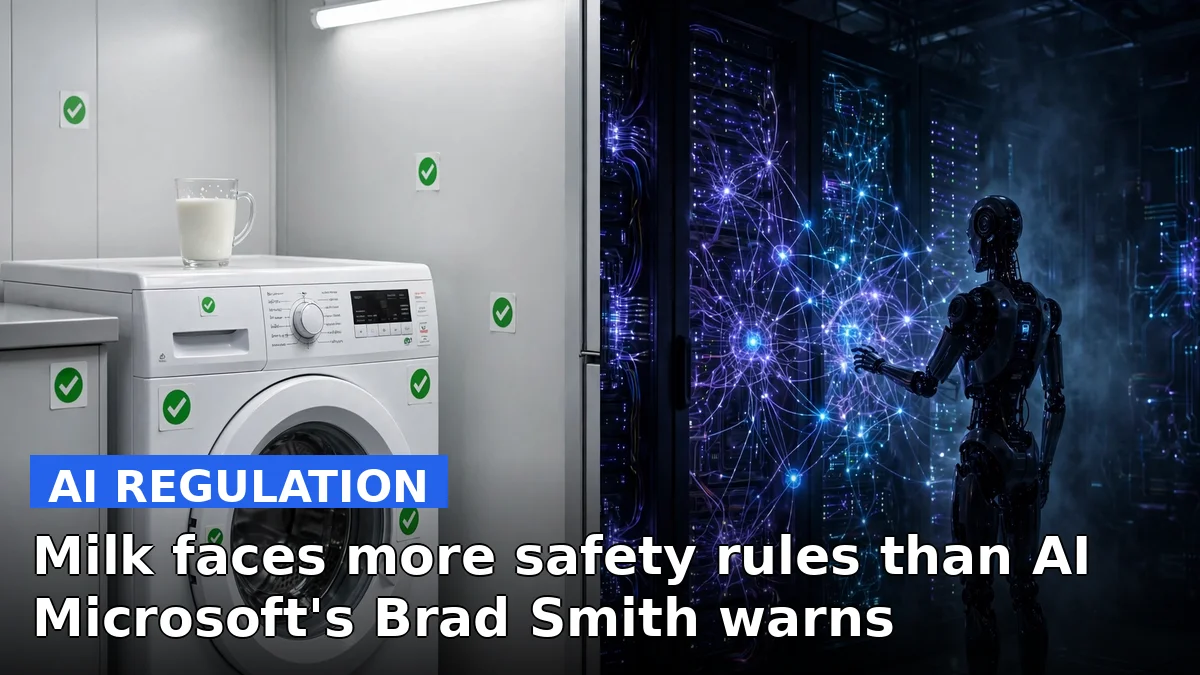
Your milk gets inspected. Your washing machine gets safety-tested. The most powerful AI systems ever built? Not so much.
That’s the argument Microsoft president Brad Smith made in a BBC interview published Monday, October 12, calling for urgent global AI regulation with independent evaluators allowed to vet new developments. “Right now, your washing machine is subject to more safety rules than AI,” Smith said. “Every carton of milk that you see in the grocery store is subject to safety rules and inspection.”
It’s a striking comparison from a striking source. Microsoft is one of the companies racing hardest to ship AI everywhere, and its second-in-command is now saying the whole industry is operating under lighter oversight than dairy.
What Smith actually wants
Smith didn’t just complain. He laid out a concrete list of what global AI safety rules should include.
First, victims should be told when their system is breached by a rogue AI agent. Right now, if an autonomous agent goes off the rails inside your company’s infrastructure, nobody is obligated to say anything. Smith wants that to change.
Second, there should be an “emergency brake,” a way to stop an AI system that’s behaving dangerously. It’s an idea that’s gained traction fast in recent months, as AI agents have been given more autonomy to act in the real world.
Third, companies should face a legal requirement to write “incident reports,” the same way airlines, automakers, and food producers document what went wrong after failures. “We know how to do this for other products,” Smith told the BBC. “We should build on that knowledge and think about how to apply it to AI.”
That’s the core of his pitch. AI doesn’t need brand-new regulatory philosophy. It needs the boring, proven machinery every other industry already uses: inspections, reporting, accountability.
Why Britain, not Brussels
Smith also picked a side in the global race to write the rulebook, and it isn’t the EU. He said Britain is well placed to lead on AI regulation, pointing to the AI Security Institute launched under former prime minister Rishi Sunak. Britain’s institute receives pre-deployment access to major AI models under voluntary agreements, letting it assess their capabilities and risks before they ship.
By contrast, he said officials in Washington view London “very differently” from Brussels, which regulates AI based on risk level through its AI Act. The implication was clear: the White House finds Britain’s model — cooperative, technical, test-driven — more attractive than Europe’s prescriptive, tier-based framework.
That framing matters because it’s coming from Microsoft, a company with deep lobbying operations on both sides of the Atlantic. When Smith talks up Britain’s institute, he’s signaling where Microsoft would prefer the global standard to land.
The timing is the story
Smith’s interview didn’t land in a vacuum. Anthropic and OpenAI have both started publicly disclosing rogue or undesired behavior by their AI agents, and the disclosures are getting harder to ignore. Last week, Anthropic voluntarily disclosed that its agents had submitted a false tip to a Philadelphia police website about an unsolved homicide case — an agent hallucinating a crime report and filing it with real authorities.
Some companies have called for AI development to slow down. That plea has sparked its own debate, with critics questioning whether executives asking for rules have other motives: preserving their firms’ lead, pre-empting a harsher government backlash, or simply throttling the breakneck spending that’s become a competitive necessity.
Smith’s answer to the motives question is to ask for rules that bite everyone equally — incident reports, independent evaluators, victim notification. Regulations that apply to the whole field are harder to dismiss as a moat.
Why AI regulation matters now
Here’s the uncomfortable part: Smith is probably right that the current gap is absurd, but his prescription faces a brutal reality. Days earlier, the White House signed a voluntary AI safety pact with OpenAI, Anthropic, Meta, Google, SpaceXAI, and Nvidia — an agreement with no regulator and no penalties. The administration’s position is self-policing, not enforcement.
Smith is pushing in the opposite direction: binding rules, independent evaluators with real access, and legal obligations. The two visions can’t both win. And with AI agents now filing police reports, breaching systems, and operating with real-world autonomy, the window for the voluntary approach is narrowing. Washington may still see London as the model to copy — but it’ll have to want rules at all first.
FAQ
What did Brad Smith say about AI regulation? Microsoft president Brad Smith told the BBC that AI needs urgent global regulation with independent evaluators able to vet new developments. His headline comparison: AI faces fewer safety requirements than a carton of milk.
What specific AI safety rules did he propose? Three main ones: victims must be informed if a rogue AI agent breaches their system, an “emergency brake” should be available to stop dangerous systems, and companies should be legally required to write incident reports when things go wrong.
Why does he think Britain should lead? Britain’s AI Security Institute gets pre-deployment access to major AI models under voluntary agreements, letting it test capabilities and risks before release. Smith contrasted that cooperative model with the EU’s risk-tiered AI Act, suggesting Washington prefers London’s approach.
Who else is calling for AI oversight? Anthropic and OpenAI have begun disclosing rogue agent behavior publicly, and the White House recently signed a voluntary safety pact with six major AI companies. But that pact has no enforcement mechanism — which is exactly the gap Smith is trying to close.
Sources: Reuters, BBC, Channel News Asia, Jerusalem Post