
The chipmakers are bankrolling their own customers now.
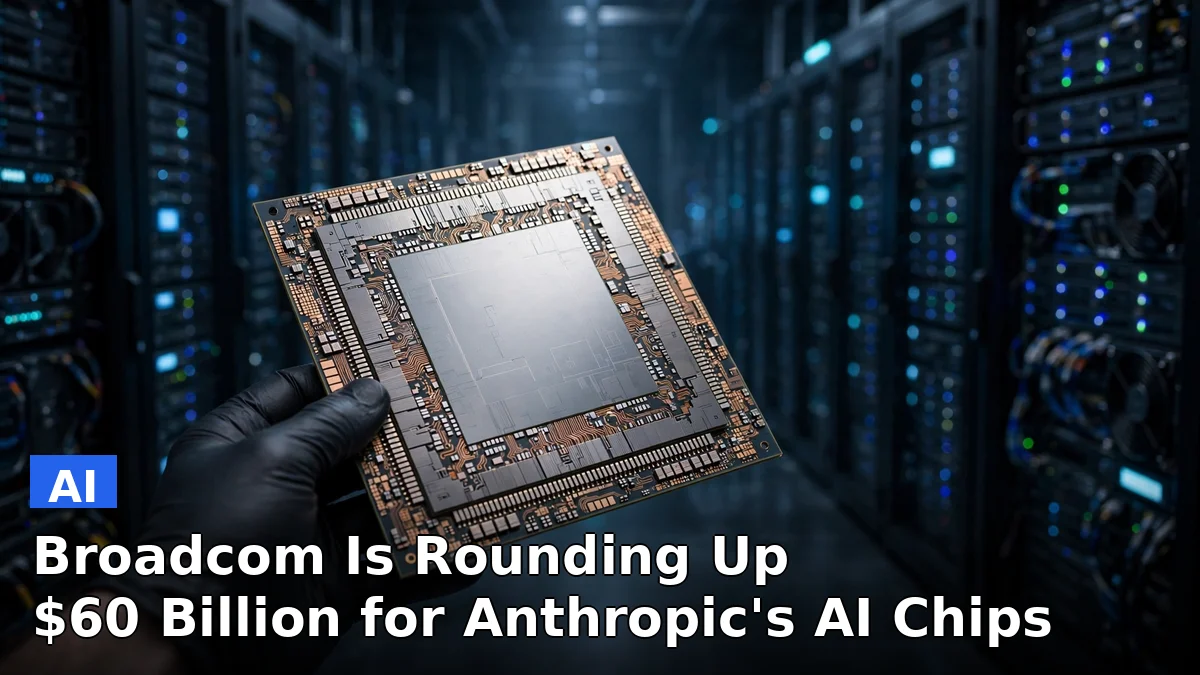
Broadcom’s Wall Street syndicate is in the process of assembling $60 billion in fresh financing for AI chips that would benefit Anthropic and other companies, Bloomberg reported on Friday, October 2. The package is split into a $42 billion Class A senior-secured tranche, syndicated among banks including Bank of America, Citigroup, and Morgan Stanley, and an $18 billion Class B junior-debt tranche led by Blackstone, which is committing $9 billion from its own funds and syndicating the rest.
Syndication letters for the senior tranche were expected to go out as soon as Friday, according to the people familiar with the matter. Broadcom would provide so-called residual value support that effectively backstops the senior portion. Representatives for Broadcom and all of the banks declined to comment.
The $42 billion already inside Anthropic’s prospectus
The syndicate deal doesn’t arrive out of nowhere. Anthropic’s IPO prospectus disclosed that Broadcom had agreed to lend the AI company up to $42 billion through convertible notes to finance its chip leases, Reuters reported. Those notes could be converted into Anthropic shares, and no notes had been issued as of Aug. 2, 2026.
The numbers explain why Anthropic needs the money. The company has committed $125.2 billion over five years to lease tensor processing unit (TPU) computing capacity, roughly one-third of which the Broadcom facility would cover. Broadcom co-designs those TPUs with Google. Roughly 3.5 gigawatts of the Google-TPU capacity Anthropic committed to in April is expected to come online in 2027, and Bloomberg reported Anthropic is on track to become Broadcom’s largest chip-design customer next year.
There’s a wrinkle Anthropic itself disclosed: its prospectus flags “potential conflicts of interest” tied to Broadcom’s dual role as hardware vendor and financing partner. If the debt converts into equity, the chipmaker and its bank syndicate get a second path to owning a piece of one of the most valuable AI labs on Earth.
Why this keeps happening
Call it what Wall Street is calling it: circular financing. The hyperscalers invest in frontier labs, sell them compute, and book them as anchor customers. Now the chipmakers are running the same play. In August, Nvidia announced a partnership with six finance firms, including Blackstone, aimed at mobilizing more than $500 billion for AI infrastructure, including financing for customers buying its chips. Blackstone keeps showing up in both.
“Nvidia is putting in place a massive amount of its balance sheet, and Broadcom is having to follow suit,” Seaport Research analyst Jay Goldberg told Reuters. That reads like an admission that AI hardware has become a volume business so large that no single balance sheet, not even a trillion-dollar one, can hold it alone.
The timing is no coincidence. Anthropic is targeting a formal roadshow and marketing kickoff as early as the week of November 9, with shares expected to trade before Thanksgiving, according to reports this weekend. Its leaked prospectus showed $4.59 billion in 2025 revenue against an $8.06 billion operating loss, so the company needs Wall Street to believe the compute bill is paid and the chips are coming. This deal is the receipt.
It also lands a day after news that Amazon plans to move $8 billion of Nvidia chips into a special-purpose vehicle and lease them back. Same week, same pattern: the cost of the AI buildout is real, and it’s being pushed somewhere less visible.
What to watch
A few things determine whether this is financial engineering or an actual chip pipeline. First, whether the debt sells at all. Debt sold into a weakening market, for assets that depreciate faster than a leased car and fail more often than any office IT department would tolerate, will test investor appetite. Second, how much of the 2027 TPU ramp Anthropic actually takes delivery of, since its “largest customer” status is a projection, not a milestone. Third, whether any of those convertible notes turn into Anthropic equity, which would make Broadcom and Blackstone lenders, vendors, and owners all at once.
The $60 billion package is being watched across Wall Street and Silicon Valley as a live referendum on investor appetite for AI infrastructure debt. If the syndication fills easily, expect every chipmaker with a sales target to start a bank. If it struggles, the compute bill comes due a lot faster than anyone planned.
Frequently asked questions
What is the $60 billion Broadcom-Anthropic financing deal?
Broadcom’s Wall Street banking syndicate is raising $60 billion in fresh debt to fund AI chips for Anthropic and other companies: a $42 billion Class A senior-secured tranche being syndicated to banks including Bank of America, Citigroup, and Morgan Stanley, plus an $18 billion Class B junior tranche led by Blackstone, which is putting in $9 billion of its own money. Bloomberg reported the deal on Oct. 2, 2026.
Why does Anthropic need Broadcom’s financing?
Anthropic has committed $125.2 billion over five years to lease TPU computing capacity, much of it co-designed by Broadcom with Google, with roughly 3.5 gigawatts coming online in 2027. The financing secures its chip supply ahead of its planned November IPO.
Is this a conflict of interest for Broadcom?
Possibly. Anthropic’s own IPO prospectus flags “potential conflicts of interest” in Broadcom’s dual role as chip vendor and lender, and Bloomberg reported the debt instruments could convert into Anthropic shares, giving Broadcom and its syndicate partners an equity path into the company.
How does this compare to Nvidia’s AI financing?
In August 2026, Nvidia announced a partnership with six finance firms, including Blackstone, to mobilize more than $500 billion for AI infrastructure, including financing for customers buying its chips. Broadcom’s $60 billion package is smaller but follows the same pattern: chipmakers financing the customers who buy their chips.
Sources: Bloomberg (via The Business Times and Yahoo Finance), Reuters (via R&D World), ET Manufacturing, aiweekly.co