
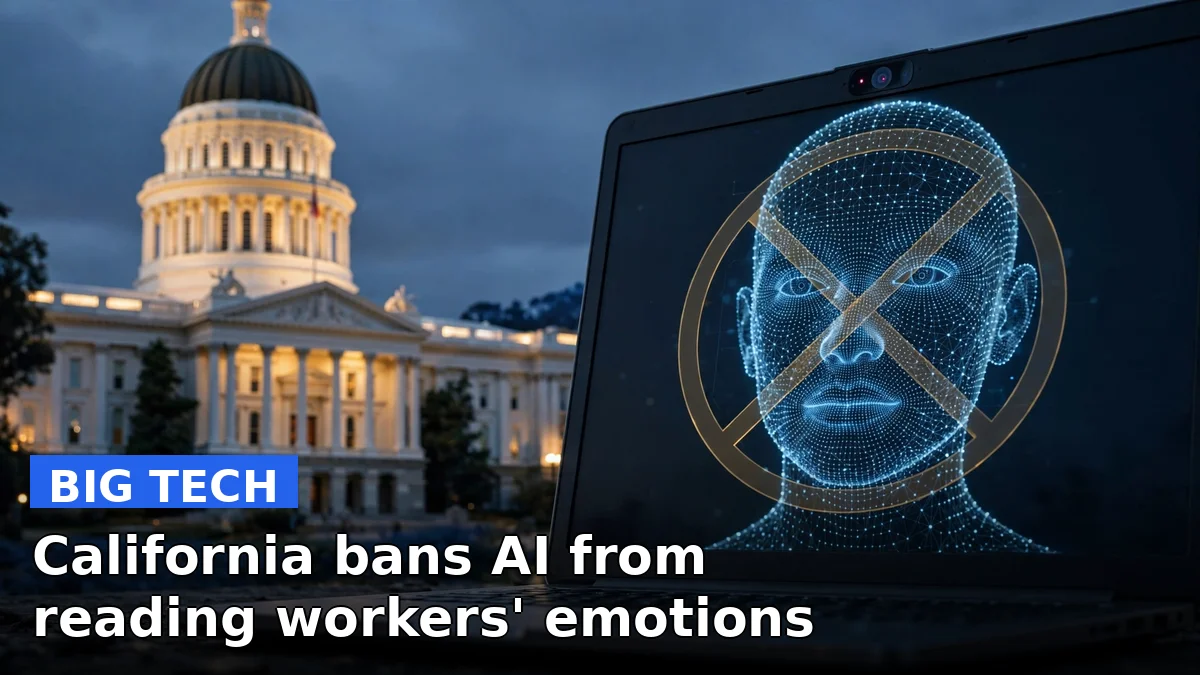
Your boss can track your hours. Starting next year, it can’t scan your face to guess how you feel.
Governor Gavin Newsom signed a package of California AI workplace laws on Sept 30, 2026, that make California the first state to flatly ban AI tools that read workers’ emotions, and the first to outlaw firings made by an algorithm alone.
The bills landed one day after President Trump celebrated a voluntary AI safety accord with tech CEOs, in which companies including Google, Meta, OpenAI, and Nvidia pledged to self-police their systems. Newsom used the signing to draw a sharp contrast: California, he said, is putting “people at the center” while Washington has yet to pass comprehensive federal AI rules.
“AI should expand opportunity, not come at the expense of workers and families,” Newsom said in a statement. “As this technology reshapes the workplace, California is putting people at the center.”
What the new California AI workplace laws actually do
The centerpiece is Assembly Bill 1883, a workplace surveillance ban authored by Assembly Member Bryan. It prohibits employers from using AI-powered tools to recognize, infer, or predict an employee’s emotional state, plus a separate rule against collecting neural data, defined as information generated by measuring activity in a worker’s central or peripheral nervous system.
The ban covers an unusually wide net. “Workplace surveillance tool” means any system, app, or device that collects employee data by means other than direct observation, according to reporting on the bill: video and audio monitoring, continuous time-trackers, geolocation tools, and electromagnetic tracking devices. The “employer” definition is broad too: private companies, every level of California government, state agencies, the University of California, school districts, transit districts, and labor contractors.
In practice, this targets tools that analyze facial expressions, voice tone, or biometric signals to guess whether workers are stressed, distracted, or unhappy. The neural-data clause reaches into headsets, earbuds, and wearables marketed for focus and fatigue tracking. The law also bans collecting neural data outright, even if it’s not being used to infer emotion.
Don’t imagine every time-clock is now illegal. The law targets two specific AI capabilities, not monitoring in general. Employers can still use AI surveillance for a documented safety purpose, and plain non-AI monitoring is untouched. A narrow exemption also applies to operations tied to federal contracts on aircraft development, national security, military, space, or defense work, but only where the surveillance is “reasonably necessary” to comply.
AB 1883 takes effect January 1, 2027, giving employers a few months to rip out or reconfigure covered tools. Violations carry civil penalties of up to $500 each, enforceable by the state labor commissioner and public prosecutors, and the law allows civil or injunctive relief including punitive damages.
No Robo Bosses: a human must sign off on firings
The second headline law is SB 947, the No Robo Bosses Act of 2026, authored by state Sen. Jerry McNerney and sponsored by the California Federation of Labor Unions and the AFL-CIO.
It prohibits employers from relying solely on an automated decision system to fire or discipline a worker. If an employer relies primarily on AI, a human reviewer must corroborate the decision with relevant supporting information. Workers must also be told when AI played a main role in the call, and get a contact person.
This one wasn’t easy to pass. Newsom vetoed an earlier version, SB 7, in 2025, warning that its notice requirements were unfocused and its restrictions could reach routine workplace tools. SB 947 is narrower: it drops deactivation decisions and predictive behavior analysis, and swaps a 12-month data dump for a right to a “meaningful, objective description” of the employee data the system used. It takes effect July 1, 2027, also with $500-per-violation civil penalties.
A third piece of the package requires employers to send workers written notice when AI is responsible for mass layoffs, a direct response to the growing fear that companies will quietly automate headcount reductions and blame the model.
The Newsom vs. Trump split on AI regulation
The signing wasn’t just about labor policy. It was a message.
Trump spent Tuesday of that week unveiling a one-page voluntary accord in which tech giants committed to internal AI safety checks, with no penalties and no firm deadlines. Newsom, at an hourlong event with reporters Wednesday, criticized the administration for having no comprehensive federal AI rules at a moment when industry leaders themselves are warning about the technology’s risks.
Then he twisted the knife on branding. Newsom signed an executive order requiring California state agencies to keep referring to the technology as “artificial intelligence,” rejecting the term “super intelligence” that Trump recently ordered federal agencies and diplomats to use. Trump has pushed the rebrand on the grounds that the word “artificial” makes intelligence sound fake.
Labor leaders, for their part, called the signing a start, not a finish. California Labor Federation president Lorena Gonzalez said more work remains, particularly around regulating AI in healthcare. The version of the firing law that passed was weakened during negotiations to exclude contractors.
Why this matters
California writes the rules that the rest of the country ends up borrowing. The state did it with emissions standards and data privacy, and it’s doing it again with workplace AI: a hard ban on emotion inference and a human-in-the-loop rule for firings is now the most aggressive labor AI regime in the United States.
For companies, the compliance clock is short. Employers running AI monitoring or automated HR tools in California need to audit their stacks well before January 2027. Vendors selling emotion-scoring products just lost their biggest market.
For everyone else, the split-screen is the story. Washington’s approach is a handshake; Sacramento’s is a statute. One of them is going to decide what AI looks like at work for the rest of the country.
FAQ
What do California’s new AI workplace laws ban? Employers can no longer use AI tools to infer workers’ emotional states or collect neural data, and they can’t rely solely on automated systems to fire or discipline workers. Violations carry civil penalties of up to $500 each.
When do the laws take effect? The emotion-reading ban (AB 1883) takes effect January 1, 2027. The No Robo Bosses Act (SB 947), requiring human review of AI-driven firing decisions, takes effect July 1, 2027.
Does the ban cover all workplace monitoring? No. It targets only AI used to recognize or infer emotional states or collect neural data. AI surveillance tied to a specific, documented safety risk is allowed, and non-AI monitoring is untouched.
How does California’s approach differ from the federal one? California is imposing binding limits with penalties, while the Trump administration favors a voluntary White House accord in which tech companies self-police. Newsom also signed an executive order requiring state agencies to keep saying “artificial intelligence” instead of Trump’s “super intelligence.”
Sources: Associated Press (via Gulf News), Bloomberg Law, Human Resources Director, Mondaq.