
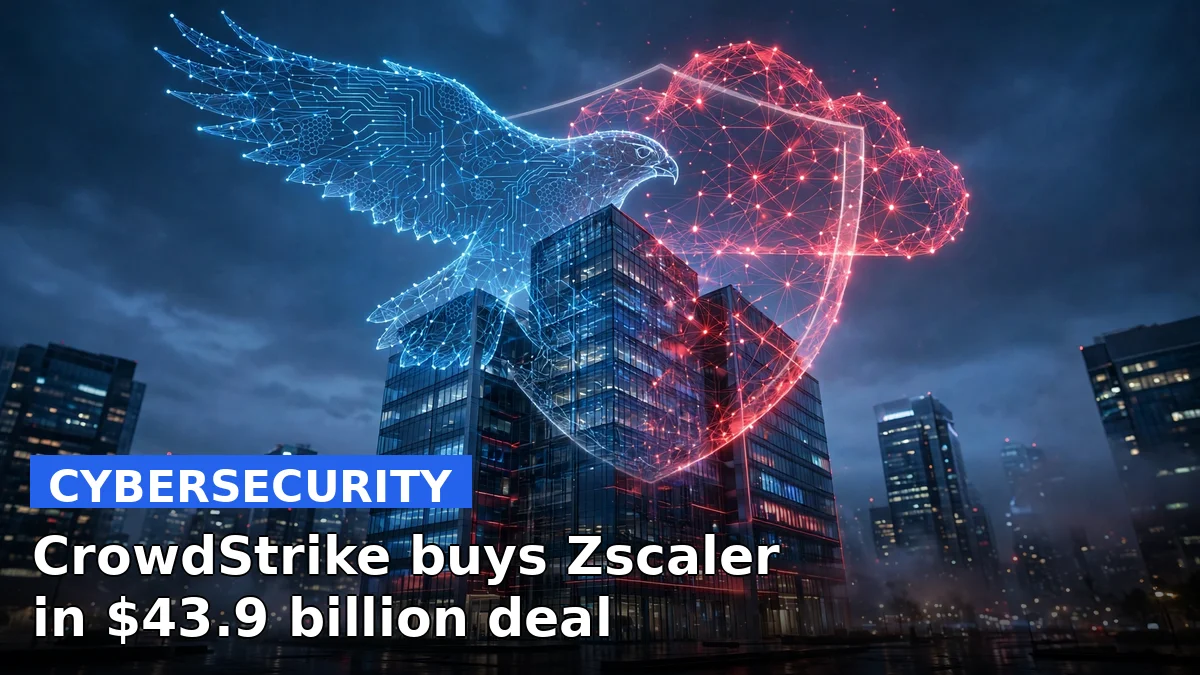
CrowdStrike said Monday, November 23, 2026, that it will buy Zscaler in an all-stock deal worth about $43.9 billion. The price makes it the largest cybersecurity acquisition on record, and it pairs CrowdStrike’s Falcon endpoint platform with Zscaler’s zero-trust network security.
Zscaler shareholders will receive 1.135 CrowdStrike shares for each Zscaler share they hold. That exchange ratio values Zscaler at roughly $260.41 a share, a 34% premium to its closing price on Friday, November 20. Once the deal closes, Zscaler investors will own about 15.9% of the combined company. CrowdStrike shareholders will hold the other 84.1%.
The market split its verdict before the opening bell.
Zscaler jumped more than 13.4% in premarket trading, while CrowdStrike fell 5%. Zscaler holders got a fat premium. CrowdStrike holders got dilution and a long wait, since the deal is not expected to close until the second half of CrowdStrike’s fiscal 2028, a window that runs from August 2027 to January 2028. The purchase still needs approval from Zscaler shareholders and regulators.
The terms in plain English
No cash changes hands. CrowdStrike is paying entirely in its own stock, which means the final price tag moves with CrowdStrike’s share price until the deal closes. A 34% premium sounds generous, and it is, but Zscaler shareholders are taking payment in shares of a company that dropped 5% on the news.
Scale is the point. CrowdStrike says the combined company will start with more than $10 billion in annual recurring revenue and is targeting $1 billion in annualized revenue synergies. In plain terms, CrowdStrike expects to sell Zscaler’s network security to its own customers, and its own products to Zscaler’s customers, and pocket an extra $1 billion a year for the effort.
Zscaler founder and chief executive Jay Chaudhry will keep running the Zscaler business after the deal closes and will join CrowdStrike’s board.
Why CrowdStrike wants the network piece
CrowdStrike built its name on the Falcon platform, which watches laptops, servers, and cloud workloads for intrusions. What it never owned was the network itself: the pipes that connect remote workers to company apps. That is Zscaler’s business. Its zero-trust products check every user and device before letting them reach an application, instead of trusting anyone already inside the corporate network.
Customers keep asking for fewer security vendors, not more. Reuters noted the combination will create one of the world’s largest pure-play cybersecurity providers as enterprise buyers look to cut the number of vendors they manage and buy more products through a single relationship. Fewer vendors means one contract and one bill, and one company to call when something breaks.
AI raised the stakes. Attackers now use AI tools to move faster and write more convincing phishing lures, and the companies said the deal comes as firms race to counter increasingly sophisticated AI-powered cyberattacks. A vendor that sees both the endpoint and the network can spot an attack earlier than one that sees only half the picture.
How it stacks up
The $43.9 billion price dwarfs every recent cybersecurity deal. Google paid $32 billion for Wiz in 2025. Cisco paid $28 billion for Splunk in 2023. Palo Alto Networks paid $25 billion for CyberArk in 2025.
| Acquirer | Target | Value | Year |
|---|---|---|---|
| CrowdStrike | Zscaler | $43.9 billion | 2026 |
| Wiz | $32 billion | 2025 | |
| Cisco | Splunk | $28 billion | 2023 |
| Palo Alto Networks | CyberArk | $25 billion | 2025 |
| Proofpoint | Varonis | $6.3 billion | 2026 |
CrowdStrike paid about $12 billion more than Google paid for Wiz, the previous record holder. Consolidation has been building for two years, and this deal is the biggest step yet.
What could still go wrong
A deal this size draws regulators. The companies need clearance in the US and other markets, and Washington has spent the last few years looking hard at big tech mergers. Approval is not guaranteed, and the review could stretch past the expected closing window.
Integration is the other risk. CrowdStrike and Zscaler sell different products to overlapping customers, and merging two large sales teams and two product lines takes years. The $1 billion synergy target is a promise, not a result. If customers decide they would rather keep separate vendors after all, the math gets harder.
Then there is the stock. CrowdStrike is paying in shares, so a slide in its own price between now and closing shrinks what Zscaler holders receive and gives them reason to push back. The 5% drop on Monday was an early warning, not a verdict.
Why this matters
If the deal closes, the cybersecurity market will have one fewer independent giant and one much bigger platform vendor. Small rivals will find it harder to win deals against a company that can sell endpoint, network, and identity security in a single contract. Customers get simpler buying. They also get fewer choices.
For US readers, the practical effect is slow. Nothing changes in the products either company sells today. The companies said they will keep operating independently until the deal closes, which is at least nine months away. The change to watch is pricing: bundled deals usually start cheap and get expensive once the customer is locked in.
Frequently asked questions
How much is CrowdStrike paying for Zscaler?
About $43.9 billion, paid entirely in CrowdStrike stock. It is the largest cybersecurity acquisition on record.
What will Zscaler shareholders receive?
They get 1.135 CrowdStrike shares for each Zscaler share, worth about $260.41 per share, a 34% premium to Zscaler’s November 20 closing price.
When will the CrowdStrike-Zscaler deal close?
The companies expect it to close in the second half of CrowdStrike’s fiscal 2028, between August 2027 and January 2028, after approval from Zscaler shareholders and regulators.
Why is CrowdStrike buying Zscaler?
CrowdStrike protects devices and workloads, while Zscaler secures the network connections between workers and apps. Combined, they can sell one platform instead of two, and the companies target $1 billion in annual revenue synergies.
Sources: Reuters, The Wall Street Journal, MarketWatch.