
DeepSeek is about to get very rich. The Chinese AI startup is close to securing at least 80 billion yuan (roughly $12 billion) in its latest funding round, Bloomberg News reported Tuesday, citing people familiar with the matter.
That’s nearly double what the company originally asked for. DeepSeek went in seeking about 50 billion yuan ($7.5 billion). Then it released its latest model last month, investors piled in, and now the final tally could approach 100 billion yuan, around $14.9 billion.
If it closes at that level, it would be one of the largest private AI funding rounds ever, full stop. And it’s not coming from Silicon Valley’s usual suspects.
Tencent and CATL anchor the $12 billion DeepSeek funding round
According to Bloomberg’s reporting, the largest commitments in the round come from two Chinese giants: battery maker CATL and Tencent Holdings, the WeChat operator. No exact figures for their contributions were disclosed.
DeepSeek, Tencent, and CATL did not immediately respond to Reuters’ requests for comment, and Reuters said it could not independently verify Bloomberg’s report. That’s worth keeping in mind: this is single-sourced reporting riding on anonymous people familiar with the matter. But it’s also exactly how the biggest China tech financings tend to surface, and multiple outlets including Reuters, CTech, and The Edge Singapore ran with it Tuesday.
The currency math: Bloomberg’s sources pegged the raise at a minimum of 80 billion yuan, which converts to about $11.93 billion at current rates ($1 = 6.7045 Chinese yuan).
The model that started the stampede
Investor demand didn’t surge on vibes. Last month DeepSeek released DeepSeek-V4.1-Flash, and the company pitched it as a step up in capability, faster inference, higher throughput, and the ability to scale to larger models. The release, per The Edge Singapore’s summary of Bloomberg’s reporting, reset expectations for cost versus performance against Anthropic and OpenAI.
That’s DeepSeek’s signature move. The Hangzhou startup first broke out in 2025 with a model that matched Silicon Valley’s offerings at a fraction of the cost — an efficiency story that embarrassed an industry spending tens of billions on data centers. This round suggests investors now want in before whatever comes next.
Founder Liang Wenfeng has, Bloomberg reported, “repeatedly stressed that pushing the technology forward is more important to him than rapid monetization.” Investors seem fine with that trade. Money keeps arriving anyway.
Where the money goes
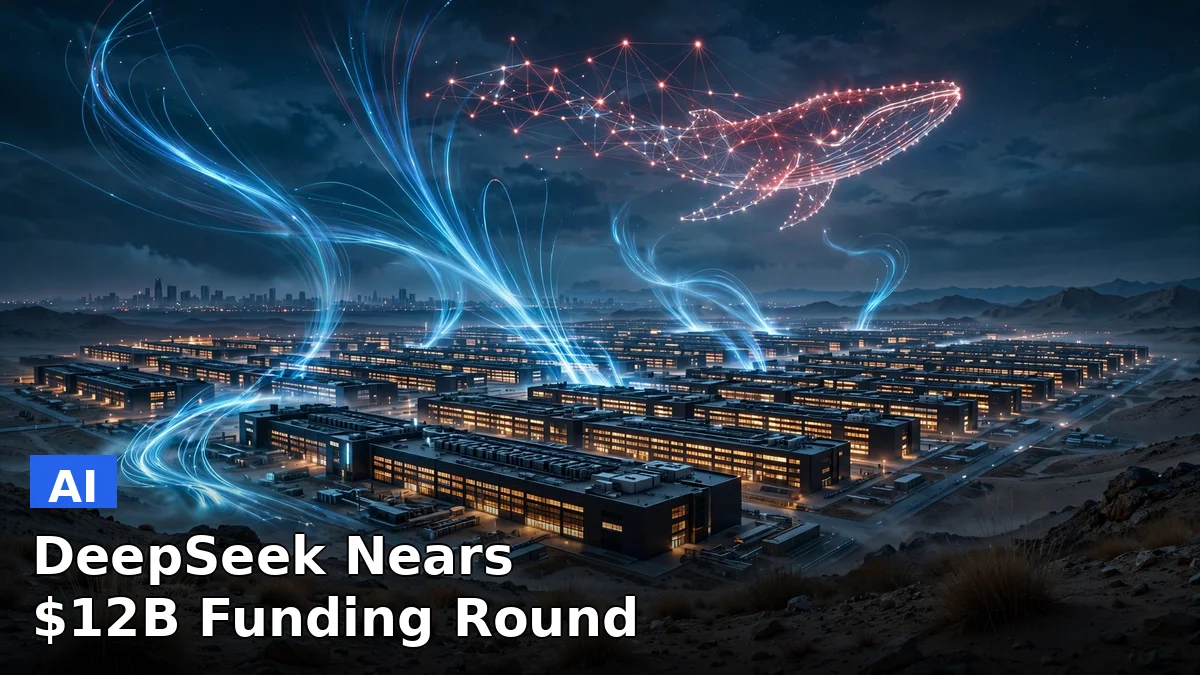
Training and running frontier AI models is a capital furnace, and DeepSeek’s ambitions are enormous. Bloomberg’s reporting says the company plans to deploy at least 160,000 of Huawei Technologies’ top accelerators at a massive data center it’s building in Inner Mongolia — a cluster that would rank among the largest known deployments of Huawei AI chips anywhere.
That detail tells you this round is about more than models. DeepSeek recently partnered with Huawei to develop programming tools optimized for Huawei’s Ascend chips, part of China’s broader push to cut dependence on Nvidia’s ecosystem. The funding essentially buys DeepSeek a Chinese compute stack: Huawei hardware, DeepSeek software, domestic money.
What about an IPO?
Reuters reported last month that DeepSeek had hired CITIC Securities to prepare for a potential STAR Market IPO — China’s Nasdaq-style tech board in Shanghai. The timing, valuation, and size of that listing remain undecided.
Rival Moonshot is further along on that path, targeting an early-2027 debut after closing a funding round at a $50 billion valuation, according to The Edge Singapore. A $12-to-$15 billion war chest puts DeepSeek in a position to set its own terms.
Why this matters
Step back and the picture is stark. In the last 24 hours, US AI labs have been testifying under oath in New York, signing voluntary White House safety accords, and debating whether they can even promise their models are safe. Meanwhile, DeepSeek just pulled in a twelve-figure round from two of China’s biggest companies without a roadshow, without a press release, and apparently without breaking a sweat.
The US-China AI contest isn’t only about who builds the smartest model. It’s about who can write the biggest check, stack the most chips, and hold their nerve. On Tuesday morning, DeepSeek answered all three.
FAQ
How much is DeepSeek raising?
At least 80 billion yuan, about $12 billion, per Bloomberg’s reporting — nearly double the $7.5 billion the company originally sought. The final tally could approach 100 billion yuan ($14.9 billion) given surging investor demand.
Who’s backing the round?
CATL and Tencent have committed among the largest amounts, according to Bloomberg’s sources. The companies haven’t confirmed their participation publicly.
Why did demand spike now?
DeepSeek’s release of its V4.1-Flash model last month reset market expectations on cost versus performance, and the money is expected to fund AI infrastructure — including a massive Inner Mongolia data center running at least 160,000 Huawei accelerators.
Is DeepSeek going public?
It’s preparing the ground. Reuters reported the company hired CITIC Securities for a potential STAR Market IPO, though timing and valuation are still undecided.
Sources: Bloomberg News (via Reuters), Reuters, CTech (Calcalistech), The Edge Singapore.