
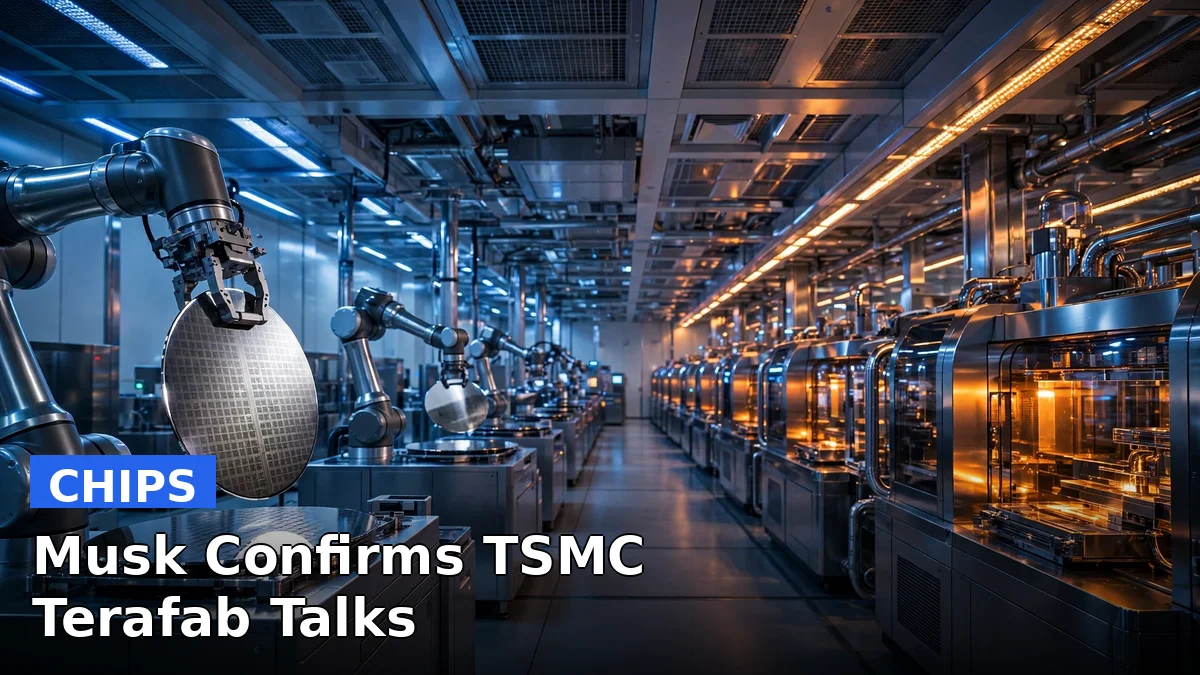
Elon Musk just put the world’s biggest chipmaker in play for his biggest hardware bet. On Saturday, Oct. 3, Musk confirmed on X that TSMC and his Terafab semiconductor project are in discussions about a chipmaking collaboration. “Just discussions, but something may come of it,” he wrote. Short post, enormous stakes: a Terafab–TSMC deal would put the world’s most advanced chip manufacturing expertise behind the Tesla and SpaceX chief’s $16.8 billion Texas megafab.
The confirmation followed an Oct. 2 exclusive from Tim Culpan, the former Bloomberg journalist behind the Culpium newsletter, who reported that TSMC is weighing various ways to participate in Terafab. Musk replied on X the next day, making it official that the talks exist. That’s the first confirmation the two sides are actually talking. What the talks could produce, nobody knows yet.
What a TSMC–Terafab deal could look like
Culpan laid out two rough structures for how it might work. In the likelier one, TSMC would own and operate a new fab itself, with companies in Musk’s orbit (Tesla, SpaceX, xAI) supplying capital, committing to buy large volumes of chips over the long term, or both. In the bolder version, SpaceX or a Terafab entity would hold majority ownership, with TSMC as a minority investor that still brings its process technology and operational know-how.
Neither company has published anything resembling terms. No ownership split, no investment figure, no process node, no capacity target, no start date. TSMC has said nothing publicly at all. When approached about its Texas plans, the company said it doesn’t comment on market rumors. So treat the structures as reported scenarios, not a negotiated plan.
Still, the shape of it echoes precedents. TSMC’s JASM joint venture in Japan and ESMC in Germany both put local partners in the capital-and-demand role while TSMC contributes technology and runs the fabs day to day. A Texas version of that playbook, with Terafab as the anchor client, wouldn’t be strange. The “Plan B” version, with Musk’s side in control and TSMC operating under it, would be something new for the world’s top contract chipmaker, which has historically refused exactly this kind of arrangement.
The Texas connection
TSMC showing up in Texas is not out of nowhere. On Sept. 30, Reuters reported, citing two people familiar with the matter, that TSMC is considering additional semiconductor investment in Texas, a project separate from the Arizona expansion where the company has now committed $265 billion. No final decision has been made, and TSMC declined comment.
A link between those Texas plans and Terafab is plausible but unconfirmed. Culpan’s reporting suggests TSMC may be scouting its Texas campus with Terafab’s chip appetite in mind as the customer that justifies building it. North America already accounts for more than three-quarters of TSMC’s wafer revenue in the first half of this year, so more US capacity is attractive on its own. Terafab would just add a very large reason to move fast.
Terafab is the kind of customer TSMC can’t ignore
Musk unveiled Terafab in March 2026 as a joint venture between Tesla and SpaceX. The pitch was audacious, even by his standards: eventually produce a full terawatt of AI compute capacity a year, more than every chipmaker on Earth combined. The concrete plans, reported by Reuters, were two advanced chip factories in Texas: one supplying chips for vehicles and humanoid robots, another for AI infrastructure. SpaceX floated an initial $55 billion investment in May. The real site, confirmed in August: Grimes County, Texas, with a first phase worth $16.8 billion and a workforce of at least 3,000.
Where the silicon goes tells you everything about the demand. Terafab targets the 2-nanometer node for Tesla’s Full Self-Driving chips, Optimus robot brains, and SpaceX’s orbital data centers. Those are exactly the leading-edge products that consume huge amounts of TSMC’s advanced manufacturing and packaging capacity. And Musk’s companies buy the volumes to make a dedicated fab pencil out.
Wait: what about Intel?
Here’s the wrinkle. Intel is already Terafab’s named foundry partner. Musk previously said Intel’s upcoming 14A process was intended for the project, reporting Reuters confirmed in May. Terafab has reportedly begun ordering equipment from ASML, Lam Research, KLA, and Tokyo Electron.
TSMC entering the picture doesn’t necessarily mean Intel is out. The projects could split: different chip designs to different foundries, front-end wafer fabrication to one and advanced packaging to the other, or TSMC handling some stages while Intel handles others. All speculation for now. What’s confirmed is only that Terafab is talking to TSMC while Intel was previously named as the technology partner. Musk’s companies have a habit of multi-sourcing; the real question is whether TSMC and Intel’s roles overlap or complement each other.
What Musk is really buying: know-how
The honest read on why this matters: making chips is not a real-estate project. A modern fab isn’t EUV machines lined up in a building with someone pressing start. It’s yield engineering, process control, equipment qualification, supplier coordination, and a workforce that knows what to do when the 50th nanometer-scale step drifts out of tolerance. That expertise is why TSMC matters more than any dollar figure in the announcement.
Musk seems to know that. In April, Tesla was recruiting semiconductor engineers in Taiwan, a hiring pool that exists thanks to TSMC and its suppliers. If Terafab ends up with TSMC operating its fabs, or even just advising on process technology, that’s a bigger milestone than any factory render: it’s Musk admitting that leading-edge manufacturing can’t be willed into existence, and choosing the partner that knows how it’s done.
Why this matters
The most important thing in this story isn’t whether another TSMC sign ends up on a factory in Texas. It’s the signal that Musk wants established manufacturers inside Terafab rather than going it alone. That’s a credibility move for the entire project, and a competitive one. Every AI lab is fighting for leading-edge capacity; Musk is trying to secure his own supply chain for cars, robots, orbital data centers, and the AI models that tie them together.
But don’t turn a weekend X post into a signed deal. Discussions are discussions. If they do produce a collaboration, it’ll be a turning point for Terafab, and a historic one for TSMC, which has never built a fab mainly for one customer’s empire. Until then, the world’s most valuable chipmaker and the world’s richest man are just talking.
Sources: Tom’s Hardware, Igor’s Lab, Tim Culpan’s Culpium newsletter, Reuters, Bloomberg.