
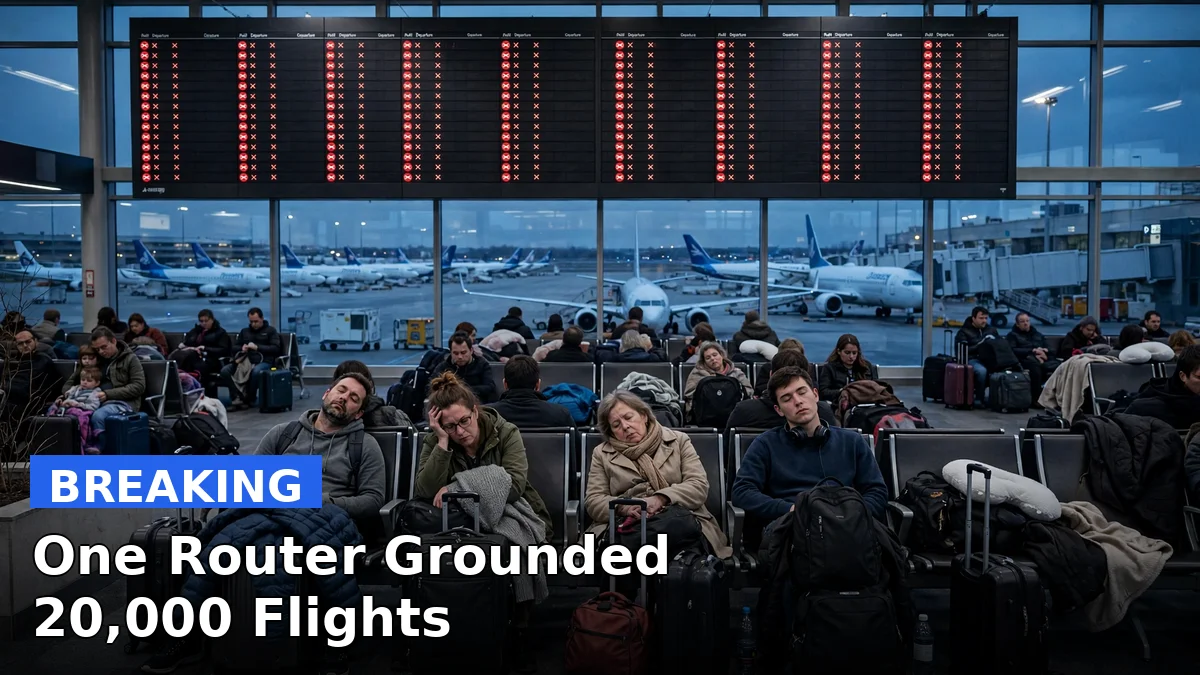
The FAA ground stop on Friday, November 13, brought nearly every departing flight in the United States to a standstill for almost five hours. It was the longest nationwide shutdown of US air travel since the September 11 attacks, and federal officials say it may have started with a single piece of networking equipment.
More than 20,000 flights have been disrupted since Friday, according to Reuters, which cited government officials. Airlines canceled nearly 10,000 flights on Friday alone and delayed more than 7,000 others, in what became one of the worst travel days in American history.
“This was an FAA system that didn’t meet the moment,” Transportation Secretary Sean Duffy said at a news conference on Saturday.
How the FAA ground stop unfolded
Trouble began at 3:36 p.m. ET on Friday, when air traffic control centers started reporting instability in radar and communications systems. The FAA could not pin down a root cause, so it ordered a nationwide ground stop — the kind of step it takes only when it cannot trust the data its controllers are seeing.
It stayed in place for almost five hours. The FAA lifted it on Friday night, but the damage was already done. Tens of thousands of passengers spent the night in airports, and the backlog spilled into the weekend. On Saturday, airlines canceled more than 3,700 more flights and delayed 2,000 others, according to Reuters.
United Airlines and Delta Air Lines added their own temporary ground stops on Saturday at Chicago O’Hare and New York LaGuardia, respectively, to deal with congestion and gate shortages.
FAA Administrator Bryan Bedford apologized for the disruption and said the system was stable, but warned that recovery would take time. He said airline schedules should be back to normal by late Sunday.
One router, 1,000 connection attempts every few seconds
The likely culprit, officials said Saturday, was a router installed by government contractor L3Harris. The company was doing routine maintenance — switching telecommunication lines from old copper wire to fiber at remote FAA sites — when the new equipment started misbehaving.
Duffy described the failure in plain terms. The new routers began flooding other routers with more than 1,000 connection attempts every four to five seconds. That flood overloaded communications at 17 of the FAA’s 22 en route centers, the facilities that manage aircraft flying between airports.
The FAA said its communications did not go down entirely, and no center went dark. The data became unstable instead — radar and radio information that controllers could no longer trust. That distinction mattered little to anyone stuck at a gate.
Investigators have not settled on the exact cause. Officials told Reuters there may have been problems with routers installed in both Arkansas and Texas.
“We’re working to determine whether we had incompetence, meaning was it user error or installer error from L3Harris, or did they install a faulty router? We haven’t determined what the fault was,” Duffy said.
L3Harris said it took the issue seriously and was “supporting the FAA in its investigation to understand the conditions that led to the Nov. 13 ground stop of our nation’s air travel.”
A 25-year-old system that was supposed to be replaced in 2006
The routers at the center of the failure were about 25 years old, Duffy said, and were supposed to have been replaced in 2006. That is the detail that turns a bad Friday into a story about the state of American infrastructure.
The FAA spends $1 billion a year just to maintain its old copper wire system, according to Reuters, and is racing to replace it with fiber-based communications. L3Harris said it has completed more than 70% of the planned conversion from legacy copper to fiber.
This was not the first time the aging system has failed in public. The FAA’s telecom network has gone down after errant fiber cuts, the accidental deletion of files, and a melted component that filled a facility with a strong chemical smell. The only other nationwide ground stop since September 11 came in January 2023, when a contractor unintentionally deleted files and halted domestic departures for about 90 minutes, disrupting 11,000 flights.
Duffy used the moment to press Congress for $50 billion in funding to modernize air traffic control. The system, officials said, will fail again until it is properly upgraded.
Not a cyberattack, and not the AI system
With a failure this big, the first questions were about a hack — and about the FAA’s new AI-assisted air traffic management system, which had just been rolled out nationwide.
Both theories were shut down fast. Federal officials said there was no sign of malicious activity behind the outage. The US Department of Transportation confirmed the ground stop was unrelated to AI-assisted air traffic management, and Homeland Security Secretary Markwayne Mullin said investigators would still look at whether any link to the new AI system existed.
The mundane explanation held. A maintenance crew swapped in new equipment, the equipment flooded the network, and a system built on 25-year-old routers could not absorb the shock.
Why this matters
Air travel in the US runs on a network that most passengers never think about until it stops working. Friday showed how thin the margin is. One bad router, installed as part of a routine upgrade, took down departures across the entire country for most of an evening — not because planes could not fly, but because controllers could not trust the screens in front of them.
The fix is not a mystery. Replace the copper, replace the routers, and finish the modernization that was supposed to happen two decades ago. The $50 billion ask is now on the table, and Congress will decide whether a five-hour shutdown of the busiest airspace in the world is the argument that finally moves it.
For travelers, the practical lesson is simpler. The FAA says schedules should be normal by late Sunday. Anyone flying this weekend should still check flight status before leaving for the airport — the backlog clears slower than the headlines do.
Frequently asked questions
What caused the FAA ground stop on November 13, 2026?
Federal officials say a router installed by contractor L3Harris during routine copper-to-fiber maintenance flooded the FAA’s air traffic control network with connection attempts, destabilizing radar and communications data at 17 of the FAA’s 22 en route centers.
How many flights were affected by the FAA ground stop?
More than 20,000 flights were disrupted. On Friday alone, airlines canceled nearly 10,000 flights and delayed more than 7,000, and thousands more were canceled on Saturday as schedules recovered.
Was the FAA ground stop caused by a cyberattack?
No. Federal officials said there was no sign of malicious activity. The failure was traced to a maintenance operation by L3Harris, not to a hack or to the FAA’s new AI air traffic system.
When did US flights return to normal after the ground stop?
The FAA lifted the ground stop on Friday night, and FAA Administrator Bryan Bedford said airline schedules should be back to normal by late Sunday, November 15.
Sources: Reuters, Associated Press, CNBC TV18, Daily Sabah.