
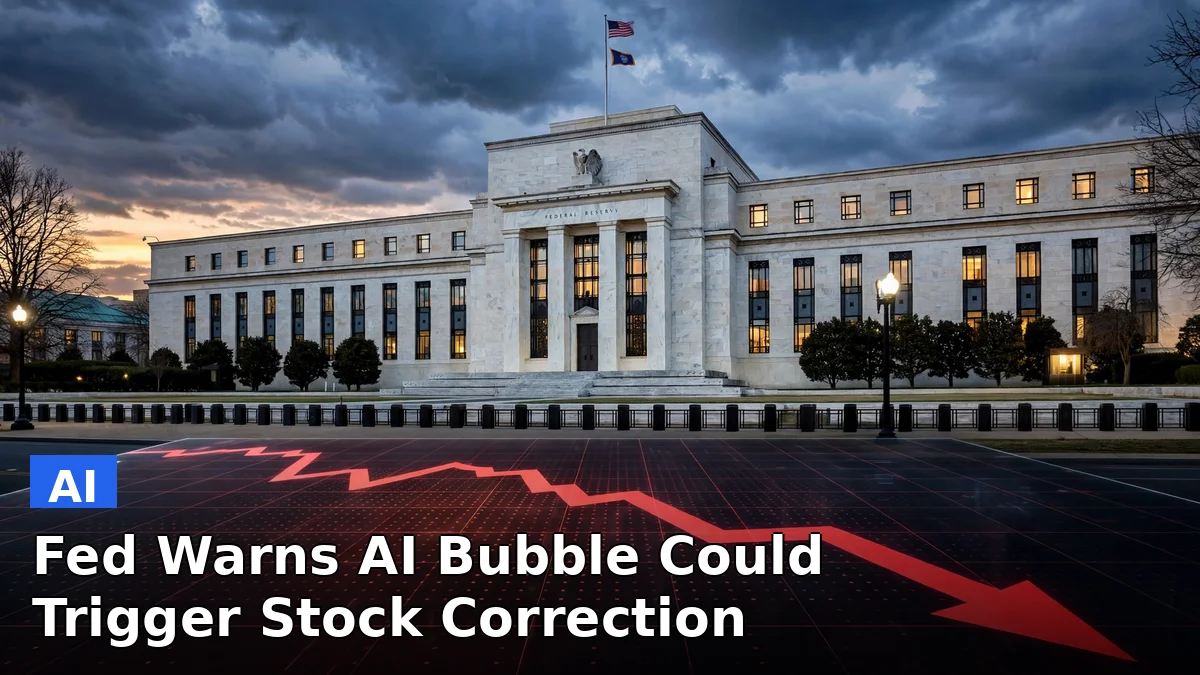
Federal Reserve Vice Chair for Supervision Michelle Bowman warned on Tuesday that stocks face “a large correction in equity valuations” if returns on artificial intelligence investments fall short of expectations.
Speaking at the Council on Foreign Relations in Washington on November 10, Bowman put the AI bubble debate in the starkest terms yet from a senior US central banker. AI-related debt is on track to exceed $800 billion this year, she said, and the money pouring into data centers, chips and models isn’t yet paying for itself.
The timing was not an accident.
The $800 billion debt behind the AI bubble
Bowman said AI-related debt now spans corporate bonds, private credit and project finance, and the total is set to pass $800 billion before the year ends. That figure counts only the borrowing on the books.
Off the books, the picture looks heavier. Bowman pointed to long-term leases, contract commitments and residual-value guarantees tied to the AI buildout, with potential payments estimated at more than three times the debt figure itself.
She also flagged a tangle the market has mostly ignored: circular financing. Tech suppliers are taking equity stakes in the very companies buying their products, which Bowman said makes counterparty risk harder to assess. When a chipmaker owns a slice of its biggest customer, a stumble on one side of the deal hits both.
AI revenue is rising, but not fast enough
Bowman didn’t question whether AI will matter. Her point was narrower, and harder to dismiss: revenue from AI is climbing quickly, but it still doesn’t cover the cost of maintaining existing models and building new data centers.
Business investment is growing at a pace similar to the 1990s tech boom, she said, with high-tech equipment, software and data centers accounting for most of the increase since 2025. About 25% of businesses now use AI daily, along with roughly 10% of workers.
That’s a lot of spending chasing a payoff that hasn’t arrived yet. If the payoff stays slow, Bowman said, the result could be a sharp correction in AI companies’ share prices, higher financing costs and reduced access to credit. A shock like that would likely slow the AI buildout itself and soften economic activity, she said.
“Lower equity prices could undermine the resilience in consumer spending,” Bowman said, in a line that explains why the Fed cares. Stocks aren’t just a Wall Street scoreboard. When portfolios shrink, households spend less, and the slowdown spreads.
Why the Fed’s AI bubble warning landed now
Bowman’s speech arrived in the middle of the biggest week of the AI boom’s young history. Anthropic is set to price its initial public offering on November 18, with trading to begin the next day, at $70 to $78 a share. The Financial Times reported that underwriters expect to price above that range, which would push the valuation past $1.5 trillion.
Nvidia, the company whose chips power most of the boom, has had a rough few days of its own. Its stock fell roughly 11% over five days as its board reportedly weighs ousting chief executive Jensen Huang.
And the spending data is starting to cool. US corporate AI spending hit another record in October, according to the Ramp AI Index, but monthly growth slowed to just 1.65%. The top 1% of companies still account for 80% of revenue at both OpenAI and Anthropic, the index found.
None of that proves a crash is coming. But it explains why a Fed official chose this week to say the quiet part out loud.
What about interest rates?
Bowman didn’t use the speech to call for a rate increase. She backed the Federal Open Market Committee’s October decision to hold the federal funds rate at 3.75% to 4%, and said policy “is not on a preset course.”
She did say inflation has disappointed. Tuesday’s consumer price report suggests 12-month core PCE inflation, the Fed’s preferred gauge, likely rose to 3.3% in October. The Fed gets October PCE data and November payrolls before its final meeting of the year, on December 8-9, where markets widely expect a quarter-point increase.
For now, Bowman’s message is simpler than any rate forecast. The AI trade has been built on borrowed money and borrowed confidence. If the returns don’t show up, the bill comes due in the stock market first.
Why this matters
Wall Street has treated the AI boom as a one-way bet for two years. A Fed vice chair just told the market, in plain language, that the bet has a downside, and that the downside wouldn’t stay inside tech stocks.
The warning is conditional, not a forecast. Bowman didn’t say a correction will happen, and she didn’t put a date on it. But the numbers she cited aren’t conditional: $800 billion in debt, obligations worth more than three times that, and revenues that still don’t cover costs.
Investors who have ridden AI stocks up this year now have a new question to answer, and it’s the one Bowman asked: what if the returns never catch up with the spending?
Frequently asked questions
What did the Fed warn about AI stocks?
Federal Reserve Vice Chair for Supervision Michelle Bowman warned on November 10, 2026, that stocks face “a large correction in equity valuations” if returns on AI investments fall short of expectations.
How much AI-related debt is there?
AI-related debt across corporate bonds, private credit and project finance is on track to exceed $800 billion in 2026. Bowman also cited off-balance-sheet obligations, including leases and contract commitments, with potential payments estimated at more than three times that figure.
Is the Fed saying an AI crash is coming?
No. Bowman’s warning is conditional. She described what could happen if AI revenue fails to keep up with sharply rising costs, not a prediction that a crash is inevitable.
When does the Fed next meet on interest rates?
The Federal Open Market Committee meets December 8-9, 2026. Markets widely expect a quarter-point rate increase at that meeting.
Sources: Bloomberg Law, Reuters, The Decoder, JBizNews