
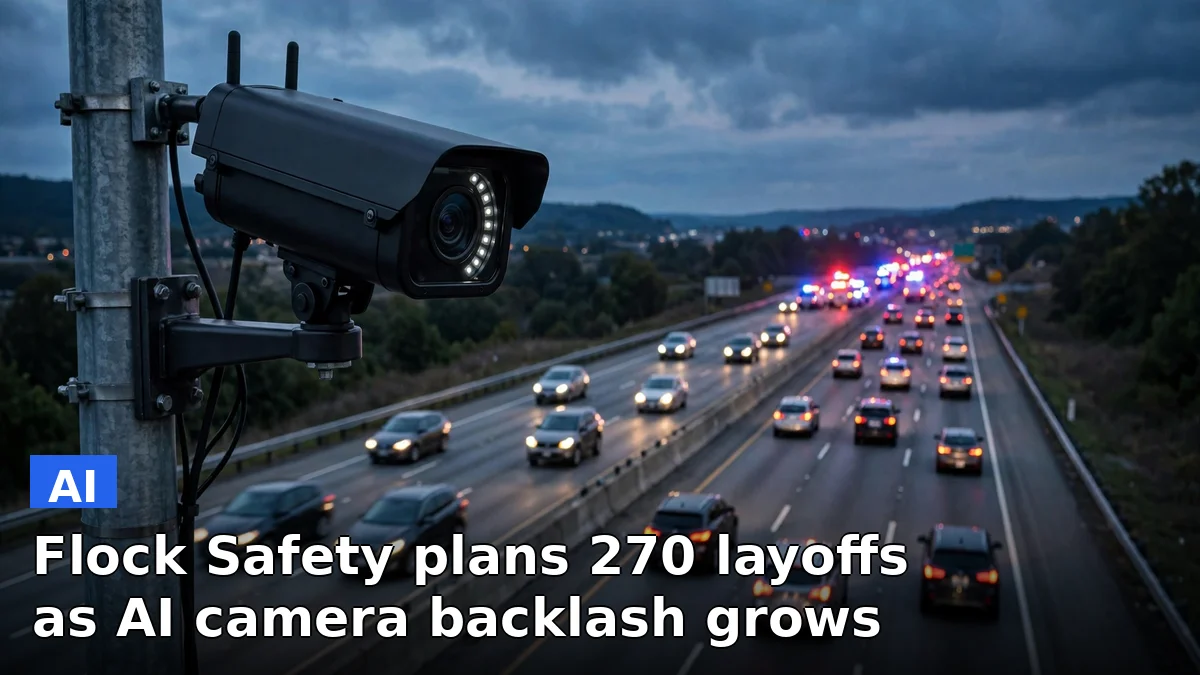
Flock Safety plans to eliminate about 270 jobs — 18% of its roughly 1,500-person workforce — as public backlash over its AI-powered license-plate cameras finally catches up to the company itself, Reuters reported Thursday.
The cuts are expected to take effect at the end of October. They follow a voluntary separation program Flock opened in September, and they land at a moment when the Atlanta startup’s technology is under sustained attack from the very communities it serves. Sources told Reuters reporters Krystal Hu and Helen Coster that the company declined to comment; the sources spoke anonymously because Flock has not made the plans public.
For a company that built its business on solving crimes, the problem is simple: plenty of Americans now see the cameras as the crime. Flock faces mounting opposition from communities, lawmakers, and regulators, even as venture investors keep backing it. A recent Reuters/Ipsos poll put the split in plain numbers — 38% of Americans support Flock cameras in their community, 47% oppose them.
The Flock Safety layoffs follow a September buyout program
The buyout was the warning shot. WIRED reported last month that Flock asked employees to apply for voluntary separation, and the people familiar with the plans told Reuters the coming cuts arrive after that program. The company hasn’t said how many people took the buyout, or how the cuts will be distributed across departments.
Timing matters here. The voluntary program gave workers until early October to apply, and Flock is expected to accept most applications, according to reporting on the program. The planned layoffs hitting at month’s end suggest the buyout didn’t get the company to the number it wanted — or that this was always a two-step workforce reduction, with the buyout as the polite first step.
Flock declined to comment to Reuters, so the company’s own reasoning remains unconfirmed. What’s confirmed is the math: 270 jobs from a 1,500-person company is a serious restructuring, not routine trimming.
A 120,000-camera network built on borrowed trust
To understand why this hurts, you have to understand what Flock built. Across 49 states, the company has mounted around 120,000 AI-powered cameras on streets and highways. They read license plates automatically, record passing vehicles, and feed the data into investigative software. Flock says the technology helps police investigate and solve crimes.
The sales pitch worked. More than 4,800 law enforcement agencies use Flock’s cameras and software, along with nearly 1,000 businesses. The company, founded in 2017, has raised over $950 million from venture investors — most recently a $275 million round in March led by Andreessen Horowitz that valued the company at $7.5 billion. That money is funding a new US manufacturing facility and a push into drone products.
But the network’s strength became its weakness. Flock’s growth depended on connecting cameras and agencies across jurisdictions into one shared system, and as customers started asking hard questions about data sharing and safeguards, the shared network that made the service useful also made it harder to govern. Founder Garrett Langley started the company after break-ins in his Atlanta neighborhood, betting that neighborhoods and police lacked the tools to solve property crimes. Now public agencies are weighing whether that shared network is something they want to keep buying into.
The scrutiny isn’t abstract. Regulators, lawmakers, and privacy advocates have pressed the company over alleged privacy violations and data-sharing practices, and the polling shows the country is nearly evenly divided. A surveillance company can survive regulators. Surviving a public that doesn’t want you in its neighborhood is a different problem.
The bigger picture
This is a rough week for the AI trade’s confidence story. On the same day Reuters reported the Flock cuts, Australian data center developer Firmus Technologies withdrew its IPO after investors balked at a A$44 billion valuation. And Thursday’s market selloff was triggered by reports that OpenAI’s annualized revenue came in about $20 billion below what investors expected.
None of that directly touches Flock’s books. But it sets the mood. Investors spent two years pricing AI companies as if the demand curve only pointed up. Now they’re asking, in different ways, the same question Flock’s critics have been asking: what happens when the growth story meets resistance it can’t spend its way through?
Flock isn’t a public company, so there’s no share price to punish it. There are only contracts, public meetings, and employees — and the company just signaled that the pressure is real enough to cut one in five jobs. For the surveillance business, which rarely has layoff season, that’s the story in one number.
FAQ
Why is Flock Safety laying off employees?
Reuters reports the cuts — about 270 jobs, or 18% of staff — follow a voluntary separation program and come as communities and lawmakers push back against the company’s AI surveillance cameras. Flock hasn’t made the plans public and declined to comment.
What does Flock Safety do?
Flock Safety makes AI-powered license-plate reader cameras and investigative software used by more than 4,800 law enforcement agencies and about 1,000 businesses. Its network includes roughly 120,000 cameras across 49 states that automatically read plates and record vehicles.
Why are people opposed to Flock cameras?
Privacy advocates, regulators, and lawmakers have raised concerns about data sharing and alleged privacy violations. A recent Reuters/Ipsos poll found 38% of Americans support Flock cameras in their community, while 47% oppose them.
Is Flock Safety in financial trouble?
Nothing public suggests that. The company raised $275 million in March at a $7.5 billion valuation, led by Andreessen Horowitz, and is funding a new US manufacturing facility. The job cuts follow a buyout program, which points to restructuring rather than distress.
Sources: Reuters (Krystal Hu and Helen Coster, Oct. 8), WIRED (Sept. reporting on the voluntary separation program), runtimewire (Ryan Merket, Oct. 8).