
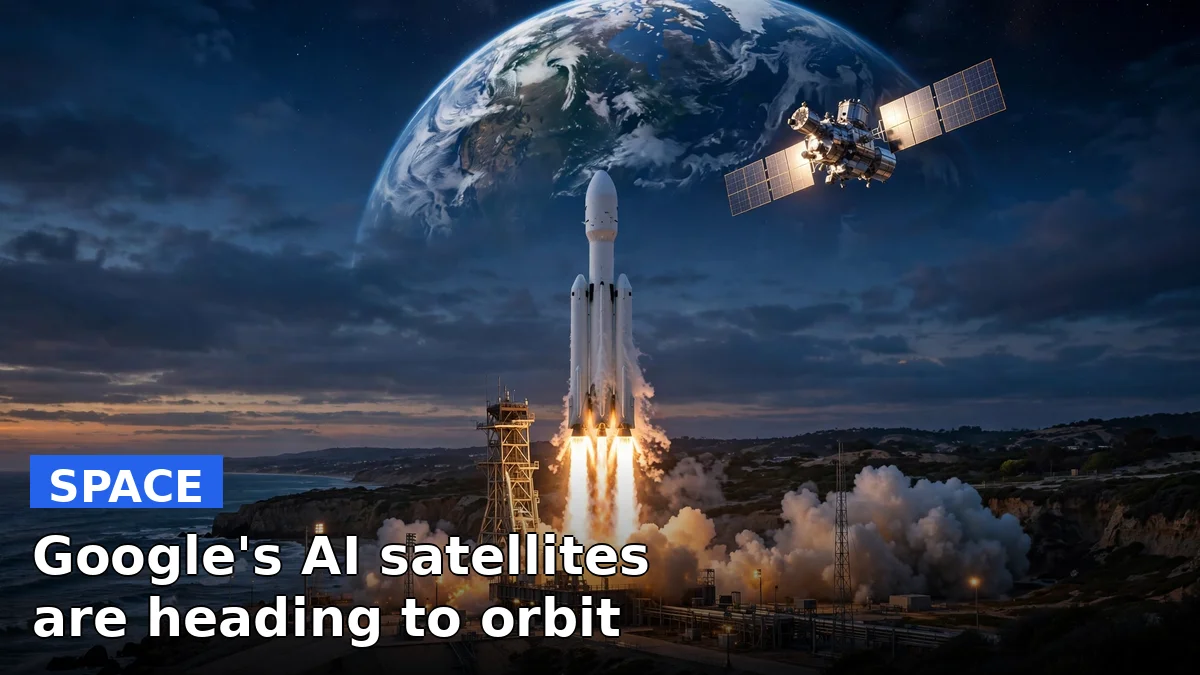
Google is sending its AI to space, and Jeff Bezos is giving it a ride. Blue Origin said Thursday that Google picked its New Glenn rocket to launch AI computing satellites in the first quarter of 2029, the first dedicated heavy-lift flight for Project Suncatcher.
Each satellite will carry Google’s own tensor processing units, or TPUs, with about the computing power of a full rack of servers in a ground-based data center, flying in a sun-synchronous orbit where they can draw on sunlight almost around the clock.
For Google, the deal is a bet that the AI industry’s biggest bottleneck has an answer above the atmosphere. Data centers on Earth already strain local power grids, land, and cooling systems. In orbit, sunlight is free and constant, and there’s no shortage of room.
The catch is the price of getting there.
What Google and Blue Origin agreed
Under the agreement announced November 19, Blue Origin will fly a dedicated New Glenn mission carrying several Suncatcher satellites. Google hasn’t said how many.
“Project Suncatcher is a long-term moonshot to scale AI infrastructure in space by tapping into the abundant solar power in orbit,” Travis Beals, the Google senior director who leads the project, said in a statement. “This dedicated launch with Blue Origin represents a crucial milestone on our roadmap as we expand the boundaries of what’s possible for the future of compute.”
New Glenn is Blue Origin’s heavy-lift rocket, and the company says it can lift 45 metric tons to low Earth orbit inside a seven-meter nose cone. Jordan Charles, senior vice president of New Glenn at Blue Origin, said the rocket’s “heavy-lift capacity and large payload volume give customers the flexibility to bring new capabilities to orbit.”
For Blue Origin, the contract is a high-profile win at a rough moment: New Glenn has run into delays, and a test explosion tied to a BE-4 engine valve in May pushed its next flight to January 2027. A Google mission gives the program a marquee customer while it works through those setbacks.
Why Google wants its AI in space
Suncatcher started on November 4, 2025, as a Google research moonshot to run machine learning on solar-powered satellites linked by lasers. A satellite in the right orbit sees the sun nearly all the time, so its panels never go dark. On Earth, a data center needs land, a grid connection, and huge amounts of water or air for cooling — and all three are getting harder to secure as AI demand grows.
The 2029 mission is the first real test at scale of whether that idea holds together as engineering, not just a slide deck.
A prototype is already up there
This isn’t Google’s first trip to orbit. On October 1, 2026, Google and Planet launched a refrigerator-sized Suncatcher prototype aboard a SpaceX Transporter-18 mission, carrying four Trillium TPUs.
Weeks later, on October 30, Google said the chip had run its Gemma 4 model in orbit and beamed back a short poem while passing over Norway. Engineers are now gathering data on how the TPUs handle launch forces, radiation, and extreme temperature swings.
Two more Planet satellites go up in 2027 to test the laser links. The 2029 mission then scales the test to rack-sized machines — where Suncatcher stops being a demo and starts looking like infrastructure.
The math still doesn’t work — yet
Here’s the problem Google hasn’t solved: rockets are expensive. Google’s own paper on Suncatcher concludes that launch costs need to reach about $200 per kilogram for the yearly cost per unit of power in space to match a data center on the ground. Today’s prices sit at $1,500 to $2,900 per kilogram, roughly 7.5 to 14.5 times above that line.
That gap is the whole gamble. If reusable rockets keep getting cheaper, the economics flip sometime in the 2030s, by Google’s own numbers. If prices stall, Suncatcher stays a research project.
Google is also counting on power costs on Earth to keep rising — AI data centers are already among the largest new loads on several US grids. A satellite dodges that fight, but it trades it for new problems: radiation-hardened hardware, heat management with no air to carry it away, and no technician to call when something breaks 500 miles up.
The bigger picture
Strip away the space-romance framing and Suncatcher is a hedge. Google built TPUs so it wouldn’t depend on Nvidia for AI chips. Now it’s testing whether it needs Earth’s power grid either.
Nobody should expect an orbital data center on a Google Cloud price list next year. The 2029 flight is one mission testing whether rack-scale compute can survive and work in space. But Google booking a heavy-lift rocket three years out says both companies think the question is worth answering with hardware.
If it works, the AI industry gets a new place to put its hungriest workloads. If it doesn’t, Google still learns exactly where the idea breaks — with real satellites, not simulations. Either way, the answer starts arriving in early 2029.
Frequently asked questions
What did Google and Blue Origin agree to?
Blue Origin will fly a dedicated New Glenn mission in the first quarter of 2029 carrying several Project Suncatcher satellites. Each satellite carries Google TPUs with roughly the computing power of a rack of servers in a ground-based data center.
Why does Google want to run AI in space?
Sunlight in orbit is constant, so solar-powered satellites can run heavy AI workloads without straining land, electricity grids, or cooling systems on Earth.
Has Google already put AI hardware in orbit?
Yes. A prototype satellite with four Trillium TPUs launched on October 1, 2026, aboard a SpaceX rocket, and Google said it ran its Gemma 4 model in orbit later that month.
Will space data centers be cheaper than ones on Earth?
Not yet. Google’s own analysis says launch costs need to fall to about $200 per kilogram to match ground data centers, while today’s prices run $1,500 to $2,900 per kilogram.
Sources: USA Today, Reuters, The Times of India, Financial Express.