
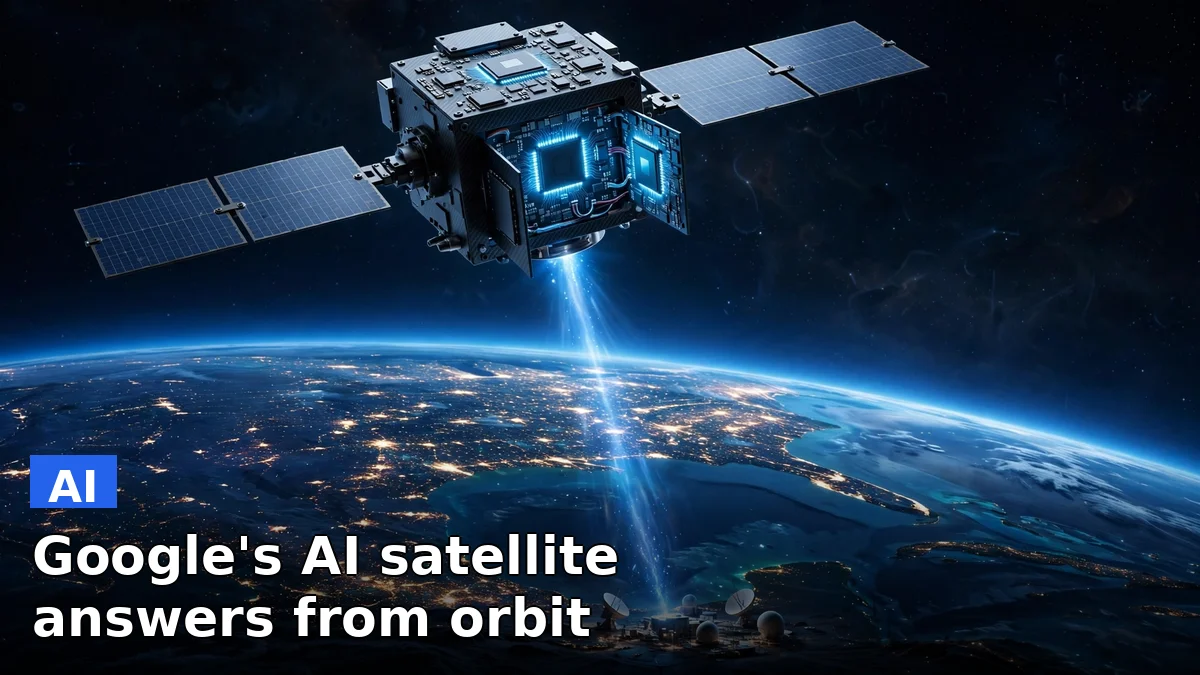
Google’s AI chips just phoned home from space. And their first message was poetry.
On Oct. 30, 2026, Google’s Project Suncatcher prototype answered its first prompt from orbit. Engineers on the ground sent a simple request to an onboard Gemma 4 model running on one of the satellite’s Tensor Processing Units, asking it to write a haiku about being in space. As the spacecraft passed over Svalbard, Norway, the answer came back down: “Blue marble below / Data streams in silent grace / Starlight feeds my core.”
Google calls it the first AI response from a data center-class TPU in orbit. Alphabet and Google CEO Sundar Pichai announced the milestone on X, writing: “After launching our prototype satellite a few weeks ago, we’ve now successfully sent a command up to orbit, booted up the TPU, ran the prompt, and received our first complete response back on earth — a haiku!”
It’s a small poem. It’s also a real engineering result.
What actually happened up there
Project Suncatcher’s prototype, a refrigerator-sized satellite built with Planet Labs, launched Oct. 1, 2026, aboard a SpaceX Falcon 9 on the Transporter-18 rideshare mission, alongside more than 100 other spacecraft. LexxWire covered the launch at the time; this week’s test is the first time the hardware has actually done AI work in orbit.
Commissioning took about a month. Google’s team powered up the satellite’s host computer and its TPU trays, ran early machine learning checks, and waited for a good ground-station pass. During that pass, engineers uplinked the prompt to Gemma 4, Google’s open model, which was already loaded on the satellite. Running a prompt on a loaded model, inference in industry terms, is far less demanding than training one. That’s the point: this test proves the chip can run at all in orbit, not that it can do everything a ground data center does.
Google didn’t stop at one poem. After the haiku, the team tried space-themed limericks and prompts asking the model to report the technical status of the satellite’s systems. A Google spokesperson told TechCrunch the satellite is operating nominally.
Why a haiku is the right test
A haiku looks like a stunt. For an engineer, it’s a clean end-to-end check: a command goes up, a chip boots, a model runs, and a finished answer comes back down through a ground station. If any link in that chain fails, the radio, the chip, the cooling, the model, you get nothing. Google got a poem.
Travis Beals, Google’s Senior Director for Paradigms of Intelligence, described the result as the mission’s “Hello World” milestone in a Google blog post dated Oct. 30. “Our chips have officially earned their space wings,” the post said.
That framing matters because it sets expectations honestly. Nobody at Google is claiming this satellite is a data center. It’s a prototype answering short prompts, and the company has been upfront about that from the start.
The hard parts: heat, radiation, and one kilowatt
Space is a brutal place to run a computer chip, and power is the tightest constraint of all. The prototype generates up to 1 kilowatt of electricity from its solar panels, TechCrunch reported, which means it can run only one of its four TPUs at a time, for about 20 minutes per pass. Then the chip has to shut down and cool off.
Cooling is the problem most people miss. On Earth, data centers blow air or pump water over hot chips. In orbit, there’s no air. Heat can only leave by radiation, slowly, into the vacuum. A chip that runs too long cooks itself. That’s why the satellite’s runs are short by design.
Radiation is the other test ahead. High-energy particles can flip bits in memory and corrupt data without triggering normal error checks. Google says its ground tests in particle accelerators suggested radiation matters less for inference — running a finished model — than for training one. Now the company gets to find out whether that holds true in actual orbit. The next phase of testing will measure how the TPUs perform under thermal stress and radiation exposure.
What comes next for Project Suncatcher: two satellites, then a constellation
If the chips hold up, Google plans to launch two interconnected satellites in 2027. That step tests something the single prototype can’t: whether spacecraft can talk to each other with high-speed links and share work. Longer term, Google has studied designs for clusters of more than 80 satellites linked by laser connections.
Don’t hold your breath for an orbital data center. Even Google’s own researchers have acknowledged the scale problem: one peer-reviewed analysis cited by TechCrunch estimated SpaceX would need to fly its Starship rocket about 1,800 times to reach the kind of cost reductions seen with earlier rockets. Launch costs, not chip performance, may be the real ceiling on this idea for years.
Why this matters
Here’s the honest read. A haiku from orbit doesn’t change anyone’s computing bill tomorrow. What it does is move Project Suncatcher from a launch press release to a working experiment. Every AI company right now is hitting the same wall on Earth: power grids that can’t build fast enough, land near cities that’s already taken, and cooling water that’s getting politically expensive. Google’s bet is that sunlight in orbit (five to eight times more energy per panel than the same panel gets on Earth, according to Beals) is worth solving a set of much weirder engineering problems.
That bet could still fail. Radiation could prove nastier than the lab tests suggested. Thermal limits could cap orbital chips at short bursts forever. Launch economics could keep the whole idea a research curiosity. But as of Oct. 30, the chips work, the model runs, and the poem came home. For a moonshot, that’s a real first step — and a reminder that the AI infrastructure race isn’t only happening in data centers. Some of it is happening 500 kilometers up, one haiku at a time.
Frequently asked questions
What is Google’s Project Suncatcher?
Project Suncatcher is Google’s research effort to find out whether AI computing can one day run in space. Solar-powered satellites carrying Google’s TPU chips could sidestep Earth’s crowded power grids, scarce land, and water-hungry data centers.
What was the first AI response from orbit?
A haiku about being in space, written by Google’s open Gemma 4 model running on a data center-class TPU aboard the Suncatcher prototype: “Blue marble below / Data streams in silent grace / Starlight feeds my core.”
When did Google’s Project Suncatcher satellite launch?
The prototype launched Oct. 1, 2026, aboard a SpaceX Falcon 9 on the Transporter-18 rideshare mission. It was built with Planet Labs and spent about a month in commissioning before its first AI test.
What happens next for Project Suncatcher?
Google will test how its TPUs hold up under thermal stress and radiation in orbit, then launch two interconnected satellites in 2027 to test links between spacecraft — the next step toward larger orbital computing clusters.
Sources: Google blog, The Verge, TechCrunch, The Economic Times, Firstpost.