
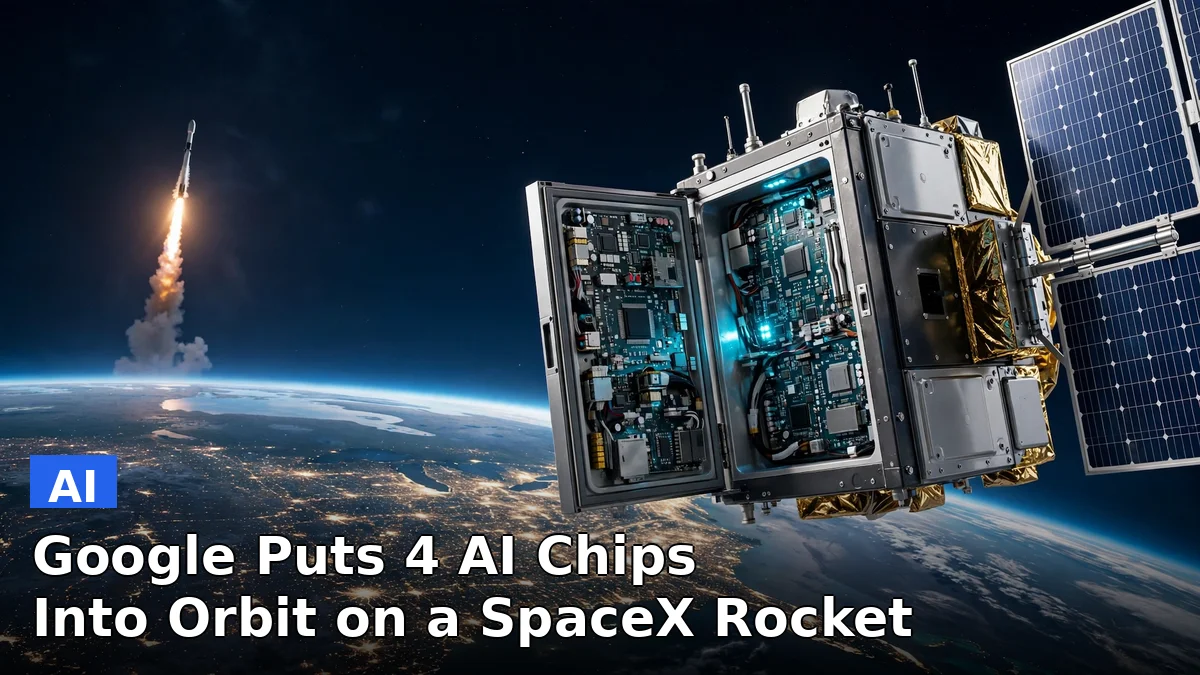
Four of Google’s AI chips are going to space today.
A refrigerator-sized satellite called MVP is scheduled to lift off aboard a SpaceX Falcon 9 on the Transporter-18 rideshare mission, with the launch window opening at 11:18 a.m. PT from Space Launch Complex 4E at Vandenberg Space Force Base in California. Inside it: four Google Trillium Tensor Processing Units, about a kilowatt of solar power, and one blunt engineering question — can Google’s AI hardware survive and actually run in orbit?
Google announced the mission on September 24 in a blog post from Travis Beals, Senior Director for Paradigms of Intelligence, under the banner of Project Suncatcher, the company’s moonshot exploring whether future AI infrastructure could live in space. The satellite was developed with Planet Labs, the satellite imaging company, which integrated Google’s AI hardware into an existing spacecraft platform rather than building a new one from scratch.
A test of survival, not a space data center
Let’s be clear about what this flight is. MVP is a hardware-survival test, not a working orbital data center. Google says the satellite will evaluate how its TPUs handle launch vibration, radiation, and the thermal swings of low Earth orbit. That’s it.
The compute plan is deliberately modest. The four chips will process short Gemini workloads for roughly 15 minutes at a time before shutting down to cool off. That sounds underwhelming next to a terrestrial data center, where thousands of accelerators run around the clock. But a ground data center doesn’t have to reject heat into a vacuum. In space, there’s no air to carry heat away, and cooling is the hard problem Google wants to study. The 15-minutes-on, cooldown-off cadence is the honest shape of the experiment.
Google’s framing of the mission is refreshingly direct. “Can our TPUs survive and operate in space? Well, we’re going to find out,” Sundar Pichai, CEO of Google and Alphabet, told Aviation Week. The mission is designed to operate for about a year and will deorbit within roughly six years.
Why Google wants its AI chips up there
The pitch for Project Suncatcher, which Google announced in November 2025, is mostly about energy. Solar panels in the right orbit soak up far more sunlight than the same panels on Earth — no night, no clouds, no atmosphere in the way. “If you put a solar panel in the right orbit, it generates five to eight times more power than that same panel down on Earth,” Beals said.
Data centers are running into the physical limits of Earth’s grids. Land, power, and the water used for cooling are all getting scarce near the places AI infrastructure wants to be built. Orbit has none of those constraints. But it has its own, much weirder ones.
“How can we efficiently scale AI infrastructure through orbital data centers by leveraging the abundant energy we get from the Sun?” asked Maria Biggs, engineering director at Google, in the Aviation Week report. That’s the thesis in one sentence: abundant solar power plus the vacuum’s cooling problem, and Google wants to find out which side of that trade wins.
What Google already put the hardware through
The launch is not the first stress test these chips have seen. Google described shaking the satellite along all three axes to mimic launch vibration, with spacecraft-level loads of up to 10 g and forces on individual components — TPUs included — in the 50-to-100 g range. A Falcon 9 ride into low Earth orbit takes about 10 minutes; the violent part is short, but it’s brutal.
Radiation got its own trial. Google says it tested Trillium TPUs with a proton beam at UC Davis’s Crocker Nuclear Laboratory, and the chips withstood a total ionizing dose greater than the shielded dose the company expects over a five-year mission. Ground tests can only tell you so much, though. Nobody’s flown this hardware before, and the space environment has a way of finding the failure modes your lab didn’t.
The road after MVP
If today’s flight goes well, Google has a bigger one lined up. The company plans to launch two more satellites in early 2027 to validate optical inter-satellite links: high-speed laser connections between spacecraft, which would be essential for any cluster of computing satellites to work together. Beyond that, designs are under study for clusters of more than 80 satellites tied together by optical links in dawn-dusk orbit.
Google isn’t alone up there. Aviation Week noted that SpaceX itself has orbital data center ambitions — which makes today’s arrangement, Google flying its AI hardware on a SpaceX rocket, a nicely awkward piece of business. Other players including Starcloud, NVIDIA, AMD, and Axiom Space are all positioning for orbital compute too. The race to the data center’s final frontier has already started.
Why this matters
Don’t mistake MVP for a moonshot stunt. Today’s flight is tiny: four chips, 15-minute runs, one year of data. But it’s the first physical artifact of a serious bet that AI infrastructure’s biggest bottleneck — energy — has an answer 300 miles up. If Trillium chips come back from this mission having survived launch, radiation, and thermal cycling with useful data, the 2027 optical-link demo becomes a real engineering program instead of a thought experiment. And if they don’t survive, Google learns exactly why for the price of one rideshare slot.
Either way, the most interesting thing about today’s launch isn’t the satellite. It’s the admission behind it: the data center of the 2030s might not be a building at all.
Frequently asked questions
What is Google’s Project Suncatcher? Project Suncatcher is Google’s research moonshot to find out whether AI computing infrastructure can one day run in space. The idea: solar-powered satellites carrying Google’s AI chips could bypass Earth’s power grids, land limits, and water-hungry data centers.
What is Google launching into space on October 1? A refrigerator-sized prototype satellite called MVP, built with Planet Labs, carrying four Google Trillium Tensor Processing Units. It rides a SpaceX Falcon 9 on the Transporter-18 rideshare mission from Vandenberg Space Force Base in California, with the launch window opening at 11:18 a.m. PT.
Will the satellite work as an AI data center? No. MVP is a survival test, not a production system. Its chips will run Gemini workloads for about 15 minutes at a time before shutting down to cool, collecting data on how Google’s TPUs handle launch forces, radiation, and the thermal extremes of low Earth orbit.
What comes after this test flight? Google plans a two-satellite launch in early 2027 to test optical links between spacecraft, and is studying designs for clusters of more than 80 satellites connected by high-speed laser links.
Sources: Aviation Week, Ars Technica, The New York Times, Google