
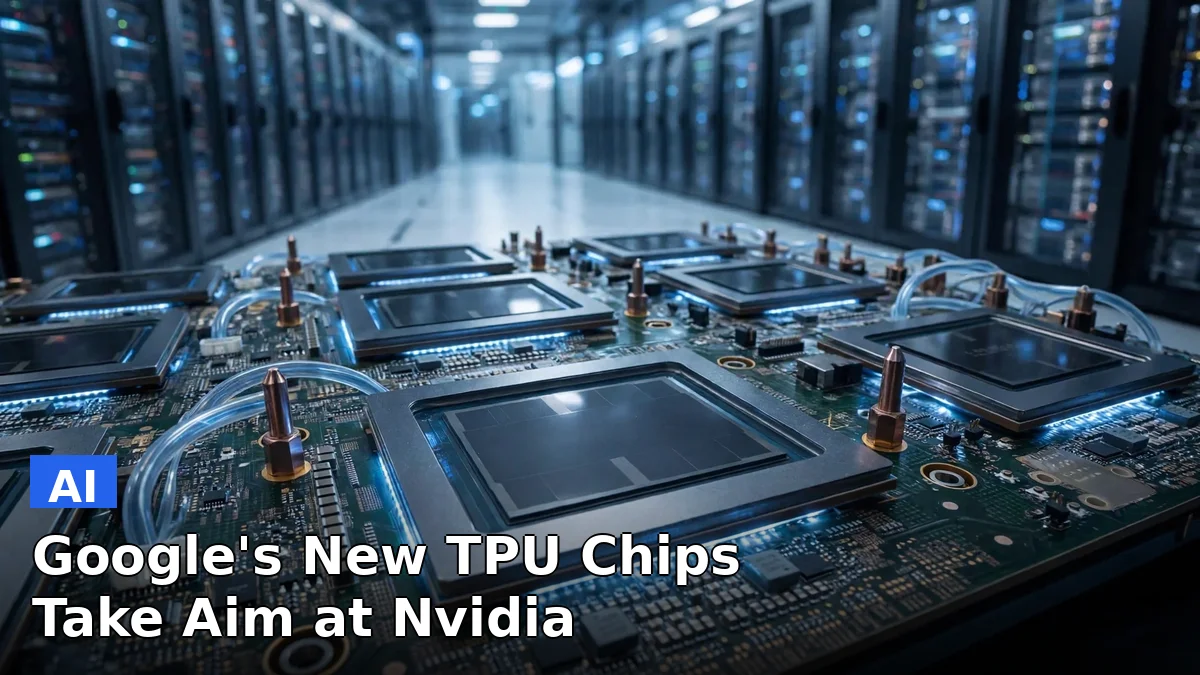
Google rolled out two more of its custom AI chips on Monday, and the company says it has now shipped four new TPU systems in a single year — a first in the decade-plus history of its in-house silicon. The new systems are TPU 8tx, built for confidential inference, and TPU 8i Max, built for AI agents that chew through massive context windows.
The announcement came Monday morning from Amin Vahdat, Google’s senior vice president and chief technologist for AI and infrastructure. It fills out an eighth-generation TPU lineup that started in April with the 8t training chip and the 8i reasoning chip. “This is the first time we have introduced four TPU systems in a single year,” Vahdat wrote in the announcement.
Google gave no prices and no ship dates for either system. Bloomberg reported that both are due in 2027, and framed the launch as Google’s latest push against Nvidia, whose GPUs still run most of the AI industry’s training and inference.
What the Google TPU 8tx and 8i Max chips actually do
TPU 8tx is aimed squarely at customers who can’t afford a leak. Banks, governments and other regulated enterprises run frontier or proprietary models next to their most sensitive data, and the usual setup has a weak spot: data is encrypted when stored or sent over a network, but it has to be unlocked in memory while a computer processes it.
The 8tx attacks that gap in hardware. It’s built on the same silicon as the TPU 8t training chip and paired with 5th Generation AMD EPYC CPU hosts, with security baked into the hardware layer so data and model weights stay protected and isolated even while in active use. Google says it delivers up to 2x lower latency than TPU 8t by borrowing the Boardfly network built for the 8i, with a near-zero performance penalty from the security layer.
It’s not inference-only, either. Because it pairs training-grade compute with a fast inference network, teams can fine-tune models on private data, distill large models into smaller ones and train agents through reinforcement learning on one system — no need to shuttle sensitive data between separate clusters.
TPU 8i Max solves a different problem: the memory wall. When dozens of AI agents work together across an entire software codebase or hours of video at once, memory bandwidth becomes the bottleneck fast. Google’s answer is to put two low-latency TPU 8i chips onto a single package, doubling the compute, SRAM and high-bandwidth-memory bandwidth of a single 8i.
The numbers, as reported by Network World: 768 MB of on-chip SRAM, 17.2 TB/s of memory bandwidth and 384 GB of high-bandwidth memory. And because the dual-chip package fits twice the silicon into the existing rack footprint, data centers can pack far more computing power into the same floor space and power budget.
Nvidia should take notice.
Four chips in one year is the point
Google’s argument is that a new chip and a new system are two very different things. Designing a new chip means laying out billions of transistors on a silicon wafer, a multi-year process. A system is about how you package the compute, networking and storage around chips you already have — and that can be reconfigured in months.
“When we built our very first TPU more than a decade ago, we knew AI software would evolve much faster than silicon manufacturing ever could,” Vahdat wrote. That bet on modularity is what lets Google ship four systems in a year while a new chip generation takes far longer.
The business behind the hardware is growing fast. Google says TPUs now have nearly 100 customers, from frontier AI labs to trading firms, retailers and universities. Google Cloud revenue rose 103% year over year to $30.7 billion in the third quarter, according to parent company Alphabet’s earnings — growth Google credits in part to demand for its AI infrastructure.
The April chips set the baseline for this generation. TPU 8t, the training workhorse, offers up to 2.7 times better training performance than the previous generation, with superpods that scale to 9,600 chips and two petabytes of shared high-bandwidth memory. TPU 8i, the reasoning engine, pairs 288 GB of high-bandwidth memory with 384 MB of on-chip SRAM and offers 80% better inference price-performance than the last generation, according to Google.
The software push matters as much as the silicon
Google didn’t just announce hardware. It also used the post to push a set of software moves aimed at making TPUs as easy to use as general-purpose hardware — a long-standing complaint about its custom chips.
Last month, Google open-sourced TorchTPU, so PyTorch code and Hugging Face models now run natively on TPUs. A new open-source TPU agent suite, now in preview, plugs into coding tools like Claude Code, Cursor and Google Antigravity to automate TPU onboarding, diagnose bottlenecks and autotune custom kernels in plain language. And a new XLA Serving Engine lets teams train models in Python and serve them from a low-latency C++ runtime across TPUs, GPUs and CPUs.
Two more pieces target the way agents actually behave. Agent Compute Engine, new software that automatically suspends idle agent sessions and shifts working memory off the chip in milliseconds, cuts the cost of agents that pause for seconds or hours waiting on a database, a tool or a human. TPU Sync, now open-sourced, turns chip memory, host DRAM, shared storage and the data center network into a single memory hierarchy — Google says it cuts KV transfer latency and time to first token by more than 90%.
Cloud Pathways, which brings the Google DeepMind runtime behind Gemini to every Google Cloud customer, is now generally available on Google Kubernetes Engine. GKE dynamic slicing is also generally available, letting operators assemble TPU cubes into larger topologies or split them into smaller isolated workloads on the fly; Google says it cuts job startup times by up to 5x and speeds fault recovery by up to 4.5x.
Why this matters
Strip away the spec sheets and Google is making a bet about where AI workloads are headed: toward agents that hold huge amounts of context in memory, and toward regulated customers who want those agents working next to data that can’t leave the building. TPU 8tx and TPU 8i Max are built for exactly those two jobs, and the four-systems-in-a-year cadence says Google can now iterate on packaging faster than Nvidia can iterate on silicon.
The honest caveat is that every performance figure in this story is Google’s own. No independent benchmarks exist for either new system, no customer was named for them, and no prices or ship dates were published. The 2027 arrival date comes from Bloomberg, not from Google, which means customers can’t run these chips tomorrow.
Still, the direction is hard to miss. Nvidia sells the fastest general-purpose AI chips on the market. Google is selling purpose-built systems for each stage of the AI lifecycle — training, reasoning, confidential computing and long context — plus the software to run them. If agents keep getting bigger and more regulated, that pitch gets harder to ignore.
Frequently asked questions
What is Google TPU 8tx?
TPU 8tx is Google’s new system for secure and confidential AI inference. Built on the same silicon as the TPU 8t training chip and paired with 5th Gen AMD EPYC hosts, it keeps sensitive data and model weights protected in hardware while they are being used, and Google says it delivers up to 2x lower latency than TPU 8t.
What is Google TPU 8i Max?
TPU 8i Max packs two TPU 8i chips into a single package for workloads with massive context windows. Google says it doubles the compute, SRAM and high-bandwidth-memory bandwidth of a single TPU 8i, with 768 MB of on-chip SRAM and 17.2 TB/s of memory bandwidth, according to Network World.
When will Google TPU 8tx and TPU 8i Max be available?
Google has not given prices or ship dates for either system. Bloomberg reported that both systems are due in 2027, framing the launch as Google stepping up its rivalry with Nvidia.
How do Google’s new TPUs compare to Nvidia’s GPUs?
Google positions its TPUs as purpose-built systems for training, reasoning, confidential computing and long-context work, and says TPUs now serve nearly 100 customers. But no independent benchmarks exist for TPU 8tx or TPU 8i Max yet, and Nvidia’s GPUs still run most of the AI industry’s training and inference.
Sources: Google (company blog), The Verge, Bloomberg, Network World