
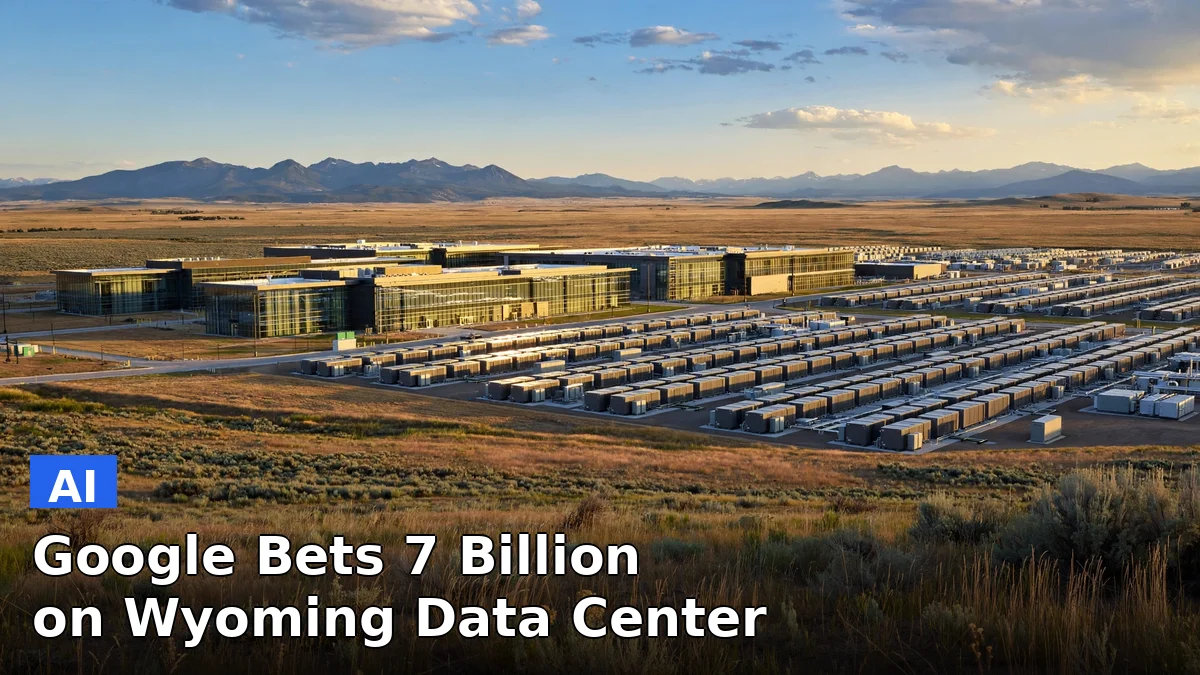
Google is going to Wyoming. The company announced Thursday that it will build its first data center in the state, a $17 billion bet on Laramie County that pairs the campus with one of the largest carbon-capture power projects ever tied to a tech company.
The Google Wyoming data center will sit near Cheyenne, built with Tallgrass Energy, Black Hills Energy, American Electric Power (AEP) and Related Digital. Google hasn’t said when the campus itself will open, but the power plant behind it has a date: AEP and its partners plan to start construction in 2026 and have it fully running by the end of 2028.
The timing is the story. Google announced the deal two days after voters in the November 3 midterms rejected data centers in 40 of 41 local ballot measures across 10 states, according to CNBC. OpenAI published its own community compact the same day, promising to pay full power costs at future campuses. Big Tech is now negotiating its buildout in public, town by town, and Wyoming is the first test of the new pitch.
The power plan behind the Google Wyoming data center
Most data centers plug into the grid and leave the power problem to someone else. This one comes with its own plant.
Google contracted with AEP for a 702-megawatt fuel-cell development with carbon capture and storage (CCS), which the company calls first of its kind at commercial scale and the largest planned project of its type. Fuel cells turn natural gas into electricity through a chemical reaction instead of burning it, and Bloom Energy will manufacture the cells in the United States. The capture system is designed to trap a large majority of the plant’s carbon emissions and store them permanently underground at Tallgrass’s Eastern Wyoming Sequestration Hub.
AEP disclosed the other half of the deal on October 14: it plans to invest about $4 billion in the 702 MW fuel-cell project near Cheyenne under a 20-year power purchase agreement with Google. Google will buy power from Cheyenne Fuel Cell, LLC, which is roughly 92% owned by AEP and nearly 8% owned by funds advised by Basalt Infrastructure Partners.
Google will also draw power from gas generators run by Tallgrass and Black Hills Energy, and it’s studying whether to fit Tallgrass’s combined-cycle turbines with carbon capture too. That part is still a study, not a commitment. Taken together, the Wyoming deal brings Google’s total contracted carbon-capture capacity to nearly 1 gigawatt.
“We will pay for 100% of the power we use, and when we build data centers, we’ll cover the infrastructure needs directly driven by our growth,” Steve Walter, Google’s vice president of global infrastructure and energy, wrote in the announcement.
Water gets a mention too. The campus will be air-cooled to limit strain on local water supplies, and Google says it will invest in local water-replenishment efforts.
Why Wyoming, and why now
Wyoming has what the AI buildout keeps running out of: room, cheap gas and a place to put carbon. Tallgrass’s sequestration hub predates Google’s arrival by years — the company won a Wyoming Energy Authority grant to develop it back in January 2022 — and the geology that made the state a coal and gas producer now makes it a candidate for burying emissions.
There’s also a less technical reason. Wyoming’s state government has spent years courting data centers, and Cheyenne sits on fiber routes between Denver and Salt Lake City. Google’s announcement makes it the latest hyperscaler to plant a flag in a state with fewer neighbors to object — though as this week’s ballot results show, even friendly states have limits.
Google isn’t starting from zero on carbon capture. Its first CCS agreement, announced in October 2025, backs the Broadwing Energy project in Decatur, Illinois, a plant of more than 400 MW that aims to capture about 90% of its carbon dioxide, with commercial operation targeted for early 2030. Wyoming is the second and far bigger swing.
What Cheyenne gets out of it
Google’s pitch to Laramie County leans hard on money and jobs. The company says the project will generate hundreds of millions of dollars in local property taxes for Laramie County and School District 1, on top of community investment focused on K-12 education, workforce development and skilled-trades training.
Company representatives have already been working the room. Google and its partners held a community meeting in downtown Cheyenne, where they spoke with more than 200 residents, and hosted a Community Day at the Cheyenne Children’s Museum. Now Google, Tallgrass, Black Hills, Related Digital, AEP and Bloom Energy are setting up a Community Council meant to work through the side effects of data-center growth in Cheyenne — traffic, housing, power prices — before they become fights.
That last part matters more than the tax figure. Residents at the meeting asked for a fuller picture of the economic benefits, more detail on careers and job training, and attention to how growth affects the community. A council doesn’t answer those questions, but it gives Google a place to keep answering them in public.
The bigger picture
Step back and the Wyoming announcement looks less like a real-estate deal than a template. Voters just told the industry to slow down. Google’s answer is a package: we’ll pay our own power bill, we’ll build the clean-ish generation ourselves, we’ll cool with air instead of water, and we’ll sit on a council with the neighbors.
Whether that package holds up depends on execution nobody has seen yet. Carbon capture at this scale has a thin track record, and the 702 MW plant’s capture rate is a design target, not a measured result. The data center’s own opening date is still blank. And $17 billion is a long-term figure — Google hasn’t said how much arrives in year one versus year ten.
Still, the direction is clear. After a week in which AI stocks lost trillions and voters rejected new data centers almost everywhere they got the chance, the companies building the AI boom are learning to sell the power plant and the community council along with the servers. Wyoming is where Google is trying it first.
Sources: Google (The Keyword blog), Securities.io, Unite.AI, Reuters, Wyoming USA Wire.
FAQ
How much is Google investing in its Wyoming data center?
Google says it is making a long-term, $17 billion investment in its first Wyoming data center, in Laramie County near Cheyenne. The company has not said how the money breaks down across phases or when the campus will open.
How will the Google Wyoming data center get its power?
Much of it will come from a 702 MW fuel-cell development contracted with American Electric Power, using natural gas with carbon capture and storage. Google will also buy power from gas generators run by Tallgrass Energy and Black Hills Energy, and says it will pay for 100% of the power it uses.
When will the Wyoming data center be built?
AEP and its partners plan to start building the fuel-cell plant in 2026 and have it fully running by the end of 2028. Google has not given a construction timetable or opening date for the data center itself.
Why did Google pick Wyoming for a data center?
Wyoming offers space, natural gas and a carbon-storage hub, and the project pairs the campus with a 702 MW fuel-cell plant with carbon capture. The announcement also landed two days after voters rejected data centers in 40 of 41 local ballot measures, so Google is pitching the deal as a model for winning community support.