
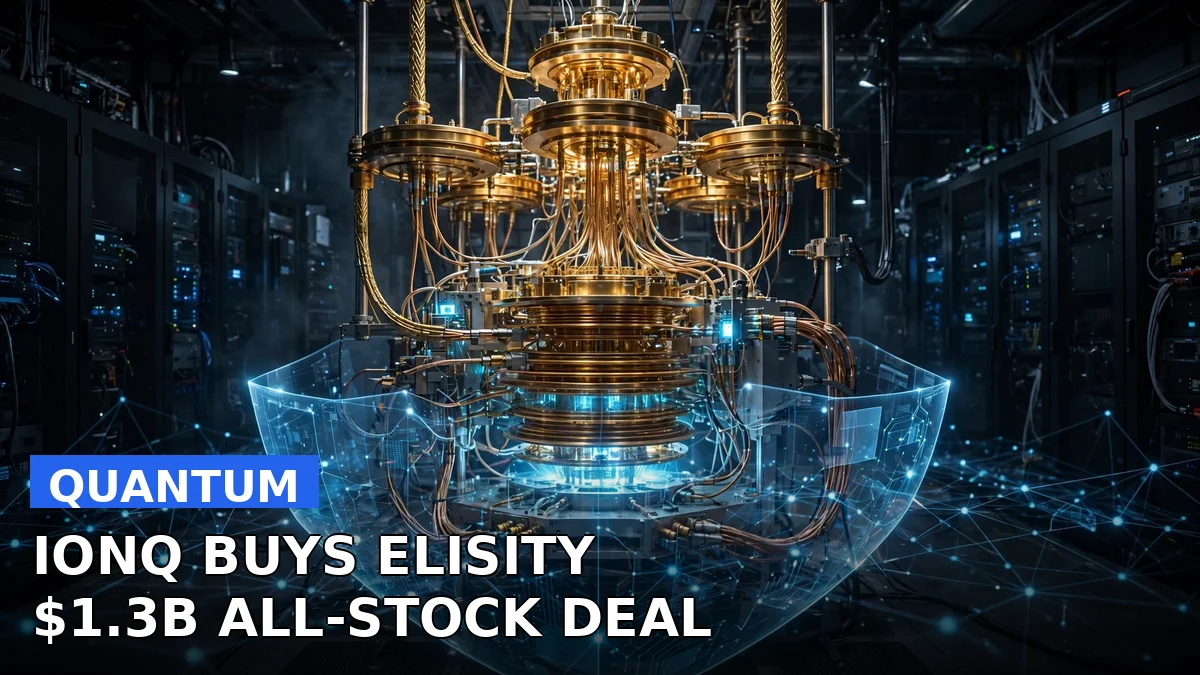
IonQ is going all in on cybersecurity. The quantum computing company said Monday it has agreed to buy Elisity, a zero-trust security firm, in an all-stock deal worth up to $1.3 billion — the priciest purchase in IonQ’s history and the clearest sign yet that quantum computing and cybersecurity are becoming the same business.
The IonQ Elisity acquisition was announced in an IonQ press release and reported by Reuters, Barron’s, and Investor’s Business Daily. Up to $150 million of the headline value comes as earnouts tied to Elisity’s performance after closing, so the final price depends on how the business does. The number of IonQ shares changing hands will be set off the 20-day volume-weighted average price before closing, with a floor of $33.07 and a ceiling of $49.61 per share. IonQ expects the deal to close in the fourth quarter of 2026, subject to regulatory approval, and Elisity CEO James Winebrenner will stay on to run the business.
CEO Niccolo de Masi isn’t being subtle about why he’s buying. “Q-Day is coming much faster than predicted,” he said, using the industry’s term for the day a quantum computer gets powerful enough to crack the public-key encryption that guards bank accounts, hospital records, and government email. Security researchers have warned for years about “harvest now, decrypt later” attacks — adversaries stealing encrypted data today in hopes of unlocking it with a quantum machine tomorrow. De Masi told the Wall Street Journal the risk is already here: “The bad guys are going to keep taking advantage of new technology. Unfortunately, we are entering the most dangerous years, vis-a-vis cybersecurity risks.”
What IonQ actually gets
Elisity is seven years old and not a household name. Founded in 2019 and based in San Jose, it builds identity-based microsegmentation: software that decides which users, devices, workloads, and AI agents are allowed to talk to each other on a corporate network, then enforces least-privilege rules so an intruder can’t hop from one machine to the next.
That is unglamorous work. It is also becoming mandatory work. Gartner expects 60% of enterprises pursuing zero-trust architecture to run more than one form of microsegmentation by 2026, up from under 5% in 2023, and Elisity’s customers skew heavily toward hospitals and health systems, organizations with sprawling device fleets and almost no tolerance for downtime.
The business itself looks healthy. IonQ says Elisity has more than 100 global customer deployments, has doubled its revenue and customer base year over year, and has zero customer churn. It raised $37 million in a Series B round led by Insight Partners in 2024, with backing from AllegisCyber Capital and Two Bear Capital, bringing total funding past $72 million. A $1.3 billion exit is a big multiple on that, which is exactly why the earnout structure matters. IonQ is paying partly in promises.
Winebrenner put the pitch plainly in a blog post on the deal: “Our customers need to prioritize post-quantum cryptography initiatives while securing existing assets to keep essential operations running.”
Why a quantum computer company wants a firewall company
The deal pairs two different kinds of defense. IonQ already sells post-quantum cryptography (PQC) and quantum key distribution (QKD) hardware, including the Clavis XG Multiplex launched in June, which guards data moving across fiber-optic networks. Elisity’s software-defined zero trust handles today’s threats: ransomware, intruders, rogue AI agents wandering corporate networks. Together, IonQ says, they cover the transition from now to the quantum era.
The White House angle is explicit. IonQ’s press release said the acquisition accelerates the effort to “secure the nation for the quantum era” under a White House executive order signed June 22, 2026 — and the combined company will target both enterprise and government buyers, including federal agencies under post-quantum mandates. The prize IonQ cites: a microsegmentation market worth more than $10 billion, growing at double-digit rates.
Investors are not thrilled
Wall Street’s reaction was swift. IonQ shares tumbled about 9% on Monday to near $36, adding to a rough stretch — the stock was already down 11% in 2026 as of Friday’s close. A $16 billion company paying up to $1.3 billion in stock is dilution no matter how you slice it, and some investors worry IonQ is sprinting before its core quantum business can support the weight.
Cantor analyst Troy Jensen struck a more balanced note, telling Barron’s that Elisity brings a “high-growth enterprise security business” and an “expert team” to IonQ. But even the bullish case has a caveat worth repeating: this is an agreement, not a closed deal. The price, the share count, and the closing itself are all still moving targets.
IonQ’s buying spree shows no signs of slowing
The Elisity deal caps a remarkable acquisition run. Earlier this year IonQ paid $1.8 billion for SkyWater Technology, the Bloomington, Minnesota chipmaker, to bring semiconductor manufacturing in-house for its quantum processors. Last year it bought Oxford Ionics, whose proprietary technology helped IonQ claim a record in quantum performance and advance in a federal benchmarking program. Vector Atomic, Lightsynq, and Capella are also on the shopping list.
De Masi has described the endgame as becoming the quantum industry’s largest “merchant supplier” — one full-stack platform across quantum computing, networking, sensing, and now cybersecurity. “Just as adding SkyWater Technology expanded IonQ’s capabilities in chip design, fabrication and packaging, Elisity will bring proven enterprise policy enforcement scale and deployment experience to our quantum security strategy,” he said in a statement.
Why this matters
Quantum computing stocks have always sold a story about the future. This deal sells protection for the present — and that is a telling shift. If Q-Day really is arriving faster than predicted, the company that owns the enterprise security relationship owns the upgrade cycle: every bank, hospital, and federal agency will need someone to hold its hand through the migration to post-quantum encryption.
Don’t overread the headline number, though. $1.3 billion is the maximum, not the guaranteed payout. The earnout clause is there because IonQ isn’t sure Elisity’s growth will keep doubling. And a deal this size, in a sector this sensitive, doesn’t glide through regulatory review by default. The Q4 2026 closing target is aspirational until it isn’t. Still, the direction is unmistakable: the quantum race is no longer just about who builds the best qubit. It’s about who sells the shield when the qubit arrives.
FAQ
What is the IonQ Elisity acquisition? IonQ agreed on October 12, 2026 to acquire zero-trust cybersecurity firm Elisity in an all-stock deal worth up to $1.3 billion, including up to $150 million in performance-based earnouts. It is expected to close in the fourth quarter of 2026, pending regulatory approval.
What does Elisity do? Founded in 2019, Elisity sells identity-based microsegmentation software — a zero-trust tool that stops attackers and ransomware from moving between machines once inside a network. It has more than 100 global customer deployments, many of them hospitals and health systems.
What is Q-Day? “Q-Day” is the industry term for the point when a quantum computer becomes powerful enough to crack the public-key encryption that protects nearly everything online. IonQ CEO Niccolo de Masi says that day is “coming much faster than predicted.”
How did IonQ stock react to the deal? Shares tumbled about 9% on Monday to near $36, with investors weighing the cost of paying stock for the deal and concerns that IonQ is expanding too quickly. The company’s market value sits around $16 billion.
Sources: Reuters, Wall Street Journal, Barron’s, Investor’s Business Daily, SecurityWeek, Startup Fortune.