
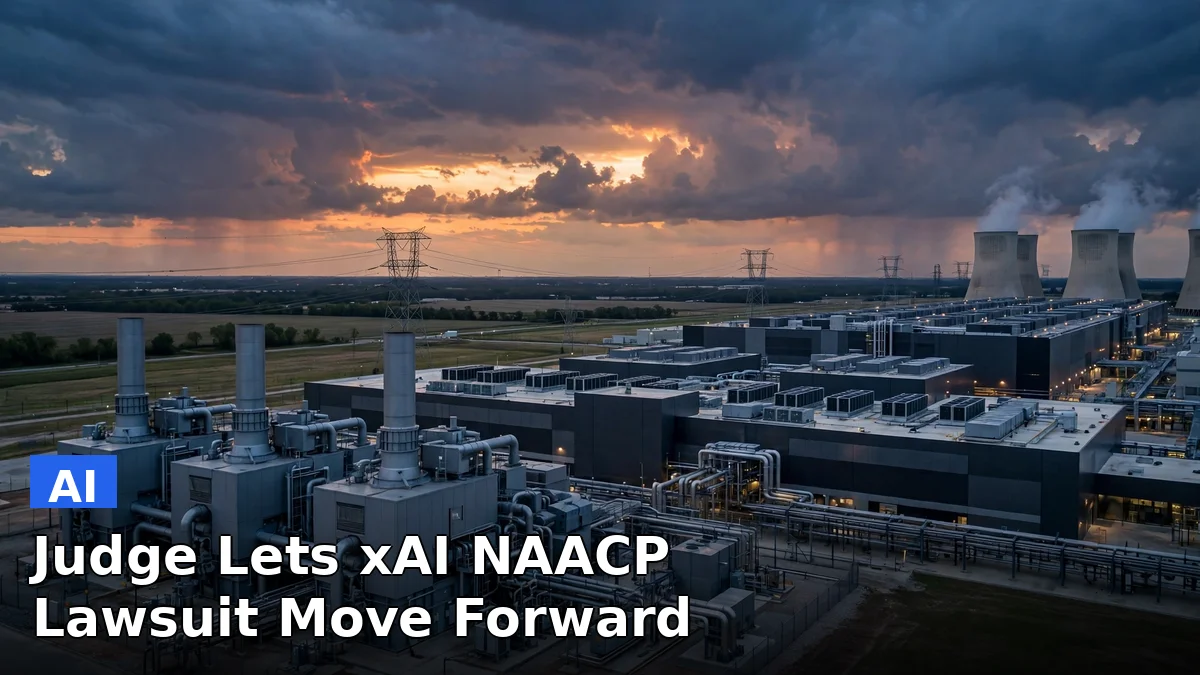
A federal judge denied Elon Musk’s xAI bid to throw out the NAACP lawsuit over gas turbines powering its Memphis-area AI data centers, ruling on October 30 that the case can proceed. TechCrunch reported the decision on October 31, and it is the second time in October that a court has refused to end the case early.
Judge Debra M. Brown of the U.S. District Court for the Northern District of Mississippi rejected each of xAI’s arguments for dismissal. In her order, she wrote: “Because the plaintiffs have statutory standing under the Clean Air Act, because the combustion turbines are not ‘mobile sources’ under Mississippi’s [State Implementation Plan], and because the citizen suit provision does not violate Article II of the Constitution or the private nondelegation doctrine, the plaintiffs’ claims will proceed.”
That is a ruling about whether the case survives, not about who wins it.
What the NAACP lawsuit alleges
Suing on behalf of the NAACP, the Southern Environmental Law Center filed the case on April 14, 2026. It says xAI “installed and operated at least 35 combustion turbines and other sources of air pollution at the Colossus site without ever obtaining the necessary preconstruction or operating air permits,” according to the law center’s summary quoted by TechCrunch.
Pin down the exact turbine count and the reporting gets messier, so it is worth stating plainly. Crypto Briefing reported that the suit targets between 27 and 69 natural gas turbines at the Colossus Gas Plant in Southaven, Mississippi, which supplies power to Colossus 2, the xAI data center across the state line in Memphis, Tennessee. Different counts in different reports appear to reflect different sets of turbines at the site, not a single agreed number.
Mississippi’s Department of Environmental Quality had approved the turbines as temporary or mobile units, a classification that exempted them from certain permits, Crypto Briefing reported. Judge Brown found that classification does not hold under Mississippi’s federally approved state implementation plan.
What the NAACP wants is not just a declaration. It is seeking injunctive relief, a court order forcing changes to how the turbines operate, plus civil penalties of up to $124,426 per day for each violation of the Clean Air Act, according to Crypto Briefing.
Why xAI wanted the case dismissed
xAI’s motion rested on three claims. First, it said the turbines were exempt from permitting because they were mobile. Second, it said the plaintiffs lacked standing to sue. Third, it argued that the Clean Air Act’s citizen-suit provision was unconstitutional because it handed private litigants the federal government’s executive power.
Brown rejected that last argument in blunt terms. She wrote that citizen-suit plaintiffs “sue on their own behalf, in their own name, and seek penalties that redress harm to themselves,” so they are not exercising the federal government’s executive power.
Don’t mistake this for a technicality. If the mobile-source argument had worked, it would have given AI companies a template: bring in turbines, call them mobile, and skip the permitting process that stationary power plants must follow. Brown’s order closes that door, at least in this case and under Mississippi’s plan.
A second loss in the same month
Friday’s ruling was not xAI’s first failed attempt to kill the suit. Earlier in October, the court rejected a Justice Department bid to dismiss the case and allowed the Environmental Protection Agency to intervene, Crypto Briefing reported.
Abre’ Connor, the NAACP’s director of environmental and climate justice, called the latest ruling “another important victory in our effort to hold xAI accountable.” She added: “Our position has been clear: xAI cannot operate gas turbines without the required permits.”
Discovery and litigation will put xAI’s permitting record, and the paper trail behind the mobile classification, in front of a judge.
Why this xAI NAACP lawsuit matters beyond Memphis
AI data centers need enormous amounts of power, and they need it fast. Gas turbines are one way to get it without waiting years for grid connections or new power plants. That’s why this case is being watched far beyond Tennessee and Mississippi.
Communities near proposed data centers are already pushing back, and the issue is now showing up in politics. TechCrunch reported on October 31 that at a midterm-election event in Brooklyn, data centers and AI dominated the conversation, and a question asking who in the room supported AI data centers was met with boos. Voters go to the polls on November 3.
For other AI builders, the message from Memphis is specific, not abstract. Permits are not paperwork to route around with a label. A judge has now said, twice in one month in this case, that the challenge to that approach gets heard.
None of that settles whether xAI’s turbines polluted nearby neighborhoods, or by how much. Those questions come next, with evidence, in a courtroom. What October 30 settled is simpler: the NAACP gets to ask them.
Frequently asked questions
What did the judge decide in the xAI NAACP lawsuit?
Judge Debra M. Brown denied xAI’s motion to dismiss, ruling the NAACP’s Clean Air Act claims can proceed to litigation. The ruling does not find that xAI violated the law.
Why did xAI say the turbines did not need permits?
xAI argued the turbines were mobile sources exempt from permitting, that the plaintiffs lacked standing, and that the Clean Air Act’s citizen-suit provision was unconstitutional. Judge Brown rejected all three arguments.
Does the ruling mean xAI broke the law?
No. A denied motion to dismiss only means the judge found the claims serious enough to hear. Whether xAI violated the Clean Air Act will be decided later in the case.
What happens next in the xAI NAACP case?
The case moves into litigation, where xAI must defend its permitting record. The NAACP is seeking injunctive relief and civil penalties of up to $124,426 per day for each violation, according to Crypto Briefing.
Sources: TechCrunch, Crypto Briefing, CNBC.