
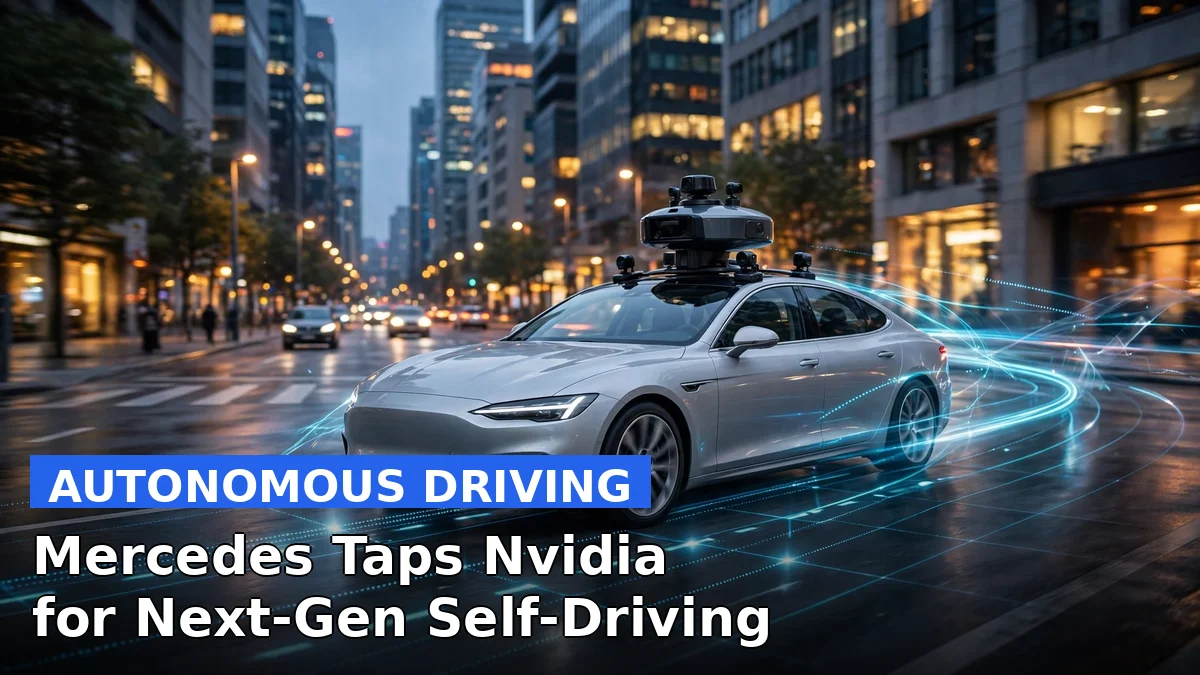
Mercedes-Benz is putting its self-driving future in Nvidia’s hands. The two companies announced on October 16 that they’re extending their strategic partnership to develop the next generation of driver assistance and automated driving systems, with SAE Level 4 as the stated goal. That’s the level where the car handles the entire driving task on its own, with no human ready to take the wheel, inside defined operating conditions.
The announcement, published in Nvidia’s newsroom and in a Mercedes-Benz press release from Stuttgart and Santa Clara, sketches a clean division of labor. Mercedes contributes what only a carmaker can: its vehicle engineering, its safety standards, and MB.OS, the in-house operating system that manages driving features and delivers over-the-air updates. Nvidia supplies the computing muscle.
Don’t expect a delivery date. The companies disclosed no financial terms and no timeline for when Level 4 systems would reach production.
The stack, piece by piece
Three Nvidia technologies sit at the heart of the deal. Hyperion is the in-vehicle computing and sensor architecture: the hardware brain. Sitting on top of it is the Alpamayo Stack, full-stack driving software that Nvidia says uses AI reasoning for urban point-to-point assistance, active safety and automated parking. The third piece is Halos, which runs as a separate parallel safety stack on top of Mercedes’ existing safety systems, adding redundancy and guardrails.
The redundancy is arguably the most important part of the announcement. Getting to Level 4 depends less on how capable a system looks in a demo and more on how it behaves when something fails: a sensor, a line of code, the AI’s interpretation of a weird situation. A second, independent safety layer is exactly the kind of architecture regulators want to see before they’ll approve cars that operate with nobody ready to intervene.
Mercedes chief technology officer Jörg Burzer put it plainly, calling Nvidia the company’s “most important strategic partner in automated driving.” He pointed to the urban point-to-point assistance system the two already built together, which Mercedes describes as the first of its kind in the western world. Nvidia’s Ali Kani, the company’s vice president of automotive, framed the deal as bringing full-stack safety to the road, building on Hyperion, in his words, “to bring this intelligence and comprehensive full-stack security to the road and make autonomous driving a reality in everyday life.”
Those are company characterizations, not independent assessments. But the track record behind them is real.
From Level 3 to Level 4
Mercedes was the first automaker to get Level 3 approval in Europe for its Drive Pilot system, which it developed with Nvidia. The caveats tell you how far the road still is: Drive Pilot tops out at 95 km/h and works only on certain highways. Level 4, by contrast, handles the entire driving task without a human in the loop at all within its operating domain. The companies name robolimousines (driverless luxury shuttles) as one of the future applications.
The partnership also stretches beyond the car itself. Mercedes is scaling its use of Nvidia technology across its global manufacturing operations, folding AI-based simulation and digital production into the MO360 production ecosystem for efficiency and quality control. Self-driving software and the factory that builds the car, running on the same AI stack.
For Nvidia, the deal is another anchor tenant for its automotive business. The chipmaker has spent years positioning itself as the computing supplier of record for the industry’s automated driving ambitions. Volvo expanded its own Nvidia partnership just this month, also targeting point-to-point automation on Hyperion. Every carmaker that commits to Hyperion as its compute architecture is a decade-long customer.
Why this Mercedes Nvidia self-driving partnership matters
The self-driving race has been declared dead more times than anyone can count, and yet the announcements keep coming because the economics haven’t changed: autonomy is a software problem that needs an enormous compute foundation, and only a handful of companies can provide both. Mercedes is betting that the winning play is a deep, exclusive-feeling partnership rather than building that foundation alone.
Skepticism is warranted. Level 4 has been “a few years away” since before most readers could legally drive, and Mercedes has been burnt before by overpromising on autonomy timelines. Neither side has committed to when any of this ships, and the jump from a highway-limited Level 3 system to a car that drives itself through a city with no human backup is a fundamentally different safety problem, not an incremental upgrade.
But the architecture here is the right shape for that problem. Two independent safety stacks, deeper integration between the carmaker’s operating system and the chipmaker’s platform, and a CTO willing to call the chip supplier his most important partner. Mercedes isn’t hedging anymore. It’s all in.
FAQ
What is the Mercedes Nvidia self-driving partnership?
It’s an expanded automated driving agreement announced October 16, 2026. Mercedes-Benz contributes its MB.OS vehicle operating system and vehicle engineering; Nvidia supplies Hyperion compute, the Alpamayo driving software stack and the Halos safety layer. SAE Level 4 (full automation within defined conditions) is the long-term target.
When will Mercedes cars with the new Nvidia tech hit the road?
The companies haven’t said. The deal covers development of next-generation driver assistance and automated driving (urban point-to-point assistance, active safety, automated parking) for future models, though the Level 4 systems are framed as future development, not products with launch dates.
What Nvidia technology is going into Mercedes cars?
Three pieces. Hyperion is the in-vehicle computing and sensor architecture. The Alpamayo Stack is full-stack driving software with AI reasoning capabilities for urban assistance, active safety and automated parking. Halos is an added safety layer: a parallel stack providing redundancy and guardrails on top of Mercedes’ existing systems.
Is Mercedes already using Nvidia in its cars?
Yes. The companies previously developed Mercedes’ Drive Pilot together, the first Level 3 system approved in Europe. Current Drive Pilot vehicles run Nvidia technology but are limited to 95 km/h on certain highways. The expanded partnership targets capabilities well beyond that.
Sources: ArenaEV, Phandroid, tbreak, AbsoluteGeeks, blockchain.news, Nvidia newsroom announcement (October 16, 2026).