
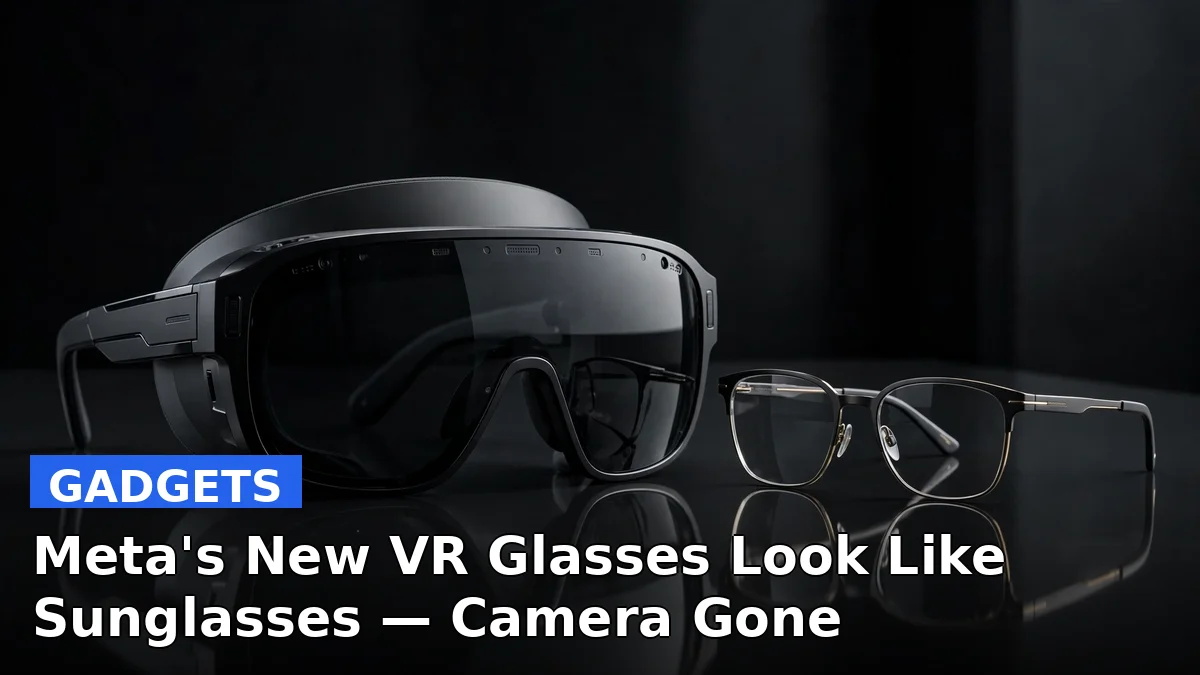
Meta’s big hardware pitch this year is a VR headset that looks like sunglasses. And in a surprise, the company also launched its first smart glasses with no camera at all.
Both devices were unveiled at the Meta Connect conference in September 2026, where CTO Andrew “Boz” Bosworth sat down with The Sun’s tech editor to explain the thinking behind them.
Meta VR Glasses: sunglasses, not a helmet
The new Meta VR Glasses drop the bulky ski-goggle look that has defined VR headsets for a decade. Instead, they look like oversized sunglasses — Meta’s wager that comfort and style matter as much as specs if VR is ever going to reach normal people.
Bosworth, who leads Meta’s Reality Labs division, described the device as the payoff of years spent shrinking VR hardware into something people might actually wear outside the house.
Ray-Ban Meta Audio: why the camera is gone
The bigger surprise was the Ray-Ban Meta Audio — the first of Meta’s smart glasses to ship without a camera.
Bosworth said the call came straight from usage data: audio is the most-used feature on Ray-Ban Meta glasses. “People are listening to music, they’re listening to podcasts, they’re doing calls,” he said.
Losing the camera freed up budget, weight, and battery: “While we love what the camera can do for people, it comes with a real cost in terms of literally cost, and as well as weight and battery life.”
The result is a cheaper, lighter pair of glasses with better battery life that keeps the speakers, microphones, and Meta AI chat.
The competition isn’t standing still
Meta isn’t the only one betting glasses are the next phone. Apple sells the Vision Pro, a $3,500 headset aimed at developers and deep-pocketed early adopters — the opposite of Meta’s mainstream play. Google is building Android XR with Samsung, and Snap keeps iterating on its Spectacles. Everyone in the industry has read the same memo: the company that makes face computers normal wins the next platform.
That’s what makes the no-camera Ray-Ban interesting. Every previous attempt at smart glasses has tripped over the same problem: people don’t like the idea of being recorded by a stranger’s eyewear. Google Glass died on that hill a decade ago. By shipping a version with no camera at all, Meta is testing whether removing the creep factor unlocks the buyers who liked the idea but hated the lens.
The money question
There’s a reason Meta keeps pushing hardware despite the costs. Reality Labs, the division behind these devices, has burned through tens of billions of dollars since Meta went all-in on the metaverse. Investors have mostly tolerated it because the core ad business prints money — but patience isn’t infinite.
Wearables are Zuckerberg’s answer to the skeptics: cheaper to build than VR headsets, easier to sell than a $3,500 face computer, and a direct line to the AI assistant Meta wants on every person. If glasses with Meta AI become something people buy the way they buy earbuds, the division starts looking less like a money pit and more like a platform bet.
That’s a big “if.” Nobody has cracked mainstream smart glasses yet. But a lighter, cheaper, camera-free pair is the most honest attempt so far at figuring out why.
Why this matters
Meta is making two bets at once. The VR Glasses bet that VR’s future is fashionable and lightweight. The Ray-Ban Meta Audio bets that most people don’t want a camera on their face — they want good audio and an AI assistant in a normal-looking frame.
If either bet pays off, it reshapes the wearables race Apple, Google, and Snap are all running.
Sources: The Sun / Scottish Sun interview with Andrew Bosworth, September 26, 2026.
Frequently asked questions
Do the Ray-Ban Meta Audio glasses have a camera? No — they are Meta’s first smart glasses without a camera. They keep speakers, microphones, and AI chat.
What are the Meta VR Glasses? A new VR headset unveiled at Meta Connect 2026 that looks like oversized sunglasses instead of a bulky headset.
Why did Meta remove the camera? Per CTO Andrew Bosworth: audio is the most-used feature, and dropping the camera improves price, weight, and battery life.