
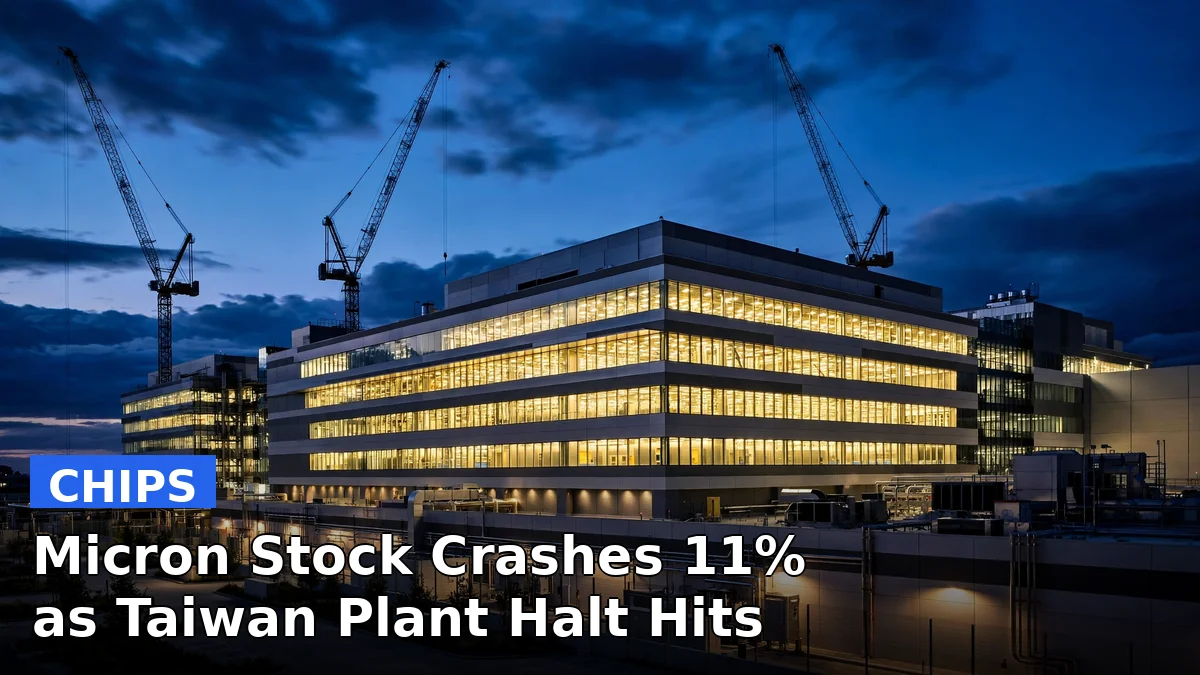
Micron’s stock crashed 11% on Thursday, November 5, after Bloomberg reported the memory chipmaker has largely stopped building a $4.5 billion plant in Taiwan. Shares traded at $708.64 in late morning, down from Wednesday’s close of $795.23.
The drop capped a brutal week for the stock. Micron fell 7% on Wednesday, and Thursday’s slide pushed it roughly 42% below its record close of $1,213.56 on June 25. It also slipped below its 200-day moving average.
The timing could hardly be worse.
What happened at Micron’s Taiwan plant
The plant in question is Fab 11E in Taoyuan, Taiwan. Bloomberg, citing people familiar with the matter, reported that construction has mostly stopped, with only limited work left to secure the site. The factory was meant to produce DRAM and high-bandwidth memory for AI data centers, with production starting in 2028. Its budget ran from $3 billion to $4.5 billion and included advanced equipment from ASML.
Micron has not confirmed the halt. The company told Bloomberg its existing Taiwan operations continue to run normally and that it is confident about maintaining supply for customers. It didn’t directly address whether construction on the new plant would resume, and it gave no new timeline. Reuters said it could not independently verify the Bloomberg report.
Taiwan matters a lot to Micron. The island accounts for about 60% of the company’s DRAM output and serves as a key hub for high-bandwidth memory production, employing around 15,000 people. A pause on new capacity is not a shutdown, but it dents the company’s plan to keep up with AI server demand.
Why the Micron stock crash hit so hard
The halt follows a labor dispute that has been simmering for weeks. Workers at the Taoyuan site are demanding a formal profit-sharing deal tied to Micron’s earnings growth from the AI boom. Reports put the ask at 15% of global operating profits paid out as cash bonuses. The Taoyuan union secured authorization to strike on October 7, when 1,994 members voted for industrial action.
Micron reached a separate agreement with the larger Taichung union in late October, but Taoyuan has not accepted it. The two sides are set to meet again on November 6, with Taiwanese labor authorities helping to run the talks. Taiwan’s Ministry of Economic Affairs said the government will help settle the dispute.
Micron also has a market-share problem. Its slice of the global DRAM market fell to 21% in the third quarter, down from 26% a year earlier, according to Counterpoint Research. Rivals have gained ground while memory demand surged, and investors now ask whether Micron can turn the AI boom into lasting profit.
A brutal day for chip stocks
Micron did not fall alone. By 11:30 a.m. ET, the Nasdaq Composite was down 3.88%, off 997.87 points at 24,738.65, while the S&P 500 had dropped 2.76% and the Dow was down 2.08%. The Philadelphia Semiconductor Index fell as much as 11% in intraday trading, its worst showing since March 2020, according to Reuters.
Nvidia slid 6.88% to $186.36. Tesla dropped 9.19% to $349.79. AMD plunged around 12%, SanDisk fell as much as 20%, and Qualcomm dropped more than 9% after its smartphone chip sales missed estimates. Intel lost 6.92%, IREN fell 16.74%, and CoreWeave declined 12.43%.
“If you look at the semiconductor index, it’s down about 31% from its 52-week high,” Adam Sarhan, chief executive of 50 Park Investments, told Reuters.
The Nasdaq is now more than 10% below its record close of 27,599.89 on October 6. If it closes there, it confirms a correction. The VanEck Semiconductor ETF had dropped 14.8% for the week.
What this means for the AI trade
Thursday’s selloff is the latest in a string of rough days for AI stocks. The Nasdaq had already been sliding since its record close on October 6, and selling in stock and bond markets has made it harder for data-center builders to raise money. Tuesday’s midterm elections added a new worry: voters approved dozens of ballot initiatives that stand to limit data-center construction in the coming months and years.
Investors are also re-reading old warnings. Michael Burry, the investor made famous by The Big Short, has warned about an AI bubble, and his name was all over trading desks again on Thursday as roughly $2 trillion in market value vanished. The question hanging over the market is simple: when does the hundreds of billions pouring into AI infrastructure start coming back as profit?
For Micron, the story cuts both ways. Memory is the scarcest ingredient in AI servers right now, and demand for high-bandwidth memory is not going away. A halted plant is a delay, not a collapse, and the company says its current factories are running fine. But the stock’s 42% fall from its June peak shows how fast the market can turn on a company whose expansion plans hit a snag. Friday’s meeting with the Taoyuan union is the next date to watch.
Frequently asked questions
Why did Micron stock crash today?
Bloomberg reported that Micron has largely paused construction of its planned Fab 11E plant in Taoyuan, Taiwan, amid a labor dispute. The report landed during a broad chip selloff, and shares fell about 11% to around $708.64.
What is Micron’s Fab 11E plant?
Fab 11E is Micron’s planned memory chip factory in Taoyuan, Taiwan, budgeted at $3 billion to $4.5 billion. It was meant to produce DRAM and high-bandwidth memory for AI data centers, with production starting in 2028.
Is Micron shutting down its Taiwan operations?
No. Micron says its existing Taiwan operations continue to run normally and that it is confident about maintaining supply for customers. The reported halt concerns planned new capacity, not current factories.
How far has the Nasdaq fallen?
The Nasdaq is more than 10% below its record close of 27,599.89 on October 6, which puts it in correction territory. The Philadelphia Semiconductor Index fell as much as 11% in intraday trading on Thursday.
Sources: Bloomberg, Reuters, The Economic Times