
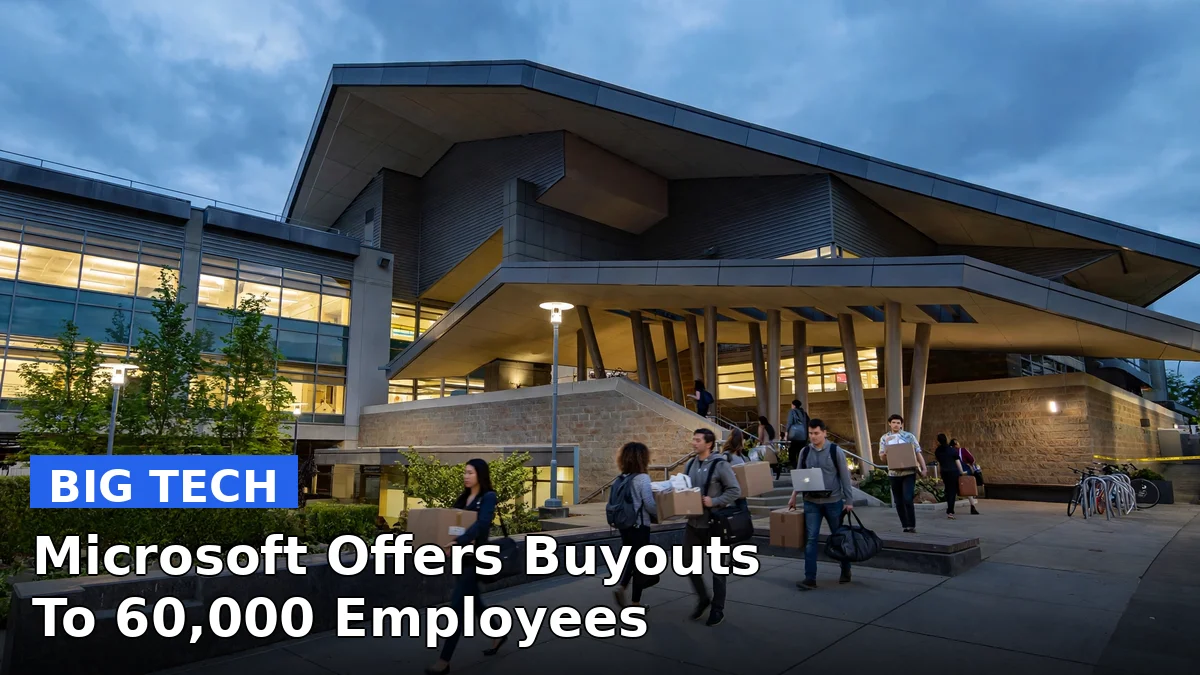
Microsoft just asked a quarter of its workforce to consider leaving. On Monday, October 26, 2026, the company opened a Microsoft voluntary exit offer to about 60,000 employees, according to reporting from Business Insider and Bloomberg, in one of the largest voluntary workforce programs a US tech giant has ever run.
That number needs a careful read. It is the number of people eligible, not the number who will leave. Microsoft itself has not confirmed the 60,000 figure in its public post, and Reuters reported that the company did not immediately comment on the headcount when asked. What Microsoft did confirm is the shape of the program: a time-limited, voluntary offer with financial support and career planning resources for staff who choose to go.
Chief People Officer Amy Coleman announced the program in a note to employees on Monday. “This offer gives eligible employees who may be considering a future outside the company a new choice to make that transition now with support,” Coleman wrote. She also called the program new for Microsoft, adding, “We’ll learn from it.”
Who is eligible for the Microsoft voluntary exit offer
Eligibility is narrower than the headline suggests. Microsoft said the offer goes to employees at level 70 and below on participating teams in the United States, Canada, the United Kingdom and India. Reports describe level 70 as vice president level and below.
Not every team is taking part. A source familiar with the matter told Reuters that the offer touches key divisions including AI experiences, Copilot, finance, human resources, Xbox and Windows and Devices. That same reporting said marketing, commercial business and security units are excluded. Other reports said some data center, sales and marketing staff are also left out, which means employees should not assume eligibility from a job title alone.
People who are eligible were told to expect an email with their individual terms. Anyone who accepts would receive benefits similar to a standard severance package, according to the reporting, rather than a specially sweetened deal. ## Why now: the AI bill comes due
No one at Microsoft has said AI is replacing these jobs, and the company’s own framing avoids that claim. But the timing is hard to separate from the cost of the AI buildout. Reuters reported that Microsoft has forecast $175 billion in capital spending for 2026, mostly for data centers and the chips and infrastructure needed to run AI systems at scale.
That spending has changed the math inside every big tech company. Data centers, power contracts and AI accelerators are long-term commitments. Payroll, by contrast, can be adjusted, and investors have been pressing Microsoft to show it can hold down other costs while its infrastructure bill climbs. Shares rose about 1% on Monday, according to reports, after hitting an all-time high earlier in October. Microsoft also reports quarterly results on Wednesday, when executives will face their first questions about the program on an earnings call.
This is not Microsoft’s first workforce reset this year
Monday’s offer did not arrive out of nowhere. Earlier in 2026, Microsoft offered buyouts to retirement-age employees, with more than 30% of roughly 8,750 eligible workers accepting, TechCrunch reported. In July, the company cut about 4,800 jobs, or roughly 2.1% of its global workforce, with a large share falling on its Xbox gaming business.
A retirement program trimmed senior, higher-paid roles. A July layoff round cut specific jobs outright. Now a broad voluntary offer reaches across divisions, from Copilot and Windows to finance and human resources, and lets employees decide for themselves.
That distinction matters.
For workers, the choice is personal and financial: take a severance-like package and a supported exit, or stay and bet their team survives the next reshaping. For Microsoft, the risk runs the other way. Voluntary programs can lose exactly the experienced people a company would most want to keep, because those employees often have the best options elsewhere.
Why this matters
If uptake is modest, Monday’s announcement will look like a pressure valve: a way to trim costs quietly, without the headlines and morale hit of a mass layoff. If tens of thousands accept, it will amount to one of the biggest workforce reductions in Microsoft’s history, delivered by choice rather than by pink slip, and it will reset expectations across the tech industry.
Other companies are watching the same trade-off. AI infrastructure spending is not slowing, and every major lab and cloud provider faces the same question: how do you pay for the data centers without letting the rest of the business balloon? A voluntary exit offer is gentler than a layoff, but it still tells employees that even a company at an all-time stock high is not done reshaping itself for the AI era.
What happens next will be measured in December, when the decision window closes, and again when Microsoft reports how many people actually left. Until then, 60,000 is a ceiling, not a result, and the most important number in this story has not been published yet.
FAQ
How many Microsoft employees are eligible for the voluntary exit offer?
About 60,000 employees are eligible, according to Business Insider and Bloomberg reporting, which is roughly 27% of Microsoft’s 223,000 full-time employees at the end of June 2026.
Who qualifies for Microsoft’s voluntary exit offer?
Eligible employees at level 70 and below, described as vice president level and below, on participating teams in the United States, Canada, the United Kingdom and India.
Is Microsoft’s voluntary exit offer a layoff?
No. It is a voluntary program, so employees choose whether to accept. Microsoft has not set a public target for how many people will take it.
When do employees have to decide on Microsoft’s buyout offer?
Reports put the decision window in early December 2026, with departures planned for the end of the year. Microsoft has described the program as time-limited without publishing a single company-wide deadline in its blog post.
Sources: Reuters, TechCrunch, Business Insider, Bloomberg.