
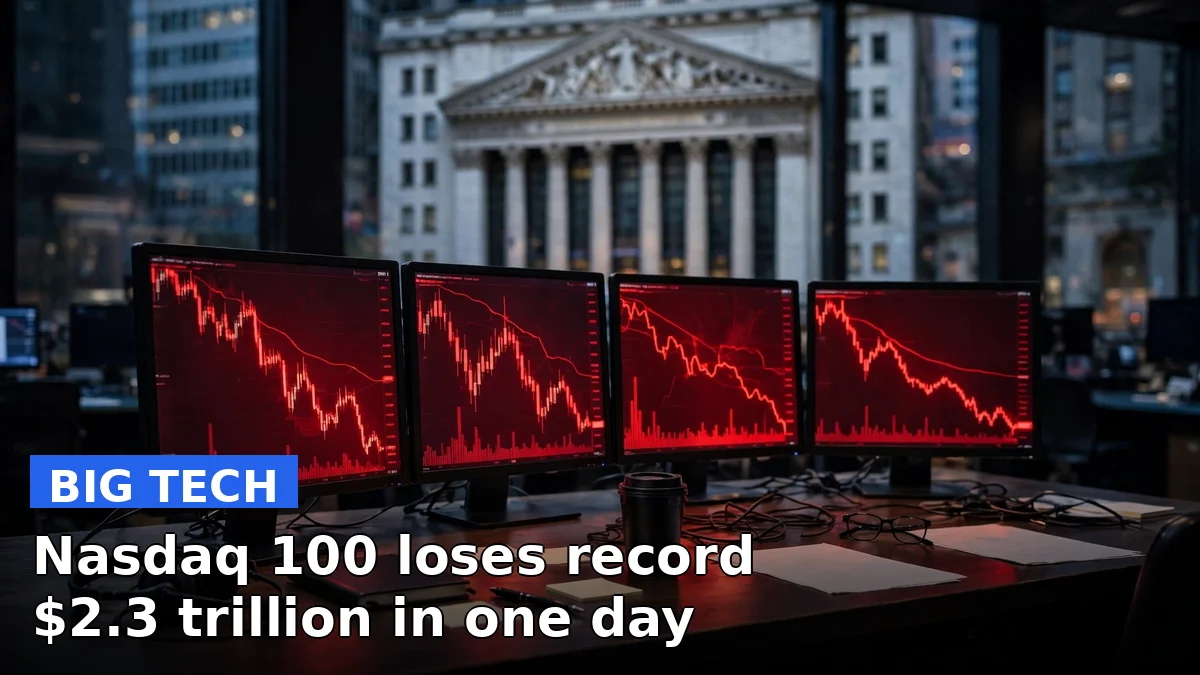
Wall Street’s AI trade just had its worst day in more than six years. The Nasdaq 100 fell 6.4% on Thursday, erasing a record $2.3 trillion in market value in a single session as investors dumped chip stocks and AI names after the Democrats’ midterm sweep.
It was the tech-heavy index’s worst day since March 16, 2020, at the height of the Covid crash. The Nasdaq Composite dropped 5.5%, the S&P 500 lost 4.4% in its worst session since April 2025, and the Dow fell 3.44%, or 1,833 points. All 30 Dow stocks finished in the red.
Chip stocks took the hardest hits. The Philadelphia Semiconductor Index plunged 12%, its worst day since March 2020, and now sits 38% below its June 22 peak. Nvidia, the world’s most valuable company, slid 9.3% and lost roughly $450 billion in market value in one day. AMD tumbled 17.3%, Micron fell 17.5%, and SanDisk cratered 22.3%.
What drove the Nasdaq 100 selloff
Wednesday told a different story. Stocks closed higher that day, with investors treating the midterm results as background noise. Thursday was the day the market did the math on what a Democratic Congress could mean for the AI buildout, and the bill came to roughly $2.3 trillion.
At first, the market liked the outcome. Stocks rallied after the vote, with investors welcoming the result. That rally lasted about a day.
Voters made their view plain. Data-center restrictions passed in 40 of 41 local ballot measures across 10 states on Tuesday, according to CNBC. In Texas, one of the country’s biggest data-center markets, governor-elect Gina Hinojosa campaigned on a temporary moratorium on new data centers and a ban on subsidies for them. “We need to stop what we are doing with data centers until we have those protections,” she told CNN.
Spending worries added fuel. Amazon, Microsoft, Alphabet, and Meta plan at least $720 billion in capital spending this year, most of it aimed at AI infrastructure. A Wells Fargo Investment Institute report from November 2 warned that investors are growing uneasy about higher-than-expected spending and what it does to free cash flow. Thursday’s rout turned that unease into a stampede.
Nvidia shows how fast the mood flipped. The stock is now down 2.6% for 2026 after gains of roughly 39%, 171%, and 239% over the previous three years, per the Economic Times. One bad day didn’t erase that run, but it did wipe out the year’s remaining gains in a single session.
The damage in numbers
Thursday’s selloff spread well beyond chips. The Magnificent 7 stocks lost $1 trillion in combined market value, CNBC reported, and the S&P 500 shed about $2.9 trillion, the largest one-day loss in the index’s history, according to MarketWatch.
Here’s how the big names fared:
- SanDisk: down 22.3%
- Micron: down 17.5%
- AMD: down 17.3%
- Arm: down 13.1%
- Tesla: down 10.8%
- Intel: down 10%
- Qualcomm: down 9.5%
- Nvidia: down 9.3%
- Meta: down 4%
- Microsoft: down 3.6%
Context matters here. The Nasdaq 100 now sits about 16% below its peak, nearing bear-market territory, which starts at a 20% drop. Semiconductor stocks are already there, down 38% from their June high.
Why this matters
Thursday didn’t kill the AI trade. It repriced it.
For two years, the bet was simple: spend whatever it takes on chips and data centers, and the returns will follow. That bet now faces two questions it didn’t face before. First, will politicians slow the buildout? Second, will the spending pay off fast enough to justify $720 billion a year? Neither question has an answer yet, and markets hate unanswered questions.
None of this says AI demand is fading. Companies are still ordering chips and building data centers. What changed is the price investors will pay for growth that now comes with political risk attached. Friday’s October jobs report is the next test, and traders will be watching it for any sign the wider economy is cooling too.
Thursday’s drop still leaves the Nasdaq 100 well above where it started the decade. The index has climbed for years on the AI trade, and one brutal session doesn’t undo that. But it does mark the moment politics joined valuation as a risk investors have to price.
Frequently asked questions
Why did the Nasdaq 100 fall 6.4% on Thursday?
Investors priced in the Democrats’ midterm sweep and what it could mean for data-center construction, after voters approved restrictions in 40 of 41 local ballot measures. Worries about Big Tech’s $720 billion in AI spending added to the selling.
How much value did the Nasdaq 100 lose?
About $2.3 trillion in a single session, the largest one-day loss in the index’s history, according to CNBC. The S&P 500 lost roughly $2.9 trillion, also a record.
Which stocks fell the most on Thursday?
SanDisk dropped 22.3%, Micron fell 17.5%, and AMD lost 17.3%. Nvidia, the world’s most valuable company, slid 9.3% and shed about $450 billion in market value.
Is the Nasdaq 100 in a bear market?
Not yet. The index is about 16% below its peak, and a bear market starts at a 20% drop. The Philadelphia Semiconductor Index, down 38% from its June peak, is already deep in bear-market territory.
Sources: CNBC, Bloomberg, MarketWatch, Economic Times, AI Weekly.