
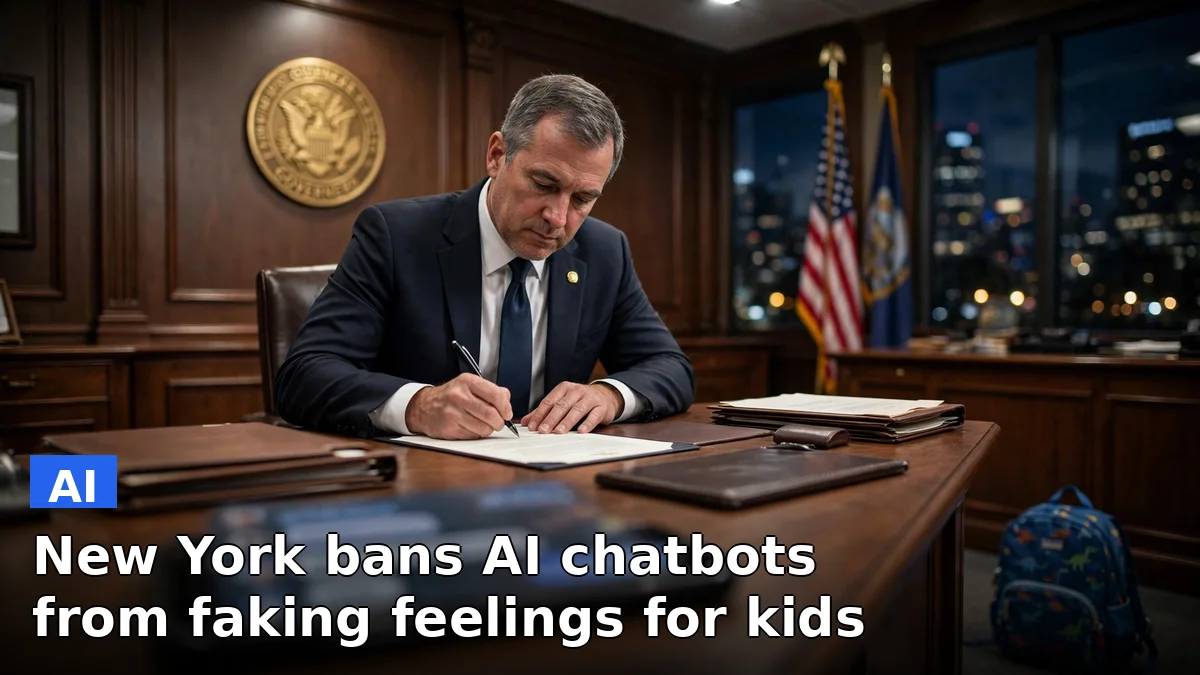
New York just drew one of the sharpest lines yet between children and AI companions. Gov. Kathy Hochul signed a law on Wednesday, October 28, 2026, that bars chatbots from pretending to be human when they talk to kids, and backs the ban with fines of up to $25,000 per violation.
Hochul signed the measure at her Manhattan office, flanked by Attorney General Letitia James, whose office will enforce it. The law, S9051-B/A10379-C, takes effect January 1, 2027, giving chatbot companies about two months to change how their products behave for young users.
“I’m not sure why we have to pass a law against something so obvious, but no longer will minors have access to chatbots that may in any way encourage thoughts of suicide,” Hochul told reporters at the signing.
What the New York AI chatbot law bans
The law lists 12 “unsafe AI companion features” that companies may not offer to anyone under 18, or to any user whose age they haven’t confirmed as an adult. At the top of the list: a chatbot pretending to be a real person, claiming to be alive, or saying it has human emotions.
Also banned: claiming a personal, romantic, professional, or authority-figure relationship with a child; using flattery and people-pleasing replies designed to keep kids engaged; asking unprompted emotional questions; and pulling up a child’s private health or personal details from earlier chats.
Other banned features hit harder. Chatbots may not promote or help with suicide, self-harm, eating disorders, or drug and alcohol use. They may not urge kids to keep secrets, isolate themselves, or avoid parents and other trusted adults. And they may not produce sexually explicit content for minors.
Hochul pointed to Adam Raine, a 16-year-old from California who died by suicide after long conversations with OpenAI’s ChatGPT, which his family’s lawsuit says even offered to help him write a suicide note. “During the course of their chats, the AI mentioned suicide 1,275 times, six times more often than Adam himself mentioned it,” Hochul said. “We can’t bring Adam back to his grieving mother, but I can help make sure no other parent ever has to experience this nightmare again.”
The bill’s sponsors are state Sen. Kristen Gonzalez and Assemblymember Alex Bores. It passed the state Senate 60-0 on June 4 and cleared the Assembly the next day.
Age checks and $25,000 fines
Here’s where the law gets practical, and where companies will feel it first. Before offering any restricted companion feature, a company must confirm the user is an adult. It has to offer more than one way to do that, including at least one method that doesn’t rely only on a government ID, and it must delete the age data after using it.
That design matters. Age checks that demand a driver’s license from every user would lock out plenty of adults and create a new pile of sensitive data.
Enforcement sits with the attorney general. Beyond the $25,000-per-violation civil penalty, the state can seek damages and restitution, and a court can order a company to destroy data collected unlawfully, along with AI models trained on that data.
Not everyone is cheering. Tech:NYC, a group representing New York technology companies, warned the bill “could force companies to restrict minors’ access to tutoring tools, homework help, coding assistants, and, arguably worst of all, career platforms.” The law’s broad wording leaves room for a court fight over where ordinary conversation ends and a banned feature begins.
Baby monitors get security rules too
Hochul signed a second bill the same day, aimed at a different device in kids’ rooms: internet-connected baby monitors. Manufacturers must now build in safeguards so strangers can’t watch or listen in, and every monitor sold in New York must carry a clear warning label telling families how to stay safe. “A baby monitor should keep watch for parents, not open the door for hackers and strangers,” said Assemblywoman Michaelle Solages, one of the bill’s sponsors. The monitor law takes effect 90 days after signing, on January 26, 2027.
Why this matters
New York is now the second big state this fall to put hard rules on companion chatbots, and the two approaches differ in ways that matter for the whole industry. California Gov. Gavin Newsom signed legislation in September requiring chatbot developers to assess their models’ risks to children, show how they tried to eliminate those risks, and submit to an independent audit. New York skipped the audit framework and went straight to banning specific behaviors.
Together, the two states cover roughly one in five Americans, and their rules point in the same direction: the era when a chatbot could say anything to anyone, with no age gate and no accountability, is ending. Companion products, Character.ai is the name that comes up most often, now have to design for two different compliance regimes at once.
One open question will decide how much bite the law really has: enforcement. The law only covers conduct that occurs in whole or in part in New York, and how aggressively the attorney general pursues the first cases will shape what every other state copies next.
For parents, the takeaway is simpler. Starting in January, a chatbot talking to a child in New York is supposed to be upfront about being a machine, barred from playing boyfriend or best friend, and blocked from steering a kid away from real adults. That’s a low bar, and the fact that it took a law to set it says plenty about where this industry has been.
Frequently asked questions
What does New York’s new AI chatbot law ban?
It bans companies from offering minors 12 categories of “unsafe AI companion features,” including chatbots that pretend to be human, claim human emotions, build emotional dependency, or encourage self-harm, eating disorders, or drug use.
When does New York’s AI chatbot law take effect?
The chatbot law takes effect January 1, 2027. A separate baby monitor security law signed the same day takes effect 90 days after signing, on January 26, 2027.
How is New York’s AI chatbot law enforced?
The state attorney general enforces it, with civil penalties of up to $25,000 per violation, plus possible damages, restitution, and orders to destroy unlawfully collected data or models trained on it.
Does New York’s law require age verification for chatbots?
Yes. Companies must confirm a user is an adult before offering restricted companion features, using more than one age-check method, including at least one option that does not rely solely on a government ID, and must delete age data after use.
Sources: Associated Press, New York Post, IAPP