
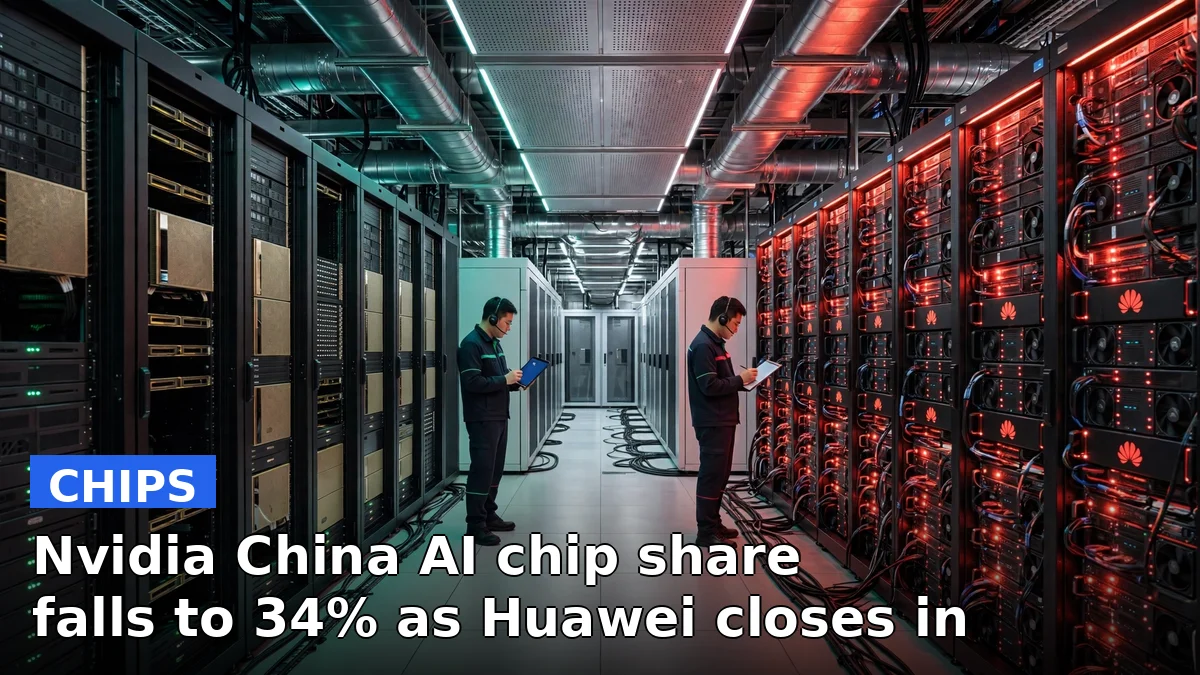
Nvidia no longer owns China’s AI chip market. Its share of the country’s data-center AI accelerator market fell to 34% in the first half of 2026, down from a commanding position just a year ago, according to IDC data seen by Reuters and published October 13.
The headline number is stark. Nvidia shipped 678,000 AI accelerators in China between January and June, a 44% drop from the same period last year. Huawei, meanwhile, shipped 572,000 units — nearly double the roughly 300,000 it managed a year earlier — taking its share to 28%. The gap between the world’s most valuable chip company and China’s most sanctioned one is now six percentage points.
Why Nvidia’s China AI chip market share is falling
Nvidia’s decline isn’t a demand story. China’s data-center buildout is booming; total AI-accelerator shipments hit 2.008 million units in the first half, according to IDC. Nvidia simply can’t sell much of what buyers want. Washington has barred its most powerful AI chips, including the B200 and B300, from export to China, and Beijing has required domestic companies to seek approval even for compliant Nvidia chips.
Nvidia CEO Jensen Huang has been blunt about the damage. He has repeatedly argued that the curbs force a US company to hand China’s roughly $50 billion AI chip market to Huawei — a position he made again in recent months as the restrictions tightened. Nvidia didn’t respond to Reuters’ request for comment on the IDC figures.
IDC, for its part, didn’t specify which Nvidia products made up the 34% share, or whether the figure included smuggled B200 and B300 chips, which Reuters notes have been finding their way into the country anyway.
The real shift: what China is buying
Buried in the IDC data is a structural turn that matters more than any single company’s share. Shipments of GPUs, the general-purpose graphics chips that defined the AI era, fell 26% to 991,000 units. Shipments of non-GPU AI accelerators, specialized chips built for particular inference and training workloads, rose nearly 80% to about 1.016 million units, overtaking GPUs outright.
Four Chinese companies control 95% of that non-GPU accelerator market: Huawei, Alibaba’s T-Head, Baidu’s Kunlunxin, and Cambricon. Their chips are landing mainly in government agencies, internet companies, and telecom operators. In other words, the segment growing fastest in China is one where Nvidia barely competes.
Huawei isn’t alone anymore
This isn’t a two-horse race. Alibaba’s chip-design unit T-Head held 7% of the overall market, Cambricon took 5%, Baidu’s Kunlunxin 4%, and Hygon 3%. Nine of the 11 Chinese chipmakers tracked by IDC increased shipments from a year earlier.
Huawei’s own trajectory shows how fast the domestic ecosystem is moving. Beyond the Ascend chips it ships today, the company said in September it will launch two new AI chips in 2027: the 960DT in the first quarter and the Ascend 960PR in the third, Reuters reported at the time. The pipeline isn’t slowing.
What this means for the AI arms race
For US policymakers, the IDC numbers land as an awkward verdict. Export controls were supposed to slow China’s AI progress by starving it of compute. Instead, they’ve helped build a domestic industry that now covers more than half the market and is accelerating fastest in the segment that matters most for the next phase of AI deployment.
Nvidia’s dominance elsewhere is untouched — it remains the default supplier for every major Western AI lab, and its data-center revenue keeps smashing records. But China was its second-biggest market, and losing share there isn’t a one-quarter blip. It’s the result of two governments pushing in the same direction, intentionally or not: one blocking supply, the other building it.
The next test comes fast. If Huawei’s 2027 chip launches hit their targets and the non-GPU segment keeps compounding, Nvidia’s 34% could look like a high-water mark rather than a trough. Washington’s export regime was designed to keep China dependent on American chips. The IDC data suggests it’s producing the opposite.
FAQ
What is Nvidia’s market share for AI chips in China now? Nvidia’s share of China’s data-center AI chip market fell to 34% in the first half of 2026, according to IDC data reported by Reuters on October 13. It shipped 678,000 AI accelerators, down 44% from a year earlier.
How much of China’s AI chip market does Huawei have? Huawei held a 28% share after shipping 572,000 AI accelerators in the first half of 2026, nearly double the roughly 300,000 units it shipped a year earlier.
Why is Nvidia losing AI chip market share in China? US export controls have restricted Nvidia’s most powerful AI chips from sale in China, while Beijing has promoted domestic alternatives and required companies to get approval to import compliant Nvidia chips.
Which Chinese companies make AI chips besides Huawei? Alibaba’s chip unit T-Head held 7% of the market, followed by Cambricon with 5%, Baidu’s Kunlunxin with 4% and Hygon with 3%. Nine of the 11 Chinese chipmakers tracked by IDC grew shipments year over year.
Sources: Reuters, Chosun Biz.