
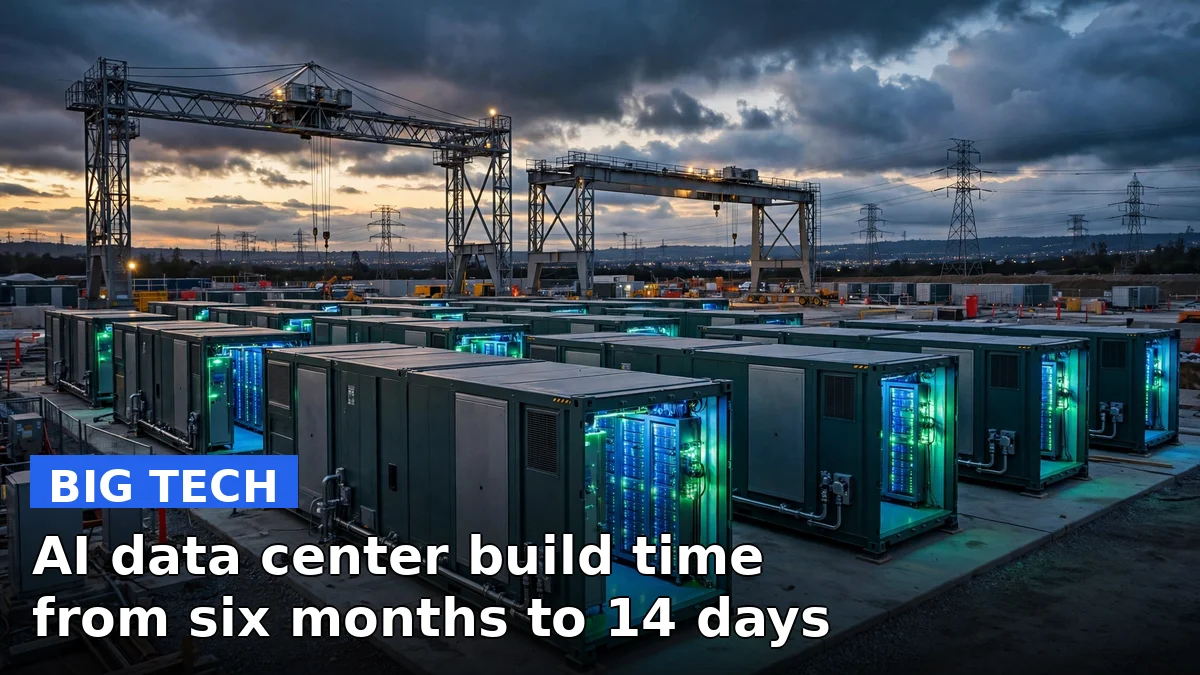
Six months of construction, fourteen days of hookup. That was the pitch Nvidia CEO Jensen Huang brought to Berlin on Wednesday, and it amounts to the company’s most aggressive move yet against the biggest bottleneck in the AI buildout: the time it takes to actually turn a site into a working data center.
The vehicle is Nvidia DSX POD, unveiled at the GTC Berlin keynote on October 21. It’s a reference design for complete Vera Rubin AI factories that partners build inside modular containers. Each container carries computing, networking, cabling, rack-level power, and liquid cooling, all assembled, integrated, and validated in a factory before the unit ever ships. Once it lands, a prepared site just connects power, cooling, and network, and the whole thing can go live in as little as 14 days, down from the six months a traditional onsite build takes.
“An AI factory creates value when it starts producing tokens — not when construction is complete,” Huang said in the announcement. “With Nvidia DSX POD, we’re bringing factory-built precision and speed to AI infrastructure construction — reducing deployment time from months to weeks so customers can scale capacity and bring revenue-generating production online faster.”
Huang put a price tag on delay
The 14-day figure is impressive on its own. Huang made it sting by doing the math on what the old timeline costs.
A one-gigawatt AI data center, he told the Berlin audience, costs roughly $50 billion to build and is expected to generate about $40 billion in annual revenue. Under those assumptions, a three-month delay in bringing the site online postpones around $10 billion in potential revenue. That’s not an abstraction for Nvidia’s customers. It’s the difference between a data center that pays for itself and one that sits as a $50 billion construction project.
The supply chain angle matters too. By moving integration into the factory, DSX POD dodges the usual onsite headaches: specialized labor shortages, component delays, and the error-prone work of cabling and commissioning racks one by one on a half-built site. Factory-tested containers, Nvidia says, shrink exposure to all of that and shorten the path to both model training and production inference.
Wall Street liked the framing. Nvidia shares were up 1.9% at $220.53 in premarket trading Wednesday morning, versus Tuesday’s close of $216.47, per market data reported the same day.
Who’s building the boxes
Nvidia doesn’t plan to manufacture the containers itself. A partner ecosystem is lined up to build and deliver the DSX POD units at scale: Dell Technologies, Hewlett Packard Enterprise, Foxconn, Schneider Electric, and Vertiv, among others. Deliveries are slated to begin worldwide in early 2027.
There’s a European angle that made Berlin the obvious venue. Huang has spent October touring the continent — hitting France, Britain, Sweden, and Germany while preaching his “sovereign AI” pitch that every country should build and control its own AI computing, data, and models. Axios pegged Nvidia’s European investments at roughly $10 billion. DSX POD, which lets a country stand up an AI factory without a local construction army, fits that narrative neatly.
Efficiency claims came along for the ride. Nvidia says the DSX AI Factory Platform can cut water consumption for cooling by up to 100% and produce the same AI output with up to 30% less power. Numbers like those matter when data center permitting fights in the US increasingly hinge on water and grid usage.
OpenShell: a guardrail for AI agents
DSX POD wasn’t the only hardware-adjacent news out of the keynote. Huang also introduced the OpenShell Reference Architecture, Nvidia’s bid to set the standard for running AI agents inside enterprise security boundaries.
The idea is to let companies deploy agents built on models from Anthropic, OpenAI, Google, Meta, and even SpaceX Super Intelligence on shared Nvidia infrastructure while keeping each customer’s data and operations walled off. Cybersecurity partners CrowdStrike and Palo Alto Networks and software names SAP and ServiceNow are already aligned with the effort, according to the announcement.
It’s a crowded field. Every cloud and model vendor is racing to own the enterprise agent stack — and Nvidia is clearly betting that whoever defines the security architecture defines where the compute runs. That would be, unsurprisingly, Nvidia chips.
T-Mobile, Nokia, and the first AI-RAN call
The telecom news was concrete: T-Mobile completed the first AI-RAN call on a live network with Nvidia and Nokia, a milestone for networks that run AI workloads and radio processing on shared infrastructure. AI-RAN is one of those technologies that’s been perpetually six months away; an actual live-network call is the kind of proof point that moves it out of the lab and into carrier planning.
Huang also touched on robotics, automotive, and healthcare announcements during the keynote, and showed off more of the company’s rack-scale Vera Rubin hardware, now in full production. Rubin is the follow-on to Blackwell, and Nvidia’s entire “AI factory” framing rests on Rubin systems doing far more than serving large language models. Huang positioned the platform as built for the whole AI agent workload, not just inference.
Why Nvidia’s DSX POD launch matters
Step back and DSX POD looks like Nvidia solving a problem it helped create. The AI infrastructure boom has collided with the physical reality that data centers take forever to build. UBS now projects tech giants’ AI capital spending will cross $1 trillion in 2027, and demand keeps outpacing supply. Six-month construction cycles are a lifetime when demand keeps outpacing supply.
The risk for buyers is the catch in the 14-day claim: that’s for a prepared site, with power, cooling, and network already in place. Grid connections and permits, not server installation, are often the real bottleneck. DSX POD doesn’t fix a utility that takes two years to deliver power.
Even so, turning the data center into a shipped product instead of a construction project is a genuine shift in how AI infrastructure gets built. If the partners deliver on schedule in early 2027, the 14-day AI factory could become the template — and the rest of the industry will have to match it or explain why it can’t.
FAQ
What is Nvidia’s DSX POD? DSX POD is a reference design for complete Vera Rubin AI factories built by partners inside modular containers. The units are integrated and validated before delivery, cutting deployment at a prepared site from six months to as little as 14 days.
When will Nvidia DSX POD data centers be available? Nvidia says partners including Dell, HPE, Foxconn, Schneider Electric, and Vertiv will begin delivering DSX POD units worldwide in early 2027.
Why does faster AI data center deployment matter? Jensen Huang said a one-gigawatt AI data center costs about $50 billion and should generate about $40 billion in annual revenue — so a three-month construction delay postpones roughly $10 billion in potential revenue.
What else did Nvidia announce at GTC Berlin? Alongside DSX POD, Huang announced the OpenShell Reference Architecture for running AI agents within security boundaries, and T-Mobile’s first AI-RAN call on a live network with Nvidia and Nokia.
Sources: NVIDIA official blog, Unite.AI, AIStockWire, Axios