
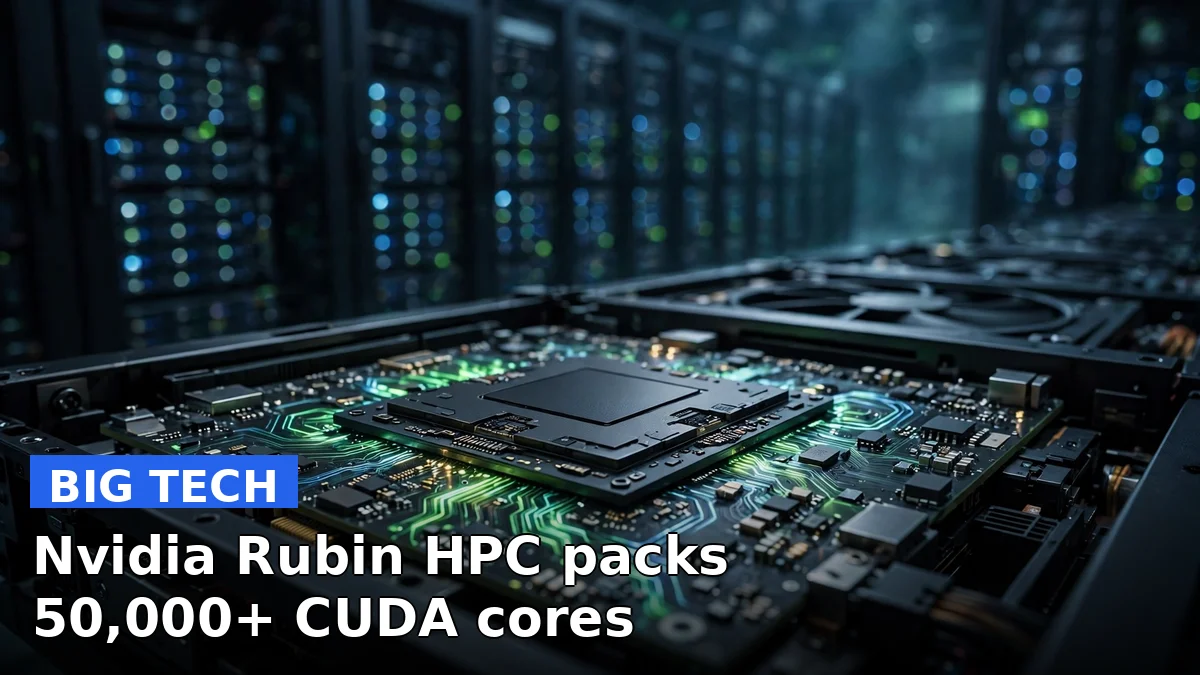
Nvidia has a new GPU, and this one isn’t built for chatbots. The company announced Rubin HPC at SC26, the supercomputing conference in Chicago, on Monday, November 16. It’s a chip for science: more than 50,000 CUDA cores on a single GPU, a number Nvidia calls a record, aimed at the simulations that climate researchers, engineers, and drug designers run every day.
Don’t expect to buy one soon. Nvidia says Rubin HPC will be available in 2028, and it hasn’t published a price, a power figure, or even how much memory the chip carries.
What Nvidia Rubin HPC actually is
Rubin HPC sits inside the Vera Rubin platform, next to the standard Rubin GPU that Nvidia sells for AI training and inference. The two chips share a name and a platform, but they do different jobs.
The standard Rubin GPU carries 28,672 CUDA cores across 224 streaming multiprocessors, according to Tom’s Hardware. Rubin HPC pushes that past 50,000 cores on one GPU, paired with sparse data acceleration to keep those cores fed, and seventh-generation NVLink for faster links between GPUs.
That trio matters because of how scientific code actually runs. A climate model or a molecular simulation doesn’t crunch one dense block of numbers after another. It reaches into an immense dataset, grabs a handful of scattered values, calculates a result, and repeats that pattern billions of times. The chip scales data movement and compute together, rather than increasing compute alone, Nvidia’s blog says.
The target routines are specific, and Nvidia named them: sparse matrix operations, stencil computations, sorting, and reductions. Those patterns sit at the heart of climate models, engineering simulation, genomic analysis, and financial risk modeling.
Why the core count isn’t the whole story
Fifty thousand cores sounds like a lot. It is. But in scientific computing, raw core count has a habit of flattering the spec sheet.
The HPCG benchmark exists to catch that gap. It measures how fast a machine runs the data-access patterns real applications use, rather than its peak arithmetic speed. None of the top 10 systems on the November 2025 HPCG list got past 3 percent of their peak performance, according to TechTimes.
That’s the problem Rubin HPC’s sparse data acceleration is supposed to solve, and it’s the number Nvidia didn’t publish that matters most. The company gave no memory capacity, no memory bandwidth, and no double-precision (FP64) throughput figure. FP64 is the currency of climate models and molecular dynamics, and without it, labs can’t compare Rubin HPC against what they already own. For comparison, the standard Rubin GPU lists 33 teraflops of FP64 and 288 GB of HBM4 memory.
Nvidia told the SC26 audience that Rubin HPC triples simulation and analytics performance, but it didn’t name the baseline for that figure.
The AI agent angle
Nvidia didn’t pitch Rubin HPC as a faster calculator. It pitched it as infrastructure for AI agents doing science.
The idea goes like this: an agent proposes a batch of candidate materials, molecules, or designs, then calls on simulations to test which ones are worth building in a lab. Faster simulations mean the agent can test more candidates and point the lab work at the most promising ones.
“For agents tackling science and engineering, faster simulation means faster discovery,” said Ian Buck, Nvidia’s vice president of hyperscale and high-performance computing. “Rubin HPC accelerates the simulations agents use to test ideas and guide their next steps, helping scientists and engineers explore more possibilities and bring breakthroughs closer.”
The software side of that pitch is already shipping. Nvidia expanded its CUDA-X libraries at SC26, adding cuPhoton, cuPotential, and cuSpa, optimized building blocks for simulation and analytics that agents can call on.
What Nvidia didn’t say, and the timing
For a chip announcement, the missing details are almost as telling as the ones Nvidia shared. No memory capacity or type. No memory bandwidth. No FP64 rate. No power draw. No price. No launch partners. No first customers. That leaves labs planning 2028 systems with a headline number and not much else, and the 2027 exascale procurement round will be decided before Rubin HPC ships.
Rubin HPC also landed on a tense day for Nvidia. The company reports its fiscal third-quarter results on Tuesday, November 17, at about 4:20 p.m. ET, with an earnings call at 5 p.m. ET. Wall Street expects revenue of about $109 billion and earnings of $2.47 per share, according to LSEG data cited by Moneycontrol, against Nvidia’s own guidance of $108 billion.
It’s the first earnings report since Jensen Huang stepped down as chief executive last week, with chief financial officer Colette Kress now serving as interim CEO and leading the call. Nvidia’s shares have lost almost a quarter of their value in November, according to the Economic Times. On Monday, the stock fell 4.1 percent while the Nasdaq dropped 2.5 percent, Al Jazeera reported.
Why this matters
The honest read is that Rubin HPC is two stories at once. One is a chip: a record core count, a genuine attempt to fix the data-movement problem that has limited supercomputers for years, and a 2028 ship date that keeps it out of the next procurement cycle. The other is a bet on how science gets done.
If AI agents become the way researchers explore new materials and drugs, then the simulations those agents run become the bottleneck, and the company that owns the simulation hardware owns a piece of every discovery.
Whether that bet pays off depends on the numbers Nvidia hasn’t shared yet. Memory bandwidth, FP64 throughput, and price will decide if Rubin HPC is a machine labs actually buy or a headline that fades before 2028.
Frequently asked questions
What is Nvidia Rubin HPC?
Rubin HPC is a new GPU in Nvidia’s Vera Rubin platform, announced November 16, 2026 at SC26 in Chicago. It is built for scientific simulation and data processing, and Nvidia expects it to be available in 2028.
How many CUDA cores does Rubin HPC have?
More than 50,000 CUDA cores on a single GPU, a figure Nvidia calls a record. The standard Rubin GPU for AI training carries 28,672 CUDA cores, so Rubin HPC has roughly 1.7 times as many.
When will Rubin HPC be available?
Nvidia expects Rubin HPC to be available in 2028. The company has not named launch partners, first customers, or a price yet.
What is Rubin HPC used for?
Climate models, engineering simulation, genomic analysis, and financial risk modeling. It targets sparse matrix operations, stencil computations, sorting, and reductions.
Sources: NVIDIA, Tom’s Hardware, HPCwire, StorageReview, TechTimes, Wccftech, Unite.AI, Al Jazeera, Moneycontrol, Economic Times