
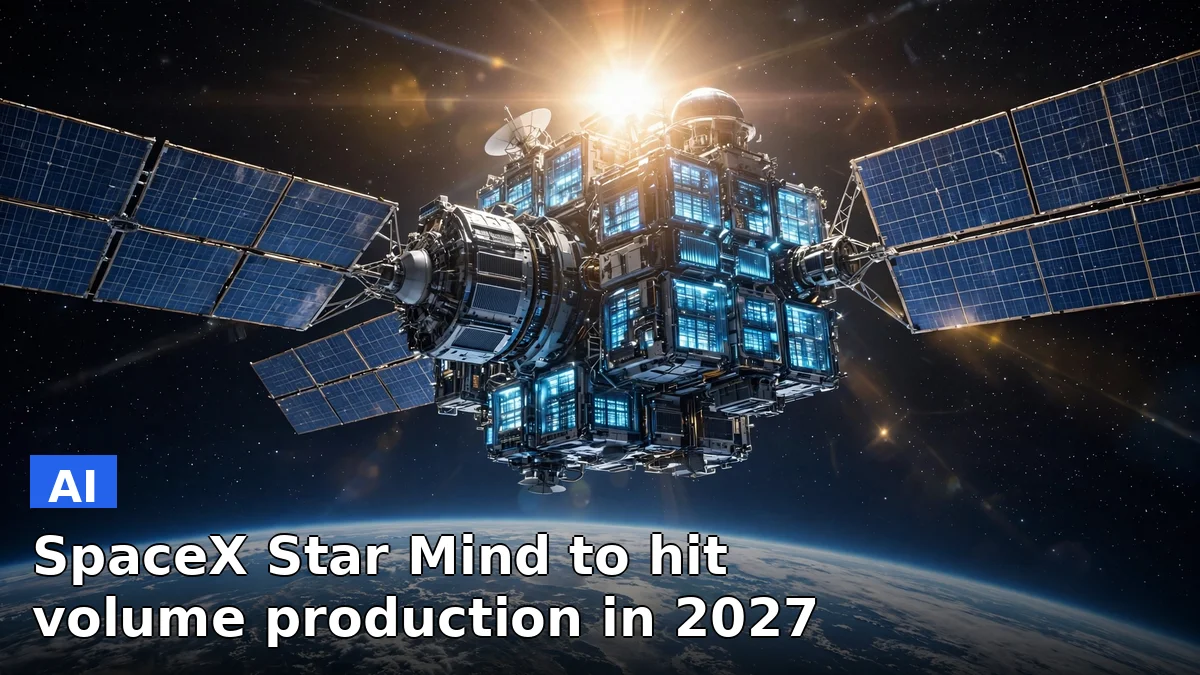
Elon Musk has put a date on the space data center. Reacting Thursday to a podcast clip of Nvidia CEO Jensen Huang, Musk wrote on X that the Star Mind computer, the space-grade AI system SpaceX is co-engineering with Nvidia, “is far better than almost anyone expects and will reach volume production next year.”
That’s 2027. Musk didn’t say what volume means, and nobody should mistake a Musk target for a schedule. But the exchange was the clearest signal yet that the orbital-compute project, first teased in August, is moving from concept toward an industrial plan.
The thread started with Huang. On the BG2 podcast, in an episode posted Thursday, October 15, the Nvidia chief said the two companies’ engineering teams are designing a server architecture for data centers in orbit. “One particular new market that we’re going to go explore together is putting data centers out in space,” Huang said, adding that the work is “a new type of architecture that might be super good in space and on Earth.”
Musk replied on X later the same day: “Old friends are the best friends. Jensen rocks” — and then the production claim. That one reply turned a hardware project teased in August into a public commitment with both CEOs on the record.
What the SpaceX Star Mind computer actually is
Star Mind sits at the center of Starmind, SpaceX’s plan to run AI compute in orbit and beam the results down to Earth. The partnership itself isn’t new. SpaceX first announced the collaboration on X on August 4, and Nvidia confirmed its hardware role on August 24. In August, Musk said the two companies had designed a space-optimized Vera Rubin NVL72 system for launch to orbit in the fourth quarter of 2027, “with significant scale in 2028.” On the ground, a standard NVL72 rack combines 72 Rubin GPUs with 36 Vera CPUs.
The scale of the ambition became public in early October, when SpaceX released a visualization of its proposed Starmind constellation: up to one million AI satellites flying in tight formation clusters around Earth. SpaceX vice president of Starlink engineering Michael Nicolls said the company needs to “operate clusters of satellites in tight formation to get enough coherent compute to run AI models in space.”
The numbers are striking. SpaceX’s AI1 satellite design stands 30 meters tall when deployed with a 75-meter wingspan, carrying a compute payload of up to 250 kilowatts at peak and 175 kilowatts on average: roughly the computing power of a full ground-based data center rack.
Behind the scenes, the money has been moving in the same direction for a while. Nvidia disclosed earlier this year that it held nearly 123 million SpaceX shares, worth roughly $21 billion. SpaceX, for its part, has been building its Gigasat Factory in Bastrop to manufacture the hardware and says it aims to be chip-vendor agnostic.
SpaceX chief financial officer Bret Johnsen said in September that the company’s compute satellites are due to fly next year, with service capability in the first half of 2028. And the rockets to carry them are coming along: Starship reached orbit for the first time on September 28, on its 14th test flight.
Why Nvidia wants its servers off the planet
The logic is simpler than it sounds. Ground-based data centers are running into three hard walls: land, power, and cooling. Huang has spent the year arguing that annual AI infrastructure spending could reach $3 trillion to $4 trillion by late this decade, and that the 2027 bottleneck will be land and electricity rather than chips. Space dodges all three: constant sunlight for solar power, free radiative cooling in the vacuum of space, and no grid queues or zoning fights.
Space has its own plumbing problems, of course. Radiation hardens nothing by itself, no technician can walk up to a rack in orbit, and every kilogram still has to ride a rocket. Dr. Benjamin Lee, an electrical engineering professor at the University of Pennsylvania, told Engadget that newer, smaller-transistor chips are more vulnerable to bit flips from solar weather — data corruption that error-correction must repeatedly fix, adding overhead that terrestrial data centers don’t have.
The timeline test
Musk’s Thursday post adds a manufacturing commitment to the launch commitment. Notebookcheck’s reporting places production at a new Bastrop facility called Gigasat, with the first AI1 prototype satellites due to fly in early 2027 and volume manufacturing targeted by year-end.
Readers who have followed Musk know the drill. His dates are best treated as intentions with a habit of slipping. What’s different this time is the counterpart: Nvidia isn’t a side player here, it’s co-engineering the system, and Huang was the one who brought the project up unprompted on a podcast. This isn’t a lone tweet. It’s a hardware partnership with a shared engineering team.
What this actually changes
For Nvidia, the Star Mind deal is part of a bigger play: Huang has been arguing that AI demand doesn’t live and die with OpenAI and Anthropic — the buyers are thousands of enterprises, sovereigns, neoclouds, and now satellite operators. Co-designing servers for orbit makes Nvidia a platform vendor for space, not just a parts supplier.
For SpaceX, the logic mirrors Starlink. The company already designs hardware, builds it in-house, and launches it itself. Selling compute from orbit would turn it into a cloud provider with no real estate bill. Musk called working with Nvidia’s engineering team “pure joy,” which is Musk-speak for a program that has cleared real technical hurdles.
Whether one million satellites ever fly is almost beside the point. The near-term question is whether a space-hardened Vera Rubin rack makes it to orbit in the fourth quarter of 2027 — and whether anything in orbit can beat the economics of a desert in Arizona with a power substation. That’s the bet Huang and Musk just made, in public, with both their names on it.
Sources: AIStockWire, TeslaNorth, Engadget, Notebookcheck
Frequently asked questions
What is the SpaceX Star Mind computer?
Star Mind is a space-grade AI computer co-engineered by SpaceX and Nvidia for orbital data centers. Elon Musk said on October 15, 2026, that it is performing better than expected and will reach volume production in 2027.
When will Nvidia hardware launch into orbit with SpaceX?
Musk has targeted the fourth quarter of 2027 for launching a space-optimized Vera Rubin NVL72 system to orbit, with significant scale-up beginning in 2028. SpaceX CFO Bret Johnsen said compute satellites are due to fly next year, with service capability in the first half of 2028. These are company targets, not guarantees.
Why put data centers in space?
Space offers constant sunlight for solar power, free radiative cooling, and no competition for land or grid connections, the bottlenecks now slowing data center construction on Earth. SpaceX argues this makes orbital AI compute cheaper at scale.
What did Jensen Huang actually say about the SpaceX deal?
On the BG2 podcast, in an episode posted October 15, 2026, Huang said the two companies are jointly exploring data centers in space, with their engineering teams building “a new type of architecture that might be super good in space and on Earth.”