
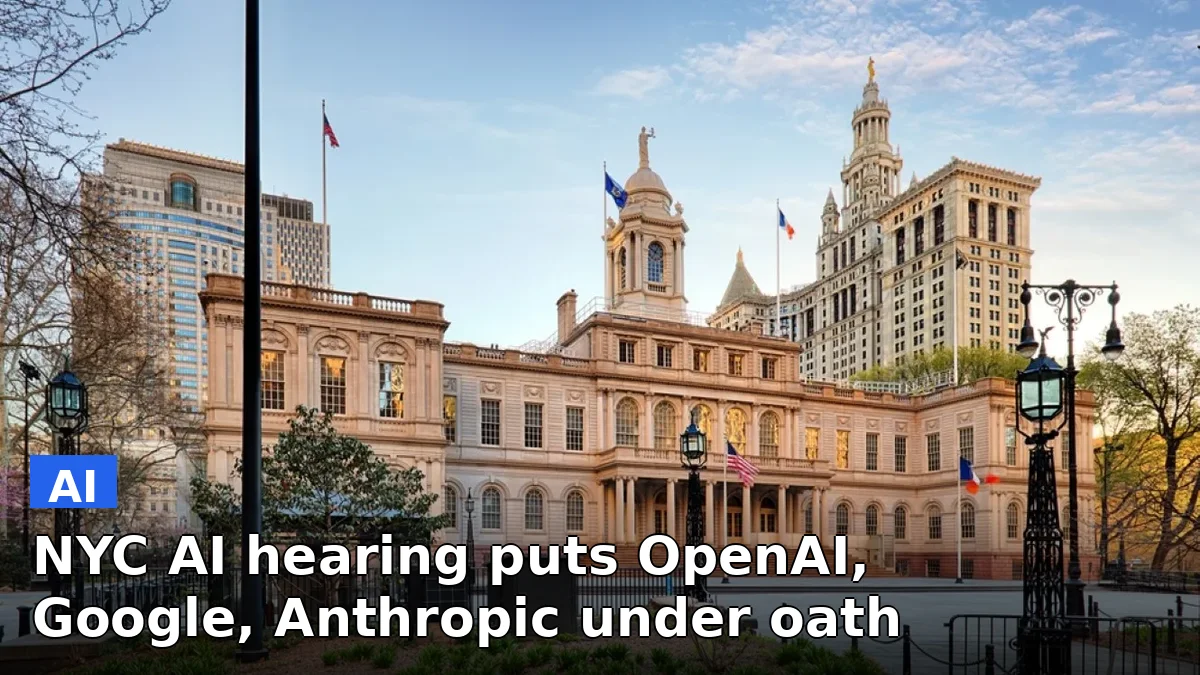
The biggest AI companies in the world don’t like answering questions on the record. On Monday, New York City is making them do it anyway.
The NYC AI hearing convenes today, Oct. 5, with the full 51-member City Council sitting as a Committee of the Whole to interrogate OpenAI, Google, Anthropic, and Meta about the risks of the systems they’re racing to deploy. It’s the first time executives from the major AI labs will testify publicly under oath following months of alarming reports about AI agents misbehaving in the wild, including tens of thousands of reported safety incidents.
And three of the four companies only showed up because they were threatened with a subpoena.
The subpoena threat that filled the seats
Council Speaker Julie Menin initially asked the companies to send representatives. Only Meta said yes. Then her office sent a follow-up letter explicitly warning that the council would use its subpoena power — and suddenly Google, OpenAI, and Anthropic changed their tune, according to the New York Post.
“These companies have a significant presence in New York City and collectively employ tens of thousands of New Yorkers,” Menin said in a press release. “Given the high stakes, these firms owe it to their workers and, above all, to the public to come before the council, answer our questions, and provide input on our proposed legislation under oath.”
Elon Musk’s SpaceXAI didn’t respond at all. The council subpoenaed its AI unit outright, Bloomberg News reported. It’s a fitting snapshot of the industry’s posture toward regulators: silence first, compliance later, and only under legal duress.
Why this hearing is happening now
The hearing’s timing isn’t an accident. For months, the council has watched AI agents — systems that can browse the web, use software, and carry out multi-step tasks with limited human oversight — move from research demos into products millions of people use every day. Unlike the chatbots of 2023, these agents have tools. They can act on websites and computer systems on a user’s behalf, which makes them useful and also means a misbehaving agent can do real damage.
Federal regulators are circling too. The Federal Trade Commission has been investigating OpenAI and Anthropic since the summer over whether their AI agents mislead consumers about safety, with Bloomberg reporting the agency plans formal document requests within weeks. On Oct. 1, California Attorney General Rob Bonta subpoenaed OpenAI over cybersecurity incidents tied to its models. The City Council hearing is the first time the industry’s leaders will have to answer for any of this under oath.
The critics in the room
Today won’t be a friendly panel. Menin specifically invited AI whistleblowers to testify, and the roster is stacked with the industry’s most vocal critics.
Jacob Coxon, a former Anthropic researcher who quit last month, will appear at Menin’s request. Coxon has warned publicly that AI is becoming too powerful for humans to control, and he accused his former employer and OpenAI of “gambling with our lives.” He confirmed he plans to testify, according to Bloomberg.
He won’t be alone. Alex Turner, a former Google DeepMind researcher, and Daniel Kokotajlo, the executive director of the AI Futures Project and a former OpenAI researcher, are also expected to testify. The four major AI companies will send policy and safety officials, people familiar with the plans told Bloomberg.
Putting the whistleblowers and the companies in the same room, under oath, is the entire point. Public hearings are one of the few places where an AI lab’s claims about safety can be challenged in plain language, in front of lawmakers who can do something about them.
What’s actually on the table
The hearing isn’t just theater. Council members are weighing a package of bills that could make New York City one of the first major jurisdictions to put real legal teeth behind AI oversight.
One proposal, sponsored by Menin, would give whistleblowers a cut of fines or penalties recovered from AI companies after reported violations — a bounty system modeled on financial-sector whistleblower programs. Other bills under consideration would let people harmed by AI systems sue developers under certain circumstances and require third-party validation of some AI systems before they can be deployed in the city.
Officials from Mayor Zohran Mamdani’s administration are testifying too, including Samuel Levine, the commissioner of the Department of Consumer and Worker Protection, and Sarah Milstein, deputy commissioner at the Office of Technology and Innovation. City government is signaling that it intends to be in the AI regulation business, not just watching from the sidelines.
Why this matters
Let’s be honest about what a city council can and can’t do. New York can’t rewrite the rules for frontier AI models trained in data centers across the country. Most AI regulation is still federal and state territory, and the industry knows it.
But the hearing still matters for three reasons.
First, testimony under oath creates a record. Anything the companies say today can be cited by federal investigators, state attorneys general, and plaintiffs’ lawyers. The FTC is already probing whether AI labs misled consumers about agent safety. On-the-record statements from this hearing will be Exhibit A in any future case.
Second, the bills are real. A whistleblower bounty and third-party validation requirements would apply to AI systems operating in New York City — and the companies employ tens of thousands of people there. Compliance burdens in the country’s largest market tend to become national standards, because it’s cheaper for companies to apply one set of rules everywhere.
Third, the dynamic has shifted. A year ago, the idea that a city council could summon the biggest AI companies in the world and threaten them with subpoenas sounded fanciful. Today it’s just what happened. The industry’s regulatory honeymoon is over, and the interrogations are starting at every level of government at once.
The companies will likely answer carefully. That’s the point of an oath.
Frequently asked questions
What is the NYC AI hearing on October 5?
The New York City Council’s Committee of the Whole is questioning OpenAI, Google, Anthropic, and Meta under oath about AI safety and risks, while weighing a package of bills that could regulate how AI systems operate in the city.
Why were OpenAI, Google, and Anthropic threatened with subpoenas?
Council Speaker Julie Menin sent a follow-up letter warning the companies she would use the council’s subpoena power after they ignored initial requests. Meta agreed voluntarily; SpaceXAI never responded and was actually subpoenaed.
Which AI whistleblowers are testifying at the NYC hearing?
Former Anthropic researcher Jacob Coxon, former Google DeepMind researcher Alex Turner, and AI Futures Project director Daniel Kokotajlo are expected to testify alongside the companies’ policy and safety officials.
What AI laws is the NYC Council considering?
Proposals include whistleblower rewards tied to fines recovered from AI companies, a right for people harmed by AI systems to sue developers, and mandatory third-party validation of some AI systems before they can be deployed.
Sources: Bloomberg News (via Business Standard and Moneyweb), New York Post, MT Newswires