
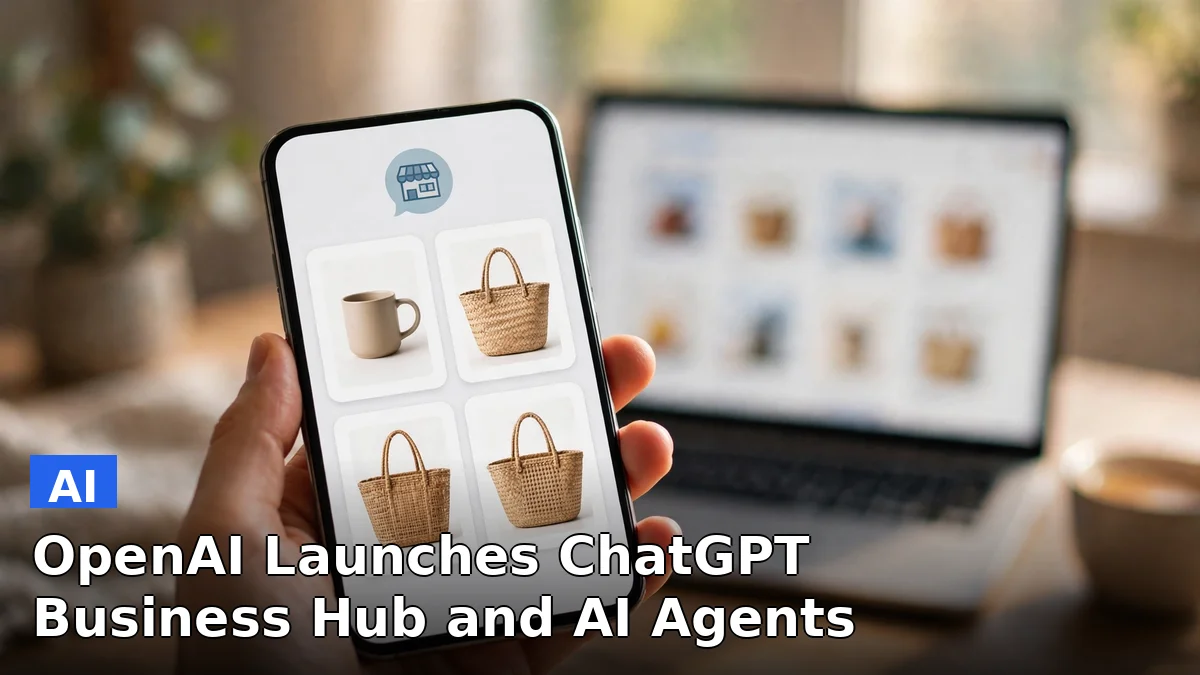
OpenAI is turning ChatGPT into a storefront. The company said Tuesday it has launched Businesses in ChatGPT, a beta feature that lets companies claim a profile, manage how they appear in answers, and put an AI agent in front of shoppers. The service now reaches 1.2 billion people a week, according to OpenAI, which makes the launch one of the biggest changes to how ChatGPT handles commerce since it started testing the format as a paid ad in September.
For now, the rollout is narrow: Business Agents are available only to eligible e-commerce and online service businesses in the United States. But the pieces OpenAI put in place on Tuesday, verified profiles, product feeds, an analytics dashboard, and a paid ad slot, add up to something much bigger than a beta: a full storefront layer on top of the world’s most-used chatbot.
Google should be paying attention.
What the ChatGPT Business Hub does
The Business Hub is the control panel. Once a business claims its profile and passes verification, it can update key details and add product feeds that include prices and availability, Reuters reported. Shopify merchants get a shortcut: they can connect a store through the Business Hub or straight from the Shopify admin, and catalog details flow in automatically.
Claimed profiles get a blue check mark, but OpenAI is careful about what it means. Claiming a profile doesn’t guarantee better placement in ChatGPT’s answers, and the chatbot keeps making its own recommendations. Profiles can also include information from other sources, and OpenAI doesn’t verify every detail a business supplies. The blue check says the profile is claimed. It doesn’t say everything on it is true.
There’s also an analytics layer, the part marketers have wanted for two years. The hub shows aggregated counts of mentions, views, and website clicks, plus the topics that bring a business up in conversation. It doesn’t show the prompts people typed or rank a business against competitors. Screenshots of an early version surfaced on November 6, when e-commerce analyst Juozas Kaziukenas posted them on LinkedIn. OpenAI hadn’t commented then. Now it’s official.
Business Agents answer shoppers inside ChatGPT
The agent is the more interesting half. After claiming a business, an eligible company can build, test, and launch a Business Agent from its own instructions and product feed. When someone finds a company through a ChatGPT answer and wants details, they can keep talking to the agent instead of leaving for the company’s website.
OpenAI labels these chats clearly as conversations with the business, and it says it doesn’t hand over users’ conversations or agent chats. What the business sees is aggregated: how often its name comes up and how many people click through, and only once the numbers pass a threshold that keeps individual users anonymous.
One limit matters. OpenAI builds the agent itself from what the business provides. Companies can’t plug in their own chatbot. “We aren’t allowing folks to bring their own agents,” Benji Shomair, OpenAI’s vice president of monetization, said at a press briefing, according to Digiday.
The free agent and the paid ad are the same thing
Here’s where the business model shows. A business can sponsor its Business Agent and use it as the destination for a ChatGPT ad, with the placement labeled as sponsored. Shomair put it plainly: “Think of the business agent as the organic experience. The sponsored agent is the paid experience, but the agent that sits behind it should be the same.”
That’s a neat trick. The agent a shopper meets for free and the one they meet through an ad are the same assistant, answering from the same product feed. OpenAI tested the paid version in September, Digiday reported, and the free agent is now the on-ramp to it. Both are free in beta, but Shomair didn’t rule out charging later. Existing Enterprise customers and advertisers can claim their business through their OpenAI representative.
Why this matters
ChatGPT has spent two years as the place people go to decide what to buy, and the place businesses couldn’t see themselves in. Google Search Console has told website owners how they show up in search since 2015. ChatGPT offered nothing comparable until Tuesday. The Business Hub closes that gap, at least in part.
The bigger bet is on where shopping goes next. If people ask ChatGPT to compare products and then keep talking to the store’s agent without opening a browser, the search results page stops being the front door. OpenAI knows it. So does Google, which has spent the year putting its own AI answers at the top of search. Tuesday’s launch doesn’t settle that fight. It does move it inside the chat window.
Open questions remain. OpenAI hasn’t said when Business Agents reach other countries or categories, and Shomair declined to share a timeline, according to Digiday. Verification doesn’t guarantee an agent gets published either, since OpenAI weighs the business category and what the agent will be used for. For now, though, the direction is clear: ChatGPT isn’t just answering questions about products anymore. It’s starting to sell them.
Frequently asked questions
What is the ChatGPT Business Hub?
It is OpenAI’s new dashboard inside ChatGPT where businesses claim and verify their profile, update company details, add product feeds with prices and availability, and see aggregated data on how often ChatGPT mentions them.
What are Business Agents in ChatGPT?
They are AI assistants that a business builds from its own instructions and product feed. Shoppers can chat with the agent inside ChatGPT to ask about products or services, and the conversation is clearly labeled as one with the business.
Do businesses have to pay for a ChatGPT Business Agent?
No, not for now. OpenAI says the Business Hub and Business Agents are free in beta, though its monetization chief did not rule out charging later. Businesses can also pay to sponsor their agent as a destination for ChatGPT ads.
Can any business claim a profile on ChatGPT?
Eligible businesses with a website can claim a profile and verify ownership. Business Agents are initially limited to eligible e-commerce and online service businesses in the United States, with more categories and countries planned.
Sources: Reuters, Unite.ai, Digiday