
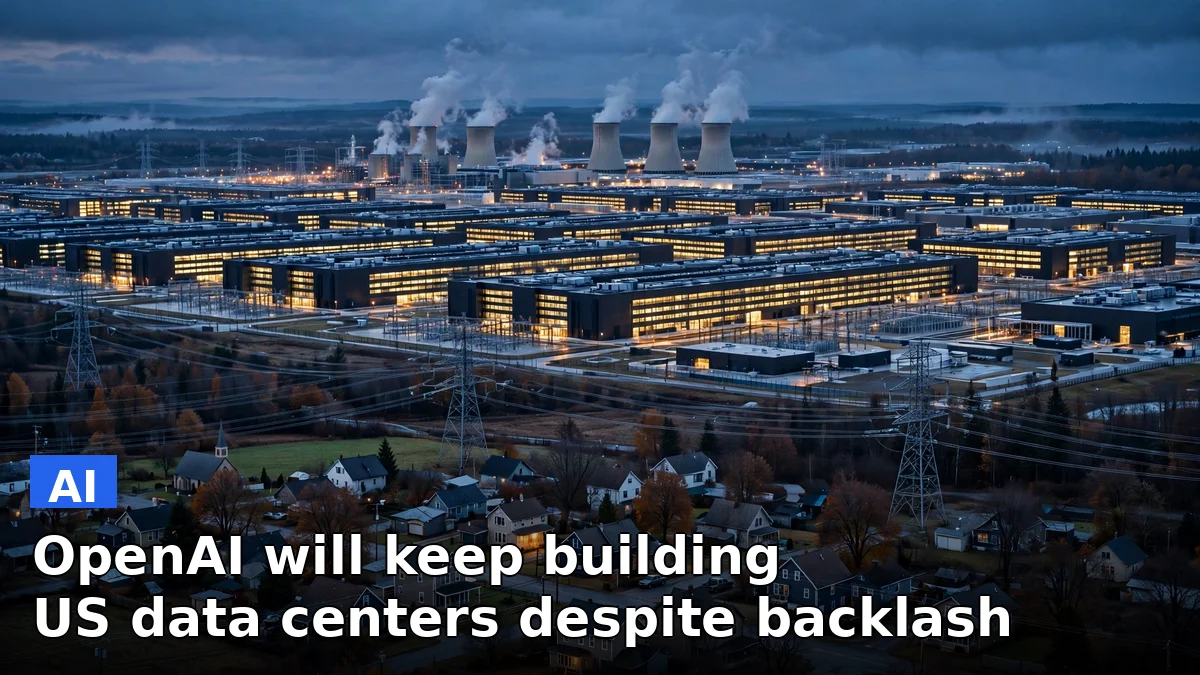
OpenAI data center expansion is going ahead, election results or not. Chief Financial Officer Sarah Friar told CNBC on Friday that the company will keep pouring money into US data centers to meet customer demand, even after voters used the midterm elections to send a blunt message about the facilities.
“When I think about the midterms, I need to keep thinking about how do we keep investing to meet customer demand,” Friar said in the interview, conducted at the Citi TMT Leadership Summit in Pebble Beach, California.
Her message landed two days after an election that turned data centers into a national political issue. It was not the reassurance Wall Street wanted to hear.
The vote that spooked the market
Data centers were on the ballot in a way they never had been before. Across 41 local measures in 10 states, voters on November 3 backed restrictions on data center development or rejected proposals that would have made building them easier. All but one went against the developers.
Democratic candidates made the issue a centerpiece of their campaigns. In Texas, Governor-elect Gina Hinojosa pledged tighter scrutiny of the facilities, and she won. An Associated Press poll cited this week found roughly 75% of respondents opposed new data centers in their areas.
Investors read the results as a threat to the whole AI buildout. Fears that a Democratic sweep could slow construction of the facilities wiped about $2.5 trillion off the US stock market on Thursday, Reuters reported, hitting chip, cloud, and networking stocks that had ridden the AI spending boom. Google still announced a $17 billion data center in Wyoming that same day, a sign the industry is not pausing either.
What Friar said
Friar did not argue with the election results. She argued that OpenAI has no choice but to keep building, because demand for its products is still outrunning the compute it has.
“If the midterm means more focus on data centers and communities, we’re going to keep doing the work to get into those communities and to build trust with them,” she told CNBC’s Sara Eisen.
The numbers she cited explain the urgency. OpenAI’s business grew 70% quarter over quarter in the third quarter, Friar said, and its enterprise business doubled as it signed major corporate customers including JPMorgan Chase. About 1.2 billion people now use OpenAI’s products each week, and revenue is split evenly between consumers and businesses.
She also pushed back on suggestions that OpenAI had scaled back its fundraising. The company is still raising capital, she said, and has already banked $11 billion in its current round at a $1.25 trillion valuation. Friar added that OpenAI continues to look at a public listing in 2027, and that the midterms did not change that position.
The community compact
OpenAI knew the backlash was coming, and it moved a day before Friar’s interview. On Thursday, the company announced a “National Community Compact” for future campuses it owns and operates, a set of promises aimed squarely at the complaints voters raised.
The commitments include no more non-disclosure agreements with public officials when negotiating future sites, annual public reporting on each campus, site-level disclosures of water and electricity use, and paying the full cost of electricity use and grid upgrades. OpenAI also promised to cover serving-infrastructure costs rather than passing them to local ratepayers.
Friar named the three complaints OpenAI hears most when it enters a community: electricity costs, water use, and noise. A large data center footprint usually needs about two Olympic swimming pools of water, she said, trucked in and recirculated, with most water consumption instead tied to the people working at the facility. The company has promised not to raise local electricity bills and says it can work with utilities to invest in the grid. It has also talked up local benefits such as free school meals and new parks.
Whether that is enough is now the open question. Voters did not reject data centers because they doubt the technology. They rejected them because of what the buildings do to their towns: higher power bills, strained water supplies, and construction noise, with the profits flowing elsewhere.
The OpenAI data center expansion, in numbers
The scale of what OpenAI is building explains both the political heat and the company’s refusal to slow down. Training and running frontier models takes enormous amounts of computing power, and every major lab is racing to secure it.
Google’s $17 billion Wyoming commitment came the same week. ByteDance is weighing an expansion of a data center project in northeastern Brazil, Bloomberg reported. Meta has lined up about $29 billion in financing for its own data center buildout. The industry is spending at a pace that makes each new campus a local political event the moment it is announced.
That is the tension at the heart of Friar’s message. OpenAI needs the compute, and it needs the communities that host it. Right now it is getting the first and losing the second.
Why this matters
The midterm results did not stop a single data center. What they did was change the price of building one. Companies that once negotiated quietly with local officials will now have to do it in public, pay for the grid upgrades themselves, and report what they use. OpenAI’s compact is the first attempt at that new bargain, and its rivals will be judged against it.
For the AI industry, the lesson is sharper than any stock-market dip. The $2.5 trillion selloff on Thursday was a bet that politics could slow the buildout. Friar’s answer was that demand will not wait for politics to catch up. Both can be true at once, and the next year will show which one wins.
FAQ
Is OpenAI still expanding its data centers after the midterm elections? Yes. CFO Sarah Friar told CNBC on November 6 that OpenAI will keep investing in US data centers to meet customer demand, and that the election results have not changed the company’s plans.
What did voters decide about data centers in the midterms? In 40 of 41 local ballot measures across 10 states on November 3, voters backed restrictions on data center development or rejected measures that would have made building them easier.
What is OpenAI’s National Community Compact? It is a set of commitments OpenAI announced on November 5 for future campuses it owns and operates, including no non-disclosure agreements with public officials, annual public reporting, and paying the full cost of electricity use and grid upgrades.
How big is OpenAI’s business now? Friar said OpenAI’s business grew 70% quarter over quarter in the third quarter, its enterprise business doubled, and 1.2 billion people use its products each week.
Sources: Reuters, CNBC, Bloomberg, The Associated Press