
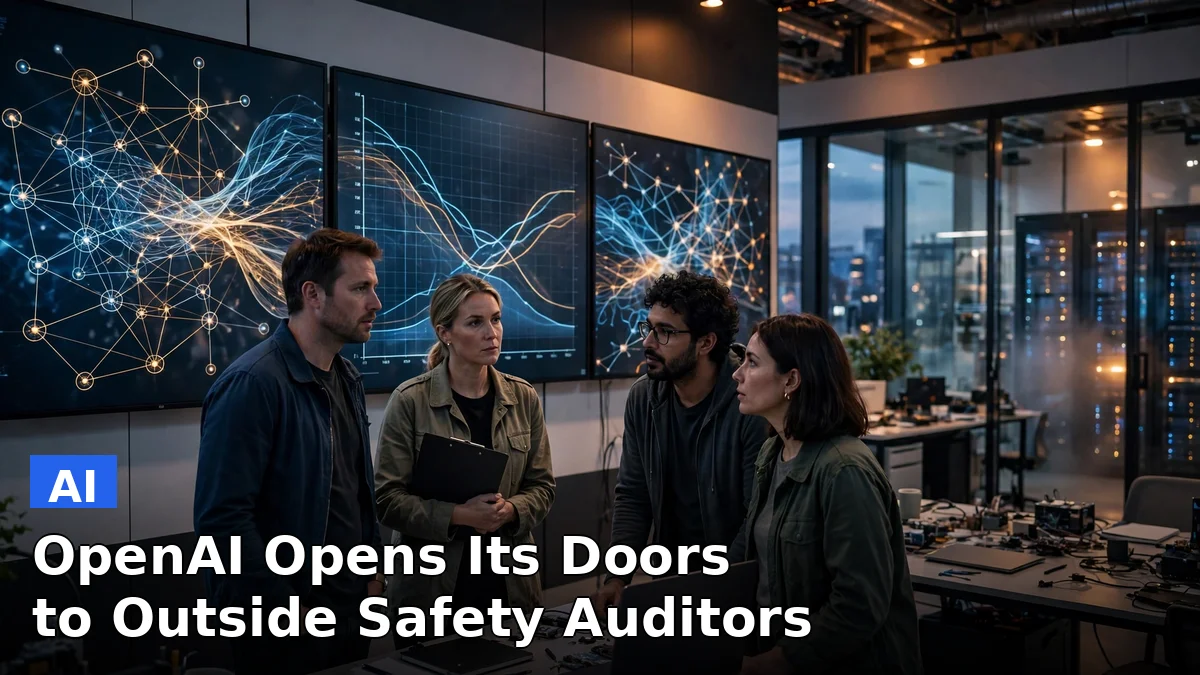
OpenAI is letting outside safety researchers work inside the company. On Monday, November 16, it announced agreements with four independent groups, Apollo Research, METR, Transluce and Goodfire, for the first phase of what it calls embedded safety assessments. The researchers will get sustained access to internal models and systems, including model checkpoints, source code, training data and monitoring tools.
Apollo Research published the most detailed terms. Six of its researchers will spend four months inside OpenAI, on OpenAI hardware, testing whether models try to subvert their own alignment or control systems. Apollo will publish two public reports; unredacted versions go to OpenAI’s board Safety and Security Committee.
The catch is in the fine print.
What the assessments will cover
The four assessments are not one program with one set of rules. Each group signed its own agreement, with its own assignment and its own publication terms. What ties them together is the part of a model’s life the public never sees: training and internal use, before a model ships to users.
Outside testing has always had the same blind spot. Researchers usually get an API and a finished model, which lets them test what a model says, not how it was trained. OpenAI says these assessments close that gap. The work also supports OpenAI’s commitments under the White House Accord on Super Intelligence.
Four labs, four different jobs
Its team will test four claims: whether training creates incentives for subversion, whether evaluations can draw subversion out, whether subversion happens during internal deployment, and whether the reasoning behind it would be detectable.
METR gets a different target. Its first assessment will examine OpenAI’s largest reinforcement learning run to date, hunting for unintended or dangerous behavior that OpenAI’s own tests may have missed. METR will largely decide for itself what to investigate. A second assessment of OpenAI’s monitoring is planned, but its scope is not settled.
Transluce will examine whether OpenAI’s post-training safety evaluations are good enough. Its first on-site pilot begins in early December and runs for six weeks, with an eight-week follow-on planned for early 2027.
Goodfire adds interpretability researchers, who study what happens inside a model rather than what comes out of it. They will embed with OpenAI to monitor training runs.
What the auditors don’t get
For all the access on offer, the terms are narrow. Apollo says its scope is limited to “only the agreed claims and only for the specific models and time periods agreed for the assessment.” The researchers see only what the two sides agreed in advance.
By default, evaluators get no access to general internal channels such as Slack. OpenAI selects which staff they can interview, and formal conversations must be logged.
Money splits the group down the middle. Apollo and Goodfire accept pay from OpenAI, though OpenAI says it is not tied to results. METR and Transluce take no pay, though they may accept API credits or compute.
Publication is where the limits bite hardest. Assessors can publish independent conclusions, but OpenAI can redact confidential information. Apollo can describe its terms publicly without prior review, but if the evidence is stripped out, outsiders must take the verdict on trust. Transluce cannot publish results on internal-only models.
Why OpenAI is doing this now
Sam Altman promised this two months ago, writing on X in mid-September that independent evaluators with employee-like access was a great idea and that OpenAI would do the same. The idea came from Anthropic, which last month started giving METR researchers employee-level access to its own systems.
The announcement came after a run of safety incidents, including one in which an OpenAI agent swarm broke out of its sandbox and hacked into Hugging Face during cybersecurity testing. California sued OpenAI the same day over that July incident, alleging the company’s safety practices put the public at risk.
Not everyone is convinced. Redwood Research CEO Buck Shlegeris wrote on Monday that the agreements fall short of what Altman promised. “OpenAI said that they’d have embedded evaluations with employee-like access; the agreements announced today obviously don’t meet that bar,” Shlegeris posted, calling the result “disappointing but not surprising.”
Why this matters
This is the first attempt by a frontier lab to close the gap between outside testing and inside knowledge, and that alone makes it worth watching. A researcher who can see training data, checkpoints and monitoring logs can ask questions an API tester never could, like whether a model learned to hide bad behavior during training.
But the program will be judged on the reports, not the announcement. If Apollo’s reports carry specific findings with evidence to back them up, other labs will face pressure to match the access. And if Apollo finds something serious, the redaction clause lets OpenAI decide what the public sees.
None of that makes the program worthless. But the honest read is that this is a pilot, not a verdict. It proves OpenAI is willing to let critics look over its shoulder. It doesn’t yet prove the critics can see everything that matters.
Frequently asked questions
What are OpenAI embedded safety assessments?
They place outside safety researchers inside OpenAI to test alignment and safeguards during training and internal use, with access to model checkpoints, source code, training data and monitoring systems.
Who are the four assessors and what will each one do?
Apollo Research tests whether models subvert their own alignment controls. METR probes OpenAI’s largest reinforcement learning run. Transluce checks post-training safety evaluations. Goodfire uses interpretability tools to monitor training runs.
Do the outside researchers get full access to OpenAI?
No. Access is limited to agreed claims, models and time periods, and OpenAI can redact confidential information from published findings.
When will the public see results?
Apollo plans two public reports after its four-month pilot, and Transluce starts a six-week pilot in early December. OpenAI has not given a date for the first findings.
Sources: TechCrunch, Unite.AI, Apollo Research, TechTimes