
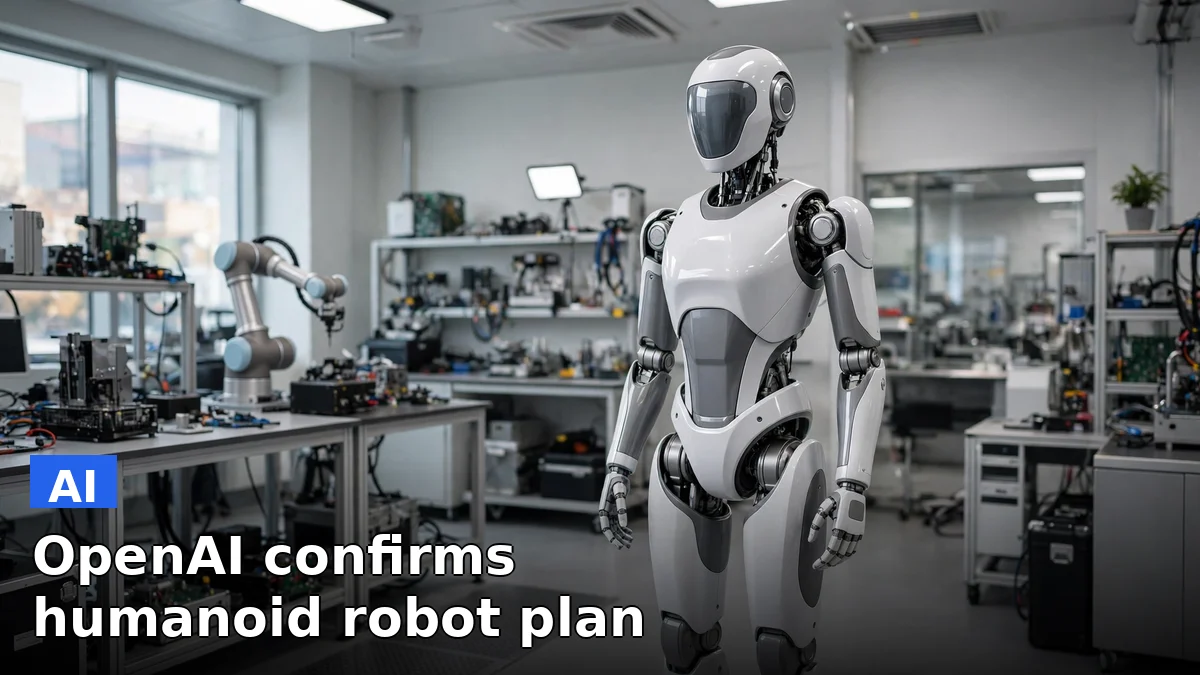
OpenAI is building a humanoid robot. That’s not speculation anymore; it’s a commitment Sam Altman made in two words on the Sources podcast in early September: “We will.”
The quote, first reported by Forbes, came when Altman was asked whether OpenAI’s hardware push would include a humanoid or a data-center machine: “We will definitely do a humanoid,” he said. “We will do other form factors as well.” Asked to pick between the two, his answer was simply: “Both.”
The timeline arrived nine days later in a Fortune interview published Sept. 15. Editor-in-Chief Alyson Shontell reminded Altman that he’d predicted robots in 2027 in a blog post the year before and asked whether the humanoid was still on that schedule. “I think we’ll have a cool demo in 2027, a great demo,” Altman said. “I don’t think there will be robots walking the streets for a few years longer, but we’ll have something impressive.”
That’s the concrete part: a demo next year, real streets years later. And behind the quotes, hiring is already underway. OpenAI’s careers page currently lists 27 robotics openings covering motion control, state estimation, actuator control, and machine-learning infrastructure. That’s not a skunkworks team. That’s a program.
Why OpenAI wants a humanoid robot body
Altman’s logic is practical, not romantic. On the podcast, he argued that “the world is very much designed for people,” so “matching that form factor seems good.” Doors, keyboards, tools, stairs, warehouse shelves, everything is sized for a body with two arms and two legs. A robot with those proportions can operate in infrastructure built for humans without anyone rebuilding the world first.
Fair point. But the body isn’t the hard part, and Altman knows it.
The brain is the real problem
What the robot looks like is, in Altman’s words, “less important than really figuring out … the brain that makes the robot work.” Giving a machine two arms and two legs doesn’t get you far if it doesn’t know what to do with them.
This is the honest part of the announcement, and it’s worth taking seriously. Picking up a coffee mug sounds trivial, but for a robot it means spotting the mug in a cluttered room, finding the handle, judging the right grip, applying the right force, and recovering when it slips. Every robot company on Earth is stuck on some version of this. Boston Dynamics can make machines dance and do backflips, and asking one to load your dishwasher without breaking half the plates is a different sport entirely.
OpenAI has been here before. Its Dactyl project trained a robotic hand to manipulate real objects, and later solve a Rubik’s Cube, using policies learned entirely in simulation. The work was a landmark in sim-to-real transfer: train in software, deploy in physics, and hope reality doesn’t disagree too hard. Reality, historically, disagrees.
They’re building the body too
Even with the brain-first framing, OpenAI isn’t buying someone else’s robot. According to Engadget’s reporting on the job listings, the company is working on custom electromechanical actuators, motors, transmissions, sensing, and thermal systems, while other postings cover manufacturing and the supply chain needed to build hardware at scale.
That detail turns a CEO quote into a real program. Anyone can show a concept humanoid. Building consistent hardware in volume takes factory discipline, not just model training. One job posting describes a short-term goal of general-purpose robots that help skilled workers build infrastructure, with a personal robot as the long-term goal. On the podcast, Altman said a household robot isn’t “the most important first thing to do,” then added: “I think everyone should have a personal robot.”
The competition isn’t waiting
OpenAI is walking into a crowded field. Tesla’s Optimus is the most famous rival, with Musk promising factory deployment. Figure AI, which OpenAI exited in early 2025 (a move that now reads less like a portfolio reshuffle and more like clearing the field for direct competition), is shipping to warehouses. Then there’s 1X Technologies, the Norwegian company in which OpenAI led a $23.5 million round in 2023 and with which it still holds an investment relationship. That relationship just got awkward: keep building on the AI of a direct hardware competitor, or develop your own foundation models?
OpenAI’s hardware track record, to be fair, is unproven. In October 2025, the Financial Times reported that the screenless device OpenAI is building with former Apple designer Jony Ive had unresolved issues around “personality,” privacy, and computing infrastructure, as TechCrunch summarized. Hardware is hard for a software company. Robots are hardware with opinions.
Why this matters
A 2027 demo is a CEO’s target, not a product plan. OpenAI hasn’t said what the demo will show, what the robot will look like, or when anyone outside the company gets near one. Treat the date with appropriate skepticism, tech timelines slip, and Altman’s have before.
But the hiring is real, the actuators are real, and the strategic logic is real. The lab that builds frontier models has decided the most valuable place to put them is inside a body shaped like ours. If the brain problem gets cracked, and a model can reliably see, plan, act, and recover in messy physical environments, the hardware race becomes a distribution race. And nobody distributes AI like OpenAI does.
The risk runs the other way, too. A company facing multiple federal probes, an Apple trade-secrets lawsuit, and a recent employee espionage case is now expanding into the physical world. Every robot is a camera, a microphone, and a set of hands. The brain Altman is building will decide what those hands do.
FAQ
Is OpenAI building a humanoid robot? Yes. Sam Altman confirmed on the Sources podcast in early September 2026: “We will definitely do a humanoid. We will do other form factors as well.”
When will OpenAI’s humanoid robot be ready? Altman told Fortune a demo is planned for 2027, but said robots won’t be walking the streets for a few years after that. No release date or price has been announced.
Why is OpenAI focusing on the robot’s brain instead of its body? Because a humanoid that can’t perceive, plan, and recover from mistakes is just expensive hardware. Altman called the design details “less important than really figuring out … the brain that makes the robot work.”
Who are OpenAI’s competitors in humanoid robots? Tesla’s Optimus, Figure AI, and 1X Technologies, all racing to make humanoids useful outside the lab.
Sources: Engadget, WebPro News (citing Fortune and Forbes reporting), Tech Times.