
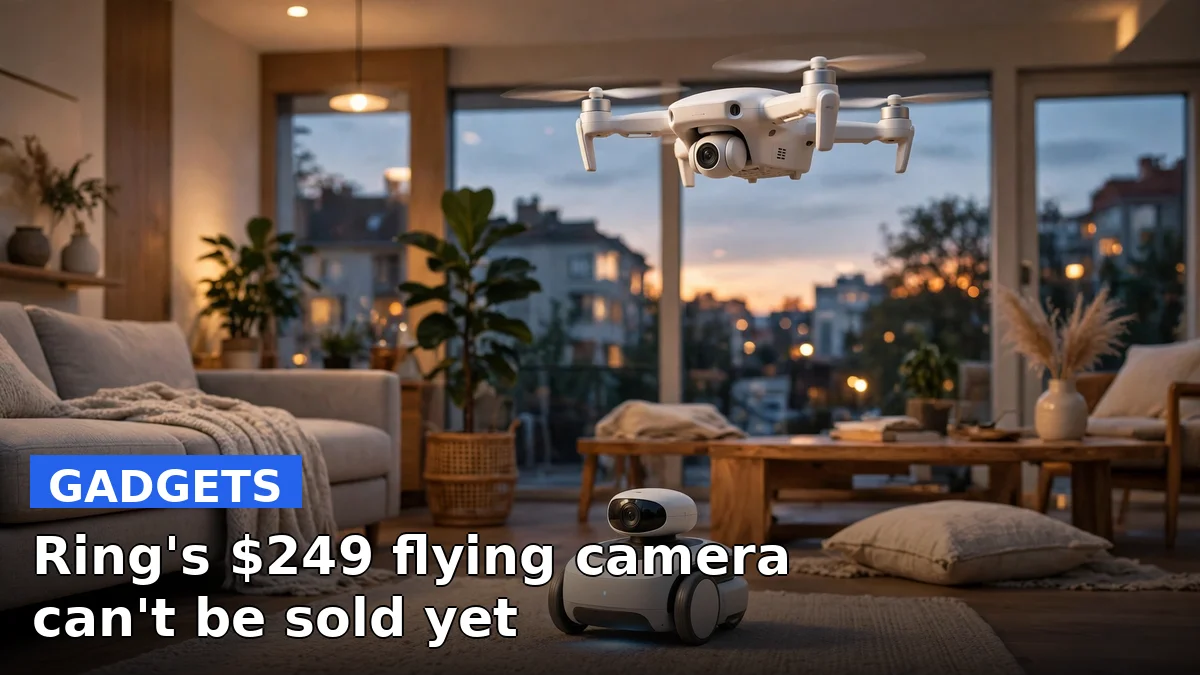
Amazon’s Ring wants its security cameras to come to you.
The company announced a new line called Ring Robotics on Tuesday, November 10, with two machines that move on their own: the Ring Drone Cam, a flying indoor camera for homes at $249.99, and the Ring Rover Cam, a wheeled patrol robot for businesses at $999.99. Both run on a navigation system Ring calls AI Pilot, which maps a home or office, picks out spots worth checking, and steers around furniture and shelving.
There’s a twist in the fine print. The Drone Cam has not received the authorization the Federal Communications Commission requires for wireless devices, so Ring cannot sell it or lease it yet. The January 27, 2027 ship date is a target, not a promise.
How the Ring Drone Cam works
The Ring Drone Cam is small. It weighs 165 grams, about as much as a smartphone, and it sits in a floor dock with its camera switched off until it’s needed. Owners can send it out on a schedule, launch it by hand, or let it take off on its own when a Ring camera, sensor, or alarm trips.
Setup starts with a walk-through. The owner carries the drone through the house once, and AI Pilot draws a floor plan, labels the rooms, and suggests patrol points near side doors and windows. From there, the drone flies its own routes and streams 2K video to the owner’s phone, with a 148-degree field of view and LED lights for dark rooms.
Flight time is short. Hands-on reports from The Verge and Ars Technica put it at roughly 5 to 8 minutes per charge, and The Verge noted that charging can take about eight minutes for each minute of flight. That’s enough for a quick check on a tripped sensor, not a long patrol.
Ring founder Jamie Siminoff demoed both devices for reporters in New York on Monday, November 9, a day before the announcement. He told them the drone is meant to scare off intruders as well as record them.
“The honest answer wasn’t more cameras; it meant reimagining what a security device could be,” Siminoff said in a statement. “That kind of invention is hard, and it takes time.”
The Ring Rover Cam, for businesses
The Rover Cam is the more practical of the two, and it’s the one you can actually buy. Preorders are open now, and deliveries start December 16, 2026, for $999.99.
It’s a wheeled robot built for offices, shops, and warehouses. It patrols on its own, investigates disturbances, and streams video at up to 4K. A periscope camera extends upward to see over counters and shelving, and The Verge put its battery life at about 30 minutes, enough to cover roughly 5,000 square feet on one floor.
Ring built the Rover from the bones of Astro, Amazon’s home robot, which debuted in 2021 and remains an invite-only product. Ring calls the Rover “a purpose-built security robot,” not a home robot doing security on the side.
Both devices share one condition: scheduled flights and patrols, plus reviewing recorded video, require a Ring Protect subscription. Ring hasn’t said which plans qualify.
The drone can’t be sold yet
The FCC problem is real, and Ring isn’t hiding it. Its own launch notice states the Drone Cam “has not received the authorization required under Federal Communications Commission rules” and “may not be offered for sale or lease, or sold or leased, until authorization is obtained.”
The agency has grown stricter about drones since it blocked new foreign-made models last December, according to TechSpot. Ring is taking email sign-ups for the Drone Cam while it waits, not preorders.
This is not a paperwork footnote. If the FCC drags its feet, the January date slips, and Ring has a launch with nothing to sell.
Ring’s second try at a flying camera
Ring has been here before. It showed off a flying indoor camera called the Always Home Cam in 2020, priced at the same $249.99. The company opened an invitation list, but the device never went on general sale.
Siminoff told The Verge that Ring has been working on the idea since 2016 and came close to shipping two other versions before landing on this one. The original drone only flew along paths owners mapped out in advance. This one builds its own floor plan and plans its own routes.
The Rover has a messy family history too. It traces back to Astro for Business, a rolling security robot Amazon launched in November 2023 at $2,350. Amazon shut it down less than a year later, refunded customers, and switched the robots off. At $999.99, the Rover costs less than half what Astro for Business did.
Siminoff himself left Ring in 2023 and returned last year to lead Ring and Amazon’s related home security businesses. He launched Ring’s predecessor, Doorbot, in 2012 and sold Ring to Amazon in 2018. Last month, Ring unveiled its first smart lock, a $249 deadbolt with no keyhole and a dial that recharges a dead battery by hand.
Why this matters
Ring is betting that the next step for home security isn’t another camera on the wall. It’s a camera that moves.
Fixed cameras have a blind spot problem: they see what they’re pointed at and nothing else. A flying camera can check the room you never bothered to wire, and a patrol robot can cover a warehouse floor that would take a dozen fixed cameras to watch. That’s the pitch, and it’s a good one.
But the pitch has a price. The drone flies for minutes, not hours, and its best features sit behind a subscription. The Rover is cheap for a security robot and still costs a thousand dollars. And the headline product, the thing in every photo from the launch, can’t legally be sold yet.
Ring’s rivals in security robots, companies like Knightscope and Cobalt AI, mostly rent their machines through subscriptions. Ring is selling hardware outright, which is a different bet: that businesses would rather own a $999 robot than rent one.
For now, the honest read is split. The Rover is a real product with a real ship date. The Drone Cam is a real idea with a real regulatory problem. Ring has six years of false starts behind this launch, and the FCC gets the next move.
Frequently asked questions
How much does the Ring Drone Cam cost?
The Ring Drone Cam costs $249.99. Ring is targeting a US ship date of January 27, 2027, but it cannot be sold or leased until the FCC authorizes the device.
When does the Ring Rover Cam ship?
December 16, 2026. The $999.99 wheeled patrol robot for businesses is already available for preorder in the US.
How long can the Ring Drone Cam fly?
About 5 to 8 minutes per charge, according to hands-on reports from The Verge and Ars Technica. Ring’s own support page says up to 8 minutes with a new, fully charged battery.
Do I need a subscription to use the Ring Drone Cam?
Yes, for the best parts. Scheduled flights, patrols, and reviewing recorded video require a Ring Protect subscription plan.
Sources: GeekWire, The Verge, Reuters, Ars Technica, TechCrunch.