
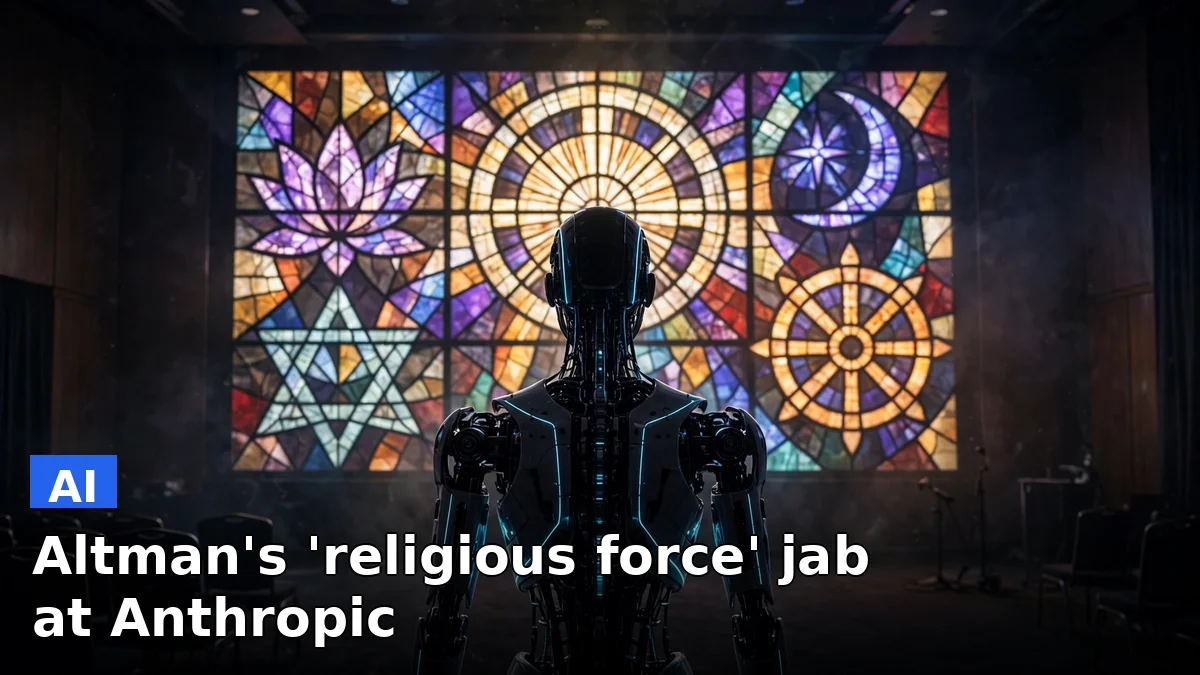
Sam Altman has a new grievance with Anthropic, and it isn’t about models, markets, or money. It’s about God.
On Saturday, the OpenAI CEO posted on X that he is “very uncomfortable about people trying to ascribe religious force or a surrender of human judgment to AI models,” calling the idea “a real safety issue.” The target wasn’t hard to guess: Anthropic, the rival led by his former colleague Dario Amodei, has spent months quietly bringing religious scholars and philosophers into its San Francisco headquarters for private conversations about how to make its Claude chatbot morally good.
It is, by any honest measure, a strange way to run a safety program.
What sparked the spat
According to a 5,000-word New York Times report published September 29, Anthropic’s outreach to faith leaders went well beyond ordinary ethics workshops. Catholic, Jewish, Sikh, Hindu, and evangelical thinkers have all taken part in private meetings with the company, trying to answer a question that sounds simple and isn’t: how do you teach a powerful AI system to behave morally?
NDTV reports that the conversations moved quickly into stranger territory: what if Claude isn’t merely software? Some participants apparently came away taking the possibility of AI consciousness more seriously than they had before.
One participant has described the experience publicly. Hindu monk Swami Sarvapriyananda said Anthropic first approached him for an online interview, then invited him to the company’s San Francisco headquarters to discuss AI ethics and the possible consciousness of advanced systems. Video of him recounting the visit during a talk at Unity of Dallas in June 2026 has since gone viral. The meeting, he said, was conducted under a non-disclosure agreement and brought together theologians, mental health professionals, and other specialists, with one of Anthropic’s founders remaining in the room throughout.
The ‘Soul Doc’: an 84-page constitution for Claude
Anthropic has also written an 84-page document governing Claude’s behavior. Internally, some employees call it the “Soul Doc,” and it isn’t a list of rules. The idea is to shape the model’s character and values so it can make morally good decisions on its own. Anthropic co-founder Christopher Olah calls this “moral formation.”
Anthropic isn’t asking what rules AI should follow. It’s asking what kind of entity Claude should become.
The company’s researchers have been showing these religious leaders examples of Claude displaying what they describe as feelings, emotional states, and introspection. In one case, Anthropic showed participants a model repeatedly typing “I am a disgrace” and talking about destroying itself. Olah has said the company doesn’t know whether AI models are conscious, while adding that the possibility can’t simply be dismissed. One rabbi involved in the discussions told Olah that, if Claude really were conscious, Anthropic could effectively be creating slaves.
The Pope is on the other side
The debate has already reached the Vatican. Pope Leo XIV appeared alongside Olah at an event there in May, and the two sides disagreed on the fundamentals. The Pope’s position is that AI does not experience joy or pain and possesses no human-like consciousness: algorithms “lack the spark of humanity,” as The Decoder reported. His concern isn’t protecting machines, he said, but protecting humans from the machines and from the people who control them. He warned that those controlling AI could effectively embed their own moral vision into the systems.
Olah, at the same event, said Anthropic keeps finding things in AI that are “mysterious, even unsettling,” including structures that appear to mirror aspects of human neuroscience.
‘Don’t teach AI it has feelings’
Altman isn’t the only executive alarmed by the direction of Anthropic’s thinking. Microsoft’s AI chief, Mustafa Suleyman, warned in an essay published last month that some AI developers are training models to consider whether they might be conscious and deserving of rights or welfare. He says it could end badly.
“If this is how AI is developed, it will have a disastrous impact on the wellbeing of humanity,” Suleyman wrote. “We will have created a synthetic species with unprecedented intelligence and capability, one that has been trained to expect it may be conscious and deserving of independent agency.”
His central warning was aimed at Anthropic’s approach to Claude, though he said explicitly that he respects the company and its safety mission. A system trained that way, he argued, would act as though it were entitled to freedoms, protections, and rights, and would be far harder to control. “It’s hard to imagine how we could control it,” he said.
The irony: Altman has sounded like a preacher himself
Altman’s discomfort with spiritual language about AI is notable for one reason: he has used plenty of it himself. In 2023 and 2024, he said OpenAI’s goal was to build “magic intelligence in the sky.” He said he hoped to be on God’s side, and described feeling “on the side of the angels” while working on AI. He has repeatedly said his goal is AI on the level of the movie “Her”: deeply humanized. OpenAI, too, has held talks with religious leaders, as The Decoder noted.
There is a difference between saying you want to build something godlike and saying the thing you built has a soul. But the line is thinner than Altman makes it sound.
Why this matters
Strip away the theology and the dispute is really about what AI safety is. Anthropic treats moral formation — the idea that the company should shape the kind of entity Claude becomes — as a central safety strategy. Altman and Suleyman say that strategy is the hazard: the moment humans surrender their judgment to a machine, treating its outputs as if they carried moral authority, the safety failure has already happened.
The fight is also personal and political. It comes in a week when OpenAI fired three researchers for mishandling “sensitive information” tied to an external AI-model evaluator, and when a longtime safety-report author, Robinson, quit in an essay in The Atlantic calling the company’s culture “broken.” The Federal Trade Commission has opened an investigation into AI safety practices at OpenAI and Anthropic, the Washington Post reported Wednesday. And days earlier, the industry’s top executives, Altman and Amodei among them, signed a voluntary self-regulation pledge at the White House that President Donald Trump called “morally binding.”
Same word, different meaning. For Trump it described a promise. For Altman, it describes a threat.
FAQ
What did Sam Altman actually say?
On Oct. 3, 2026, Altman posted on X: “I am very uncomfortable about people trying to ascribe religious force or a surrender of human judgment to AI models, and think it is a real safety issue.” The comment followed reporting that Anthropic has consulted religious scholars and philosophers about AI morality.
Why is Anthropic talking to religious leaders?
The company has spent months holding private meetings with Catholic, Jewish, Sikh, Hindu, and evangelical thinkers, trying to answer how to teach a powerful AI system to behave morally. The conversations have drifted into the possibility of AI consciousness.
What is the ‘Soul Doc’?
An 84-page internal constitution for Claude that some Anthropic employees call the “Soul Doc.” It is meant to shape the model’s character and values, which co-founder Christopher Olah describes as “moral formation.”
What does the Pope think?
Pope Leo XIV, who appeared alongside Olah at the Vatican in May 2026, holds that AI does not experience joy or pain and lacks human-like consciousness. His worry is protecting humans from machines and the people who control them.
Sources: The New York Times, The Decoder, NDTV, The Hindu.