
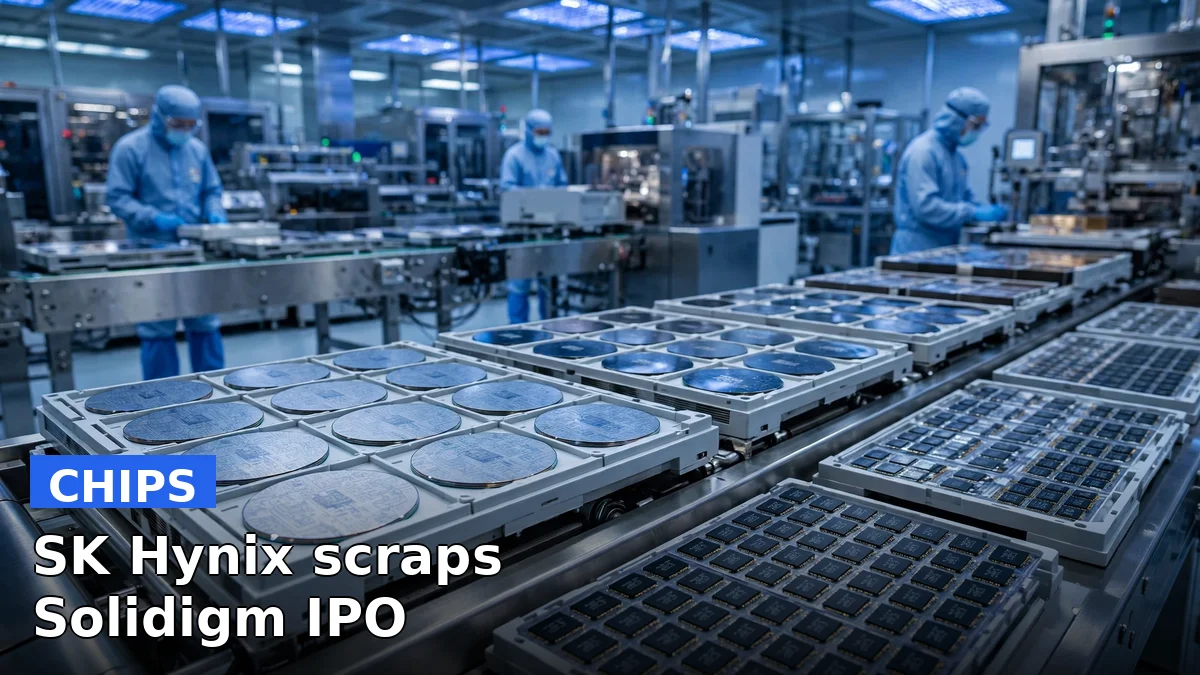
SK Hynix has dropped plans for a US listing of Solidigm, its flash-memory unit, after South Korean regulators warned the deal could shortchange minority shareholders. The chipmaker confirmed the decision in a regulatory filing on Friday, October 23, ending a listing plan that reports had valued as high as $150 billion.
Bloomberg first reported the decision on Thursday evening in the United States, and SK Hynix confirmed it in a filing dated Friday in Seoul. That filing said Solidigm had stopped reviewing both a pre-IPO funding round and an initial public offering, citing capital market conditions.
Shares rose 4.4% in Seoul on Friday, Reuters reported.
Why regulators stepped in
At the center of the dispute was a Korean rule against duplicate listings. When a parent company lists a prized subsidiary separately, existing shareholders can end up holding the parent while new investors get direct access to the faster-growing business. Regulators in Seoul argued that risk applied here.
Financial Supervisory Service Governor Lee Chan-jin told lawmakers at a parliamentary hearing on October 19 that regulators judged the Solidigm listing would fall under the duplicate-listing restriction, according to market coverage of the hearing. Bloomberg reported the same concern in plainer terms: a Solidigm listing could dilute minority investors and complicate SK Group’s ownership structure.
SK Hynix framed the decision differently. Its filing stressed that the halt was about market conditions and timing, not about the business itself. “This decision does not reflect any change in Solidigm’s growth prospects or investment needs,” the company said, according to Reuters.
What Solidigm is and what the listing was for
Solidigm isn’t a small side business. It is the NAND flash memory and solid-state drive operation SK Hynix built from Intel’s NAND unit, a deal agreed in 2020 for about $9 billion. The unit is based in Rancho Cordova, California, and it makes the storage that goes into AI data centers.
SK Hynix had picked Goldman Sachs and Morgan Stanley to lead a Nasdaq listing planned for next year, Bloomberg reported. The listing had two purposes. It would have raised money to expand production, including a possible new US factory, and it would have let investors value the storage business on its own rather than buried inside the parent.
Reports differed on the size. Bloomberg put the potential listing at about $10 billion, while people familiar with the plans told Reuters the sale could have raised $15 billion at a $150 billion valuation. Either figure would have made it one of the largest tech listings in recent years, which is why the halt landed so hard.
A rough week for AI stocks
Context did the deal no favors. The Nasdaq Composite fell 2.6% on Thursday, October 22, its worst day since June, as investors questioned how much AI spending companies can sustain. Solidigm was not the only listing to disappear that week: data center developers Firmus and AirTrunk also pulled back offerings, Bloomberg reported.
Demand for memory has not cooled; the problem was the financing route, not the product. When markets turn choppy, a deal that asks parent shareholders to accept dilution gets a much colder reception.
What happens next
SK Hynix has left the funding question open. Its statement said the company will keep exploring ways to fund Solidigm’s expansion and improve shareholder value, including reviewing the timing, scale, and financing of future investments. Reuters noted the company became dual-listed with a Nasdaq debut in July 2026, so it already has a US investor base to speak to.
One date matters more than the rest. SK Hynix reports third-quarter earnings on October 28, and analysts expect the company to lay out its shareholder return plans then. Investors who cheered the halt will want to hear what replaces the IPO money: buybacks, dividends, or a slower expansion plan.
Washington is watching too. The Trump administration has pressed foreign chipmakers to build new facilities in the United States, and Reuters reported that SK Hynix has sought to use a potential US factory as a bargaining chip in talks over approval to export US chipmaking equipment to China. A shelved listing does not end those talks, but it removes one lever from them.
Why this matters beyond one listing
Seoul has spent years trying to close the so-called Korea discount, the gap between Korean stocks and global peers that officials blame partly on weak minority protections. Blocking a duplicate listing is that campaign in action: regulators chose existing shareholders over a headline-grabbing debut.
Other Korean groups planning spin-offs will read the same message. A listing that looks like it moves value away from parent shareholders now carries real regulatory risk, even when the subsidiary is thriving. For US investors, the episode is a reminder that the AI infrastructure boom is not just a technology story. It is also a financing story, and the routes that looked open a month ago, from giant IPOs to debt-funded buildouts, are narrowing one by one.
Frequently asked questions
Why did SK Hynix cancel the Solidigm IPO?
SK Hynix said Solidigm stopped reviewing a pre-IPO round and an IPO after weighing capital market conditions, while South Korean regulators warned a separate listing could dilute minority shareholders under duplicate-listing rules.
What is Solidigm?
Solidigm is SK Hynix’s US-based NAND flash memory and solid-state drive business, built from the Intel NAND unit SK Hynix agreed to buy in 2020, and based in Rancho Cordova, California.
How did SK Hynix shares react to the Solidigm decision?
SK Hynix shares finished 4.4% higher in Seoul on October 23, 2026, as worries that a Solidigm listing would dilute parent shareholders eased, Reuters reported.
What happens next for Solidigm’s expansion?
SK Hynix has not said how it will now fund Solidigm’s expansion, and investors expect more detail on shareholder returns when the company reports third-quarter earnings on October 28, 2026.
Sources: Reuters, Bloomberg