
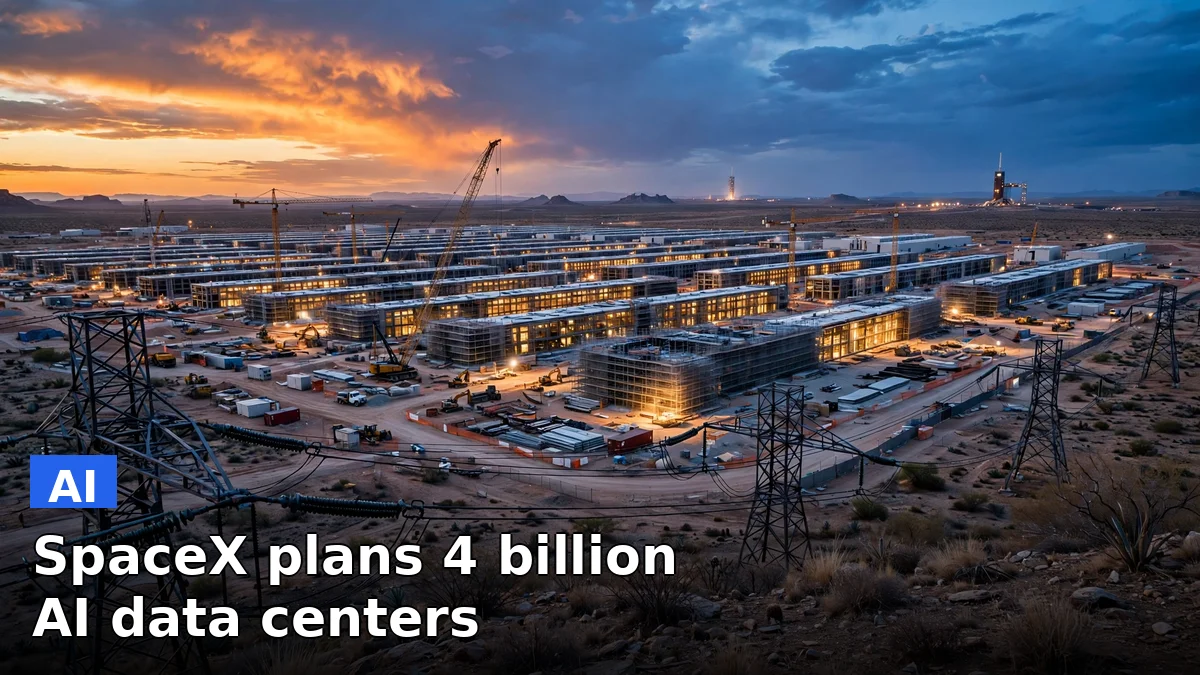
SpaceX AI data centers are about to get a lot bigger. The company said on Thursday it plans to spend more than $74 billion on two supercomputing campuses, one at its Starbase rocket site in Texas and one in Cochise County, Arizona, in a bet that its AI business is now as important as its rockets.
The numbers are hard to ignore. SpaceX expects to spend more than $24 billion at Starbase and roughly $50 billion in Arizona, it said in a statement, Reuters reported. The Wall Street Journal also reported the $74 billion figure. Both projects still need local approval, and both face votes on December 9.
“We’re advancing two extraordinary projects: a major new supercompute facility at Starbase in the Rio Grande Valley in Texas, and a second campus in Cochise County, Arizona,” SpaceX said in its November 12 announcement, titled “Building the Future.”
It’s a staggering sum for a company that went public only in June.
Two campuses, two very different bets
Texas is the self-reliance play. SpaceX plans to build its supercomputing facility on a 444-acre site near Starbase, alongside a gas-fired power plant it will own and run itself. The company has sought an air permit for a 748-megawatt plant, so the campus can generate its own electricity instead of waiting years for a grid connection.
Work there is already underway. SpaceX said the Texas project has generated more than 3,000 construction jobs and would support more than 500 permanent jobs once it is running.
Arizona is the scale play, and it’s the one drawing the most attention. The campus would sit on 747 acres along US Highway 191 near Willcox Playa, with nine buildings of about 493,000 square feet each, built in four phases of roughly 1.5 gigawatts apiece. A 24 gigawatt-hour battery system and about $3.6 billion in grid upgrades are part of the plan. SpaceX expects the site to create about 5,500 construction jobs and 1,000 permanent positions.
The company filed its Arizona application under the name Tombstone Resources LLC, an affiliate, and says the campus would use dry cooling, with no planned industrial groundwater use. It also says the project could cut power bills for members of the local electric cooperative by up to 20 percent.
The power problem is the story
Six gigawatts is the figure that stops people cold. Running around the clock, that much power adds up to 52.6 terawatt-hours a year. Arizona as a whole used 90.8 terawatt-hours in 2024, according to the US Energy Information Administration. One customer, in a rural county of about 125,000 people, would use 58 percent of everything the state used: homes, offices, factories and air conditioning combined.
That’s a nameplate maximum, not metered load, and the campus would be built in phases over years. Still, the math explains why Cochise County requires a special-use permit to build there at all.
Local pushback is already organized. A petition with about 2,400 signatures asks county officials to deny the permit, Reuters reported. Written comments from the public are due November 27, and the Cochise County Planning and Zoning Commission holds its hearing in Bisbee on December 9. If the permit is approved, construction could start in March 2027.
Starbase faces its own vote the same day, when the city commission considers a property tax abatement for the Texas project.
SpaceX AI data centers: what happens next
December 9 is now the date that matters. Two separate local bodies will decide on the same day whether the biggest AI infrastructure bet in SpaceX’s history can move forward.
Neither approval is a sure thing. Data center projects have run into growing resistance across the country since the midterm elections, with residents raising concerns about power prices, water use and the strain on local grids.
SpaceX reported $48.1 billion in capital spending in the first nine months of 2026. The $74 billion pledge works out to roughly 14 months of spending at that pace. This isn’t a side project.
Why this matters
SpaceX used to be a rocket company that also ran a satellite internet business. That description is now out of date. Its AI division generated more than half of the company’s revenue in the third quarter of 2026, Reuters reported, and the $74 billion plan is the clearest sign yet of where Elon Musk thinks the money is.
The campuses also show how the AI buildout has moved past the usual tech hubs. The biggest new computing projects in America are landing in places like Cochise County and the Rio Grande Valley, where land is cheap and power is the binding constraint. That puts small local governments in charge of decisions worth tens of billions of dollars.
For now, everything is a pledge, not a contract. SpaceX hasn’t named chip suppliers or a start date. What it has done is put a number on the table, $74 billion, and a date on the calendar, December 9.
Frequently asked questions
How much is SpaceX spending on AI data centers?
SpaceX plans to spend more than $74 billion: over $24 billion at its Starbase site in Texas and roughly $50 billion on a campus in Cochise County, Arizona.
How much power would the Arizona SpaceX campus use?
Up to 6 gigawatts at full build-out, which is about 58 percent of all the electricity Arizona used in 2024, according to US Energy Information Administration data.
Are the SpaceX AI campuses approved?
No. Both face local decisions on December 9, 2026: a zoning hearing in Cochise County, Arizona, and a property tax abatement vote by the Starbase City Commission in Texas.
Why is SpaceX building AI supercomputers?
Its AI division generated more than half of SpaceX’s revenue in the third quarter of 2026, and the company says it needs far more computing capacity to train and run its AI models.
Sources: Reuters, The Wall Street Journal, CNBC, Converge Digest, TechGenyz