
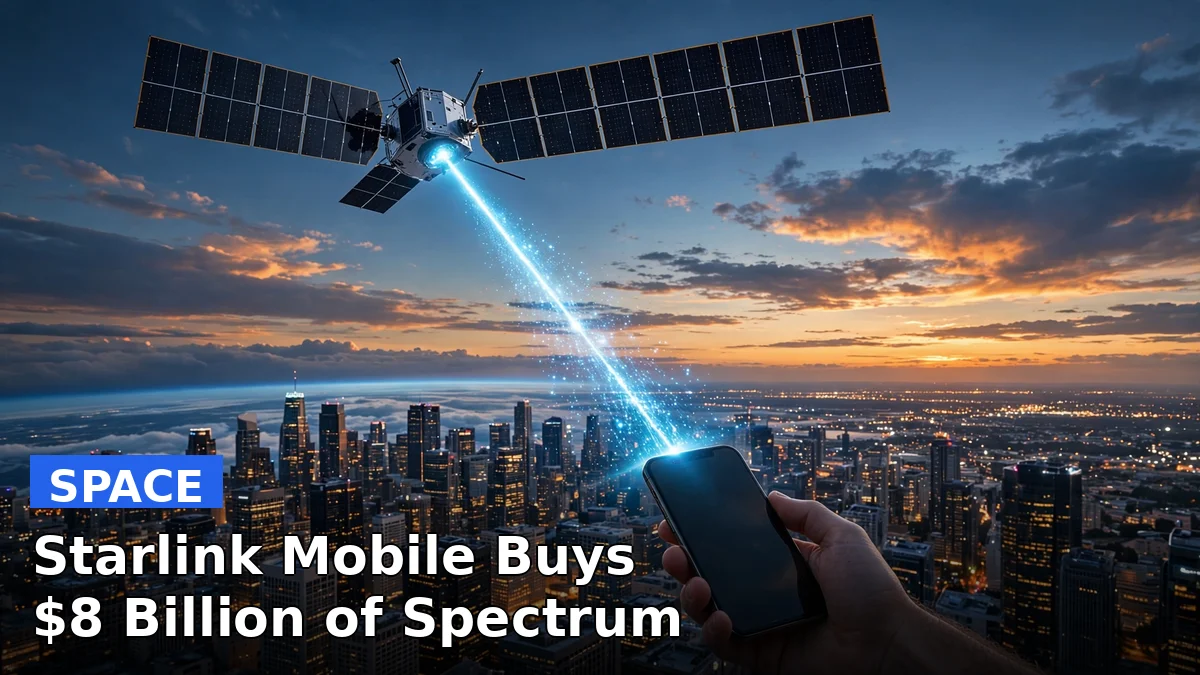
SpaceX is buying the airwaves it needs to become a real phone company. On Thursday, the company reached a definitive agreement with Grain Management to acquire a nationwide portfolio of 800 MHz low-band spectrum licenses for Starlink Mobile, its satellite-to-phone service. It covers up to 14 MHz of paired spectrum and still needs approval from the Federal Communications Commission.
The price tag explains the reaction. The Wall Street Journal reported, citing people familiar with the matter, that SpaceX will pay about $8 billion in cash. Neither SpaceX nor Grain confirmed the figure.
Wall Street treated the news as a genuine threat to the incumbents. In after-hours trading, AT&T, Verizon, and T-Mobile each dropped more than 6%.
Why the Starlink Mobile spectrum deal fills SpaceX’s biggest gap
Here’s the technical part, and it’s the part that matters. Low-band spectrum travels long distances and penetrates buildings, walls, and tree cover far better than higher frequencies. For a satellite network beaming signals straight to unmodified phones, that indoor reach was the one big capability missing.
SpaceX says the 800 MHz layer complements the 2 GHz mid-band spectrum it picked up from EchoStar last year, in two deals worth a combined $19.6 billion. The mid-band layer handles high-bandwidth traffic; the new low-band layer carries the signal through walls and into buildings. Most handsets already in use support the 800 MHz band, so customers won’t need special satellite phones.
Once the FCC signs off, SpaceX plans to pair its satellite constellation with a ground-based network. The company describes Starlink Mobile as the first operator to run both satellite and terrestrial spectrum on a single network.
Grain built much of the portfolio from 800 MHz holdings that T-Mobile sold off earlier this year. And SpaceX beat out at least one rival for the prize: back in August, SpaceX and AST SpaceMobile were reported to be competing for the same Grain licenses, then valued at around $6 billion.
What this sets up for the 2027 carrier fight
The spectrum purchase landed on the same day SpaceX told investors Starlink Mobile is being built to become a “major mobile carrier,” per its Thursday press release. SpaceX is targeting a 2027 launch, and the regulatory groundwork is already moving. The FCC approved Starlink Mobile’s second-generation constellation this week, authorizing SpaceX to launch 15,000 satellites for 2 GHz service worldwide. SpaceX claims the new satellites will deliver more than 100 times the bandwidth of the current fleet.
Bernstein analyst Madison Rezaei was careful about how far to take it. “Buying spectrum is not a commitment to build a nationwide network,” Rezaei wrote in a Thursday note. “But this is the spectrum we thought SpaceX needed to make that option more credible — and less expensive.” Because low-band spectrum travels farther, a ground network built on it needs fewer cell towers than one built on higher frequencies.
The incumbents aren’t standing still, but their reaction says plenty. All three formed a satellite-focused joint venture in May, which analysts read as an early response to the threat. William Blair analysts noted the carriers have been vocal in expressing skepticism that SpaceX can match the quality of terrestrial networks.
Investors picked a side. While the carriers fell, the tower companies rallied: Crown Castle rose 7%, American Tower climbed 5%, and SBA Communications gained 6% in Thursday’s extended session. As Rezaei’s note put it, the deal is a reminder that cell towers still matter — SpaceX’s hybrid network needs ground infrastructure too, just less of it.
The honest read: satellite-to-phone service has been a curiosity, good for emergency texts in dead zones. An $8 billion spectrum buy is something else entirely. It says SpaceX isn’t selling a backup feature. It’s selling the phone service itself.
FAQ
What exactly did SpaceX buy?
SpaceX agreed to acquire Grain Management’s nationwide portfolio of 800 MHz low-band spectrum licenses, covering up to 14 MHz of paired spectrum, for Starlink Mobile. The deal is subject to FCC approval.
Why did carrier stocks fall?
AT&T, Verizon, and T-Mobile each dropped more than 6% in after-hours trading because investors see Starlink Mobile as a credible future competitor. The low-band spectrum lets satellite signals reach phones indoors, closing the main technical gap with terrestrial networks.
How does this fit with SpaceX’s other spectrum?
The 800 MHz low-band spectrum complements the 2 GHz mid-band spectrum SpaceX acquired from EchoStar, plus 15,000 second-generation satellites the FCC approved this week. SpaceX says the combination will deliver more than 100 times the bandwidth of the current fleet to unmodified phones.
When could Starlink Mobile launch?
SpaceX is targeting 2027. FCC approval of the Grain deal and the satellite buildout are the remaining steps, and analysts caution that buying spectrum isn’t yet a firm commitment to build a full nationwide network.
Sources: Reuters, The Wall Street Journal (via TechCentral), MarketWatch (via Morningstar), Business Standard