
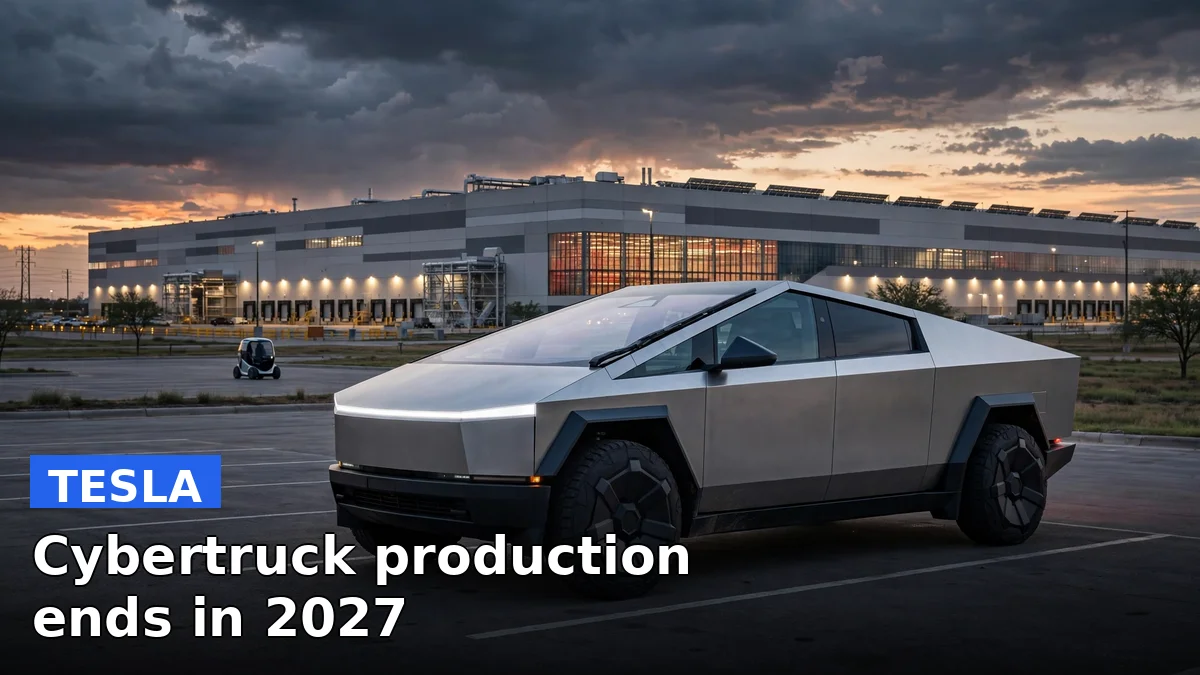
Tesla Cybertruck production ends around the middle of 2027. Elon Musk said so himself on Friday, in a post on X that gave the stainless-steel pickup about eight more months on the line. The truck will have spent just three and a half years on sale by the time the factory moves on.
“Tesla will be winding down production of the Cybertruck at Gigafactory Texas around the middle of next year to make room for increased Cybercab production,” Musk wrote, according to Reuters and The Verge. No exact stop date. No new home for the truck. Just a sentence, and the end of one of the strangest vehicles ever sold in America.
Musk’s one-post announcement
Musk’s post landed on November 6, and it did what a lot of Tesla news does now: it arrived without a press release, a filing, or a product bulletin. Reuters confirmed the wording the same day, and The Verge and TechCrunch reported it within hours. Tesla has not published anything more since.
What Musk didn’t say matters as much as what he did. He didn’t say production would stop outright, or that the Cybertruck is dead. “Winding down” leaves room for a low-rate line, a final batch, or nothing at all. He also didn’t say whether the truck could move to another plant. Gigafactory Texas is the only factory known to build it, and it’s the only one with the specialized equipment the angular body demands.
One thing is clear, though: the factory floor has a new priority. The Cybercab, Tesla’s two-seat robotaxi with no steering wheel and no pedals, is already in production at the same Texas plant, according to Tesla’s second-quarter update. Musk wants that line bigger. Something had to give.
Tesla Cybertruck production ends after a short, bumpy run
Few vehicles arrived with as much noise as the Cybertruck. Musk unveiled it on November 21, 2019, at Tesla’s design studio in Hawthorne, California — and the demo went wrong in front of the cameras when a steel ball cracked the supposedly shatterproof windows. Twice. The clip became a meme before the event ended, and the truck’s reputation never quite shook it off.
Then came the delays. Musk said in 2019 that production would start in late 2021. By August 2021, Tesla had quietly pushed everything to 2022 through a note on its reservation page. Supply chain problems pushed it further, into 2023. The first truck finally rolled off the line at Gigafactory Texas in July 2023, though Tesla later called that pilot production. The delivery event didn’t happen until November 30, 2023 — four years after the unveiling.
Four years to reach customers. Three and a half years on sale. That’s the whole run.
The numbers never added up
Musk once said Tesla would eventually build around 250,000 Cybertrucks a year. It never came close. In the third quarter of 2026, Tesla sold just 8,295 Cybertrucks, according to Auto Express, and total sales are estimated at no more than 63,000 units since launch. Kelley Blue Book estimates cited by Reuters put US sales at about 38,965 in 2024, falling to 20,237 in 2025 — a drop of 48 percent.
The truck also collected recalls the way some cars collect speeding tickets. Tesla has issued 11 recalls for the Cybertruck since it went on sale in late 2023, according to the National Highway Traffic Safety Administration.
Price didn’t help. In February 2026, Tesla launched a dual-motor all-wheel-drive trim at $59,990, the lowest price the truck had ever sold for. Then, just a day before Musk announced the wind-down, Tesla raised prices again: that same trim went to $82,490, the Premium trim to $92,490, and the Cyberbeast to $102,490, Reuters reported. A $22,500 jump on the cheapest version, hours before the CEO said the line was closing.
Why Cybercab gets the floor
If the Cybertruck’s exit looks abrupt, the replacement has been in plain sight for a while. Tesla has been building the Cybercab at Gigafactory Texas since its second-quarter update, and the robotaxi is the centerpiece of Musk’s pitch that Tesla’s future is autonomy, not metal boxes with steering wheels.
Cybertruck lead engineer Wes Morrill tried to frame the change as a handoff, not a funeral. “Cybertruck was an incredible technology development platform and lives on through Cybercab,” he posted on X after Musk’s announcement. Morrill also said Tesla will keep supplying spare parts and service support for the trucks already on the road — a message aimed at the roughly 63,000 owners who just watched their vehicle’s resale value take another hit.
For Tesla, the math is straightforward. A factory that builds a truck selling a few thousand units a quarter is a factory that could be building robotaxis instead. The Cybertruck proved Tesla could bend stainless steel into a pickup. It never proved anyone wanted to buy one in large numbers.
Why this matters
The Cybertruck was never just a truck. It was Musk’s bet that Tesla could sell a vehicle on attitude alone — no curves, no paint, no apologies. For a while, the bet looked plausible: more than a million people put down $100 reservations after the 2019 unveiling. But reservations aren’t sales, and the truck that finally shipped cost far more than the $39,900 Musk had promised.
Its exit says something bigger about where Tesla is headed. The company is no longer trying to win the pickup market, a segment it entered late and never cracked. Instead, it’s betting the Texas factory on a vehicle with no steering wheel, no pedals, and no human driver — a product that doesn’t exist in meaningful numbers yet, in a market regulators are still figuring out.
That’s a familiar Tesla pattern: kill the thing that isn’t working, double down on the thing that might. It worked with the Roadster. It worked, eventually, with the Model 3. Whether it works with a robotaxi is a question the Cybertruck’s owners, and Tesla’s shareholders, will be asking for a while.
FAQ
When does Tesla Cybertruck production end?
Tesla will wind down Cybertruck production at Gigafactory Texas around mid-2027, according to Elon Musk. He gave no exact stop date and did not say whether production would move to another plant.
Why is Tesla ending Cybertruck production?
Musk said the Texas factory floor is needed for increased Cybercab production. Sales also fell far short of Tesla’s original target of 250,000 trucks a year, with about 63,000 sold in total.
Will Tesla still service existing Cybertrucks?
Yes. Cybertruck lead engineer Wes Morrill said Tesla will keep supplying spare parts and service support for trucks already on the road.
What is the Cybercab replacing it?
The Cybercab is Tesla’s two-seat robotaxi with no steering wheel or pedals. Production has already begun at Gigafactory Texas, the same plant that builds the Cybertruck.
Sources: Reuters; The Verge; TechCrunch; Auto Express.