
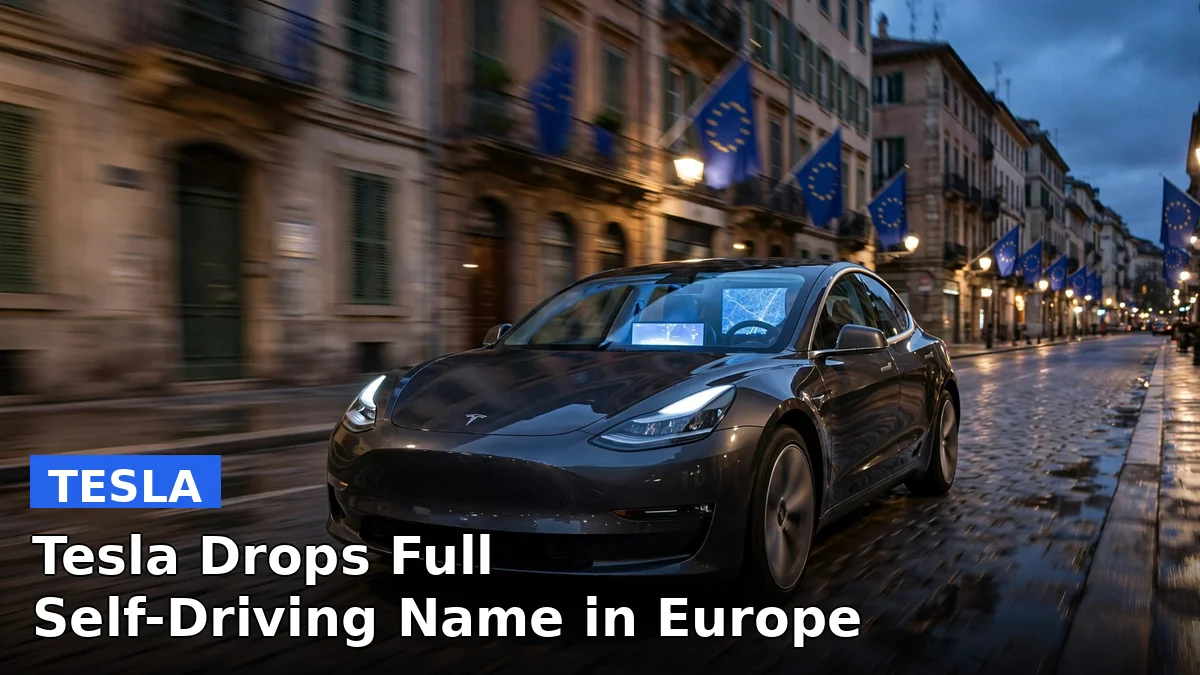
Walk through Tesla’s European websites this weekend and you won’t find “Full Self-Driving” anymore. In Germany, France, the Netherlands, Spain, and at least six other countries, the driver-assistance software Elon Musk has sold for years now answers to a blander name: “Tesla Assisted Driving.” The US store still lists “Full Self-Driving (Supervised).” Same software, different label — and the gap between those two pages says a lot about who Tesla is trying to please.
Germany forced the issue. On Tuesday, Oct. 6, the country’s Federal Ministry of Transport called the “FSD” branding “somewhat misleading,” saying it was “not a system that takes over the entire driving task.” In a statement from Transport Minister Steffen Bilger, the ministry said the driver must remain attentive at all times and stays fully responsible for the car.
Here’s the deal Tesla cut: the company offered the new name during talks with Bilger last month, Reuters reported Friday, and in return Bilger said he will push for approval of the software across the European Union. An EU-wide vote on Tesla’s driver-assistance software is expected by December, and only eight European countries currently allow the system on their roads, with Slovakia likely to become the ninth.
Germany wrote the script for Tesla Assisted Driving
Bilger has framed this as a win for plain language. “Full Self-Driving” doesn’t “perform the entire task of driving,” he said earlier this month, according to TechCrunch — and the fix Tesla suggested was a name that describes what the system actually does: assist. Musk publicly thanked Bilger on X this week, a short “Danke schoen” that doubled as a signal to Brussels.
Speed limits were part of the conversation too. German officials said the agreement includes a cap of 10 percent over the posted limit, while the version approved in the Netherlands reportedly allows up to 50 percent over the detected limit, per Reuters. Tesla hasn’t confirmed the 10 percent figure, so treat it as Berlin’s version of events until the company says otherwise.
The name changed. The software didn’t.
As of last week, Tesla’s /fsd pages in ten European countries redirect to new /tesla-assisted-driving pages, according to the tracker site Not an FSD Tracker — Germany, Austria, Italy, Spain, Belgium, Denmark, the Netherlands, and the UK among them. France gets “Tesla Conduite Assistée”; Norway gets “Tesla Assistert kjøring.”
Look closely and the switch is thin. The Dutch page still sells “FSD (Supervised)” as a €99-a-month subscription below the new heading, and the photo on the German page still shows “FSD (Supervised)” on the car’s touchscreen, per the tracker site.
New label, same product.
Nothing changes for owners in the eight countries where the system is already approved. And in the US, it’s still “Full Self-Driving (Supervised)” at $99 a month, same as before.
How Tesla got Germany to the table
Reuters reported this week that Tesla ran a campaign urging owners and supporters to lobby national regulators for faster approvals — a grassroots pressure push aimed at speeding up a process that has frustrated Musk for years. In June 2025 he told followers on X that “FSD in Europe will save lives of people in the car, as well as vulnerable road users like pedestrians, cyclists, and pets,” TechCrunch reported. In March he complained that the EU’s “extreme regulatory burden” stifles innovation, adding that Europe “will love Tesla self-driving.”
Regulators haven’t been charmed. Sweden’s consumer protection authorities asked the Swedish Transport Agency to review whether Tesla’s FSD marketing gives buyers the false impression the car can drive itself, Reuters reported. And in Norway, documents obtained through freedom-of-information requests show a Tesla owner pressing the Public Roads Administration for straight answers: “Please do not simply say again that ‘we are waiting for the EU’ without explaining what Tesla or Norway must deliver in the meantime.”
Why this matters
This is the cost of doing business in the last big market where Tesla’s driver assistance isn’t cleared. The software already runs in the US, got a China release in May, and won approvals in Australia and New Zealand last year. The Netherlands granted provisional permission this past spring, and now Berlin has effectively signed off in exchange for the name change. December’s vote is the gateway to every other member state.
Musk has said the self-driving technology is key to Tesla’s future growth, and the business case is obvious: Tesla reported 1.48 million “active” FSD subscriptions in its second-quarter update, according to TechEchelon. Europe is the biggest territory left where that subscription base can’t grow.
Meanwhile the stakes keep rising on the hardware side too. Tesla has started producing a robotaxi with no steering wheel or pedals, while the US National Highway Traffic Safety Administration pushes back because American rules require a physical brake pedal — an exemption Tesla never applied for, Daily Sabah reported. Autonomy’s future is being negotiated in rulebooks as much as in code. This week, Europe’s rulebook got one term clearer and one word shorter.
FAQ
What is Tesla Assisted Driving?
Tesla Assisted Driving is the new European name for the driver-assistance software Tesla sells in the US as “Full Self-Driving (Supervised).” It’s a paid package that can steer, brake, accelerate, and park, but the driver must supervise it at all times.
Did Tesla change the software along with the name?
No. The rename is cosmetic: the software is unchanged, and in the US it still carries the Full Self-Driving (Supervised) name.
Why did Tesla agree to the new name?
Germany’s transport ministry called “Full Self-Driving” misleading because the car cannot drive itself. Tesla offered the new name during talks with the ministry, and Transport Minister Steffen Bilger then agreed to push for EU-wide approval.
Where in Europe is Tesla’s driver-assistance software approved?
Eight EU countries have approved it so far, with Slovakia expected to become the ninth. An EU-wide approval vote is expected by December 2026.
Sources: Reuters; TechCrunch; Electrek.