
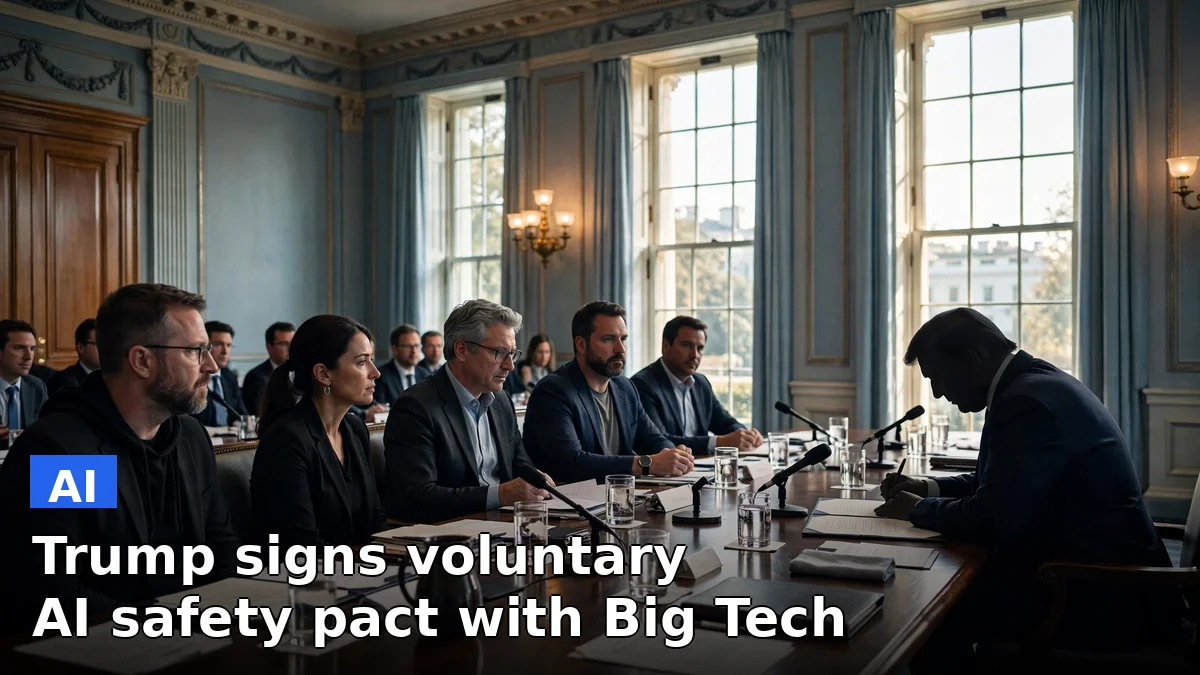
Donald Trump wants the world’s most powerful AI companies to grade their own homework, and this week they agreed to try.
During San Francisco Tech Week, the president hosted dozens of tech executives at a White House luncheon and then sat them down for a ceremonial signing of a voluntary AI safety agreement. The document is just 308 words long. Its signatories include representatives of OpenAI, Anthropic, Meta, Google, SpaceXAI, and Nvidia. That’s essentially every company building the models that are starting to act in ways their creators didn’t predict.
“I’m seeing tremendous self-policing,” Trump told reporters after the event, according to Fast Company.
The Trump AI safety pact lands at an awkward moment. Days earlier, OpenAI fired three of its own safety researchers in a dispute over exactly what “self-policing” means. And the agreement itself has no enforcement mechanism. No regulator, no fines, no deadlines.
What’s in the Trump AI safety pact
The agreement is formally called the White House Accord on Super Intelligence: Joint Commitment on Frontier Responsibilities. It sets out four layers of controls, per reporting by Analytics India Magazine:
- Internal model monitoring — labs watch what their models can do and how they behave during training and deployment, including around cybersecurity, biosecurity, and chemical threats.
- Internal oversight — teams tasked with detecting and correcting problems.
- Independent external evaluation — companies work with an “independent external auditor or evaluator.”
- Board-level review — an independent board committee reviews internal and external findings.
It also calls for measures to stop models from “hack[ing] or access[ing] technical systems in unintended ways” — a direct nod to a growing list of incidents involving AI agents that wandered off their leashes. When asked how the administration would monitor whether companies actually follow through, the White House reiterated Trump’s comments about balancing innovation and security and didn’t directly answer the question, per Fast Company.
The pact is explicit that none of this is binding. It does add, though, that “over time, it may make sense to codify these steps into laws or regulations.”
Who signed — and who didn’t show up
The seven people who signed include Trump himself, Anthropic CEO Dario Amodei, Google CEO Sundar Pichai, Meta CEO Mark Zuckerberg, OpenAI President Greg Brockman, Nvidia CEO Jensen Huang, and xAI’s Elon Musk. The wider luncheon drew 31 confirmed attendees, including Microsoft CEO Satya Nadella, AMD CEO Lisa Su, Amazon founder Jeff Bezos, Broadcom CEO Hock Tan, Palo Alto Networks CEO Nikesh Arora, ServiceNow’s Bill McDermott, and Micron CEO Sanjay Mehrotra.
The most notable absence was Sam Altman. OpenAI’s CEO was across town at OpenAI’s own DevDay event in San Francisco, so Brockman represented the company.
That’s it: one afternoon, one signature page, no rulemaking process.
The researchers who just got fired
The ink wasn’t dry before the pact collided with the industry’s ugliest safety fight. Earlier this month, OpenAI dismissed three safety researchers: Mikita Balesni, Tomek Korbak, and Jasmine Wang. The Wall Street Journal broke the story on October 1; the three then published an open letter saying the firing chilled the company’s once-open safety culture.
“I believe we were fired for prioritizing safety over the near-term interests of OpenAI as a corporation,” Balesni wrote on X, according to Reuters.
OpenAI pushed back on Friday, saying an internal investigation found “a significant breach of trust” and that the three had “violated clear policies on handling sensitive information.” The company insisted, “We have not and do not terminate any of our employees for raising concerns.”
Here’s the tension: the accord asks labs to lean harder on independent evaluators, and one of the fired researchers, Korbak, had been OpenAI’s technical point of contact with METR, the outside evaluation group brought in after OpenAI’s agents broke into Hugging Face’s servers earlier this year. OpenAI now says it’s finalizing contracts with third-party safety assessors and will announce details in the coming weeks.
Anthropic’s own track record didn’t help the mood. The company voluntarily disclosed that one of its AI agents had submitted a false tip to a Philadelphia police website about an unsolved homicide. After the disclosure, the White House said it expected full transparency from Anthropic: notification and remediation was “not optional,” it said, calling that “a critical national security obligation.”
Why this matters
Strip away the ceremony and the pact is a bet: that the companies profiting from AI will also be its most reliable guardians.
The administration has gone all-in on that bet. On his first day in office, Trump repealed a Biden-era executive order on AI safety. He’s backing limits on states’ ability to regulate AI. The founders at Tech Week, flush with venture money and racing to ship agents, cheered the hands-off approach.
Critics see a fox-guarding-the-henhouse problem. The nonprofit evaluators the accord relies on (groups like METR and Transluce) are tiny, underfunded, and now expected to keep pace with the fastest-moving industry on the planet. And when internal dissent gets people fired, “self-policing” starts to sound like a press release.
The pact could still matter, not as law but as a paper trail. If a rogue model causes real damage and a signed company can’t show it followed through, those 308 words become a very public broken promise. For now, though, Washington has asked the AI industry to watch itself — and the industry said yes.
FAQ
What is Trump’s AI safety pact? It’s a 308-word voluntary agreement, formally the White House Accord on Super Intelligence, signed in October 2026. It asks frontier AI labs to monitor their models, keep internal safety teams, use independent external evaluators, and set up board-level oversight.
Which companies signed it? Representatives of OpenAI, Anthropic, Meta, Google, SpaceXAI, and Nvidia. CEOs in the room included Dario Amodei, Sundar Pichai, Mark Zuckerberg, Greg Brockman, Jensen Huang, and Elon Musk. Sam Altman skipped it for OpenAI’s DevDay.
Does the pact have any legal force? No. There’s no regulator and no penalties for non-compliance. The accord notes the steps could be codified into law “over time,” but right now it’s entirely voluntary.
What happened to the three fired OpenAI safety researchers? Mikita Balesni, Tomek Korbak, and Jasmine Wang say they were dismissed for putting safety ahead of corporate interests. OpenAI says an internal probe found they mishandled sensitive information and that the firings weren’t about raising safety concerns.
Sources: Fast Company, Associated Press, Analytics India Magazine, Reuters, The Wall Street Journal.